

In this column, Ruth Keggin-Gell from Culture Vannin explores 12 Manx words linked to the upcoming festive season.
I was delighted to use one of artist Felicity Wood’s new stamps on a letter recently.
Presented by Isle of Man Stamps and Coins, they celebrate Manx Christmas traditions associated with ‘Kegeesh Ommidjagh’ – Manx for ‘Foolish fortnight’.
The name comes from the tradition of stopping all but necessary work for a fortnight, making time for frivolity.
Have you ever heard of Mollag bands? These were groups who roamed towns making ‘a rare din’ with singing, dancing and homemade instruments.
A mollag is an inflated sheep’s bladder, traditionally used as a fishing float, which the lads used to clout people in the street!
Oie’ll Voirrey, also known as Oie’ll Verree, is the eve of Mary – Christmas Eve.
Moirrey, pronounced ‘MUR-ruh’, is Manx for ‘Mary’: from this we get Voirrey.
After the evening service, the Parish clerk and congregation stayed in church to sing or listen to carvals.
Loosely translated as ‘carols’, these religious Manx Gaelic songs were usually sung unaccompanied by a man.


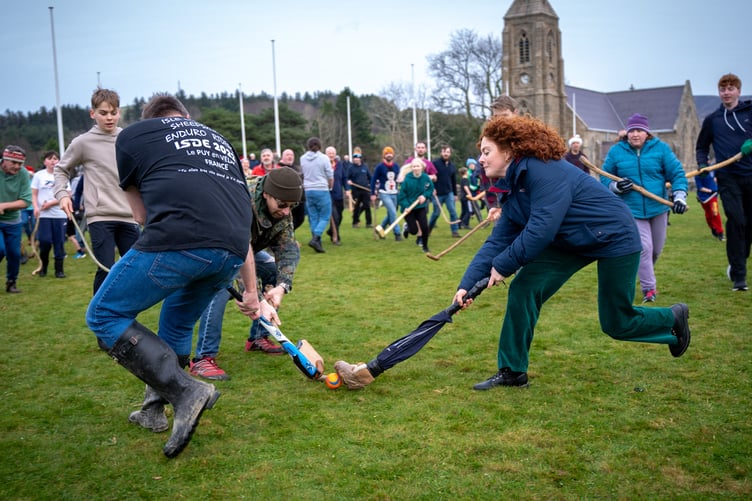
The annual cammag match held on St Stephen’s Day is still going strong.
Cammag is the Isle of Man’s traditional sport, related to Irish hurling and camogie, and Scottish shinty.
Cammag comes from the Manx cam, meaning ‘crooked’ or ‘bent’, describing the stick’s end; ‘-ag’ can be a diminutive suffix.
Played for hundreds of years, Cammag declined after football became popular in the island around a century ago.
The game continues to be played next to Tynwald Hill on December when the North and South of the island compete.
2025 saw the largest attendance and number of players on record; come and help make 2026 even bigger!
New Year is a time to visit people, sharing food and drink. There is a tradition of ‘first-footing’ in several parts of the British Isles; the Manx name for the first person who crosses your threshold is quaaltagh, literally ‘meeter’.
I grew up with this tradition and was disgruntled to learn that women and redheads were thought unlucky, while tall, dark men brought luck.
Hmm!
Kegeesh Ommidjagh ended on Twelfth Night with the Laair Vane (‘Laair’ – mare; ‘Vane’ – white).
Someone dressed as a white horse would burst into gatherings, snapping jaws and causing a ruckus until chased out. Other accounts say people ignored it, as it only snapped at those who reacted.
The custom links to White Horse traditions across the Celtic world.
Last year’s stamps featured the ‘White Boys’, or ny Guillyn Baney, who performed a traditional Manx ‘mumming’ play.
Guillyn means ‘boys’, and baney means ‘white’ (in its plural form!). The name refers to the white costumes in the play.
There is no fixed script, but key elements include saints, a fight, a death, a resurrection thanks to ‘the Doctor’, Manx song and dance.
The tradition has appeared in Manx towns and villages at Christmas since the 19th century, and you can catch a performance this Saturday (November 28) at the ‘Festive Manx Day Out’ in Peel.
Look out for Felicity Wood’s stamps when sending your Christmas cards, and post little pieces of Manx tradition around the world!
There are lots of resources at www.learnmanx.com/christmas and www.culturevannin.im/manxfolklore