
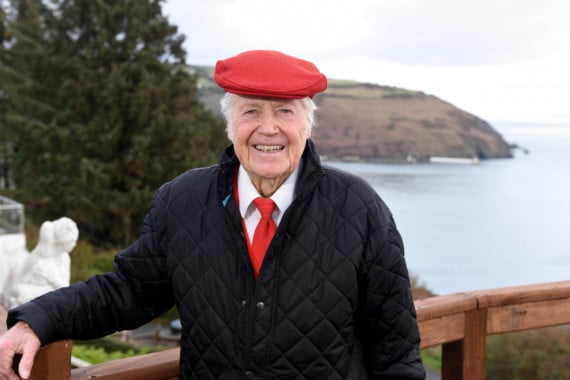
Born in Scotland in 1929, James Douglas lived in Britain throughout the Second World War, an experience which he said made a life long impression on him.
Shortly after the war ended, he emigrated to America in 1946, which included a mad dash to London.
He said: ’I was given 24 hours’ notice [by the US authorities] to get from Scotland down to London and board a boat bound for America. I loved Britain but America was different and represented a new challenge and new hope as Britain came out of the war.’
When Mr Douglas got to America, he went to Ohio and straight to an architect in search for work.
.jpeg?width=209&height=140&crop=209:145,smart&quality=75)

’I walked straight into Bellman, Gilette and Richards and asked to speak to the manager’, he said.
’I offered to work for two weeks for free to prove myself. The three owners were a bit amused and explained they didn’t need an architect but liked my attitude and decided to hire me on $50 a week.
’That’s a key lesson for today: make an impression, you have to impress people to get a job.’
After a short while, Mr Douglas began working for the billionaire real estate developer, financier and philanthropist Mark Taper. Again showing his remarkable drive, Mr Douglas quickly impressed his new employer, who soon promoted him.
He said: ’I was earning money I couldn’t believe, I was loaning money and being paid a percentage of it and I was qualified to loan anywhere across the United States. So I thought instead of just working for Mr Taper, I could work for myself and make more money.’
Not long after, Mr Douglas’s plans were interrupted by the Korean War. He was drafted into the army and spent two years training forces at Fort Knox in Kentucky on their way to the front line.
Awaiting his turn, he went home one weekend where a sermon at church made him consider war as a minister spoke of the sixth commandment, ’thou shalt not kill’.
Mr Douglas said: ’On my way back to the base, I was praying and asking not to go to war, I didn’t want to murder anyone. The next day I wasn’t on the list to go, or the day after, or the day after that. It turned out, I’d been selected to remain and train the troops. It was here I learned the difference between how British and American soldiers march.
A general came to me one morning and said: "Douglas, you have the best British forces in the American army". I thought that was quite funny.’
After his two years were up, Mr Douglas left the army and returned to arranging loans and being an architect.
Mr Douglas’s life would be extraordinary enough by that point, but then in the 1980s he began to work for the leader of the free world, President Ronald Reagan. He supported Ronald Reagan when he ran for president and contributed to Reagan’s campaigns.
At one of the many rallies held he was approached by John Heinz, who was the chairman of the Republican Party, and asked if he would become a member of the Presidential Task Force. To this date Mr Douglas still has his membership card.
’I was part of his task force, so he’d send us to places like Palestine and Israel. I remember being in the Golan Heights during Lebanese shelling. I always got on with the people, no matter who they were. There would always be some tension, sometimes guns were pointed, but then we’d sit and talk and then you realise we’re all the same.
’The people out there want what we want, to be safe and free and a better life for their children.’
During his time with President Reagan, Mr Douglas was an eyewitness to one of history’s greatest moments as the American President stood in Berlin and delivered the iconic words ’Mr Gorbachev, tear down this wall.’
President Reagan gave Mr Douglas a present which came after his ’proudest day’ when Reagan arranged for a flag to be flown over the White House in recognition of his service to America.
He still has the flag and a signed picture given to him by President Reagan along with other items the president presented to him.
Just over 28 years ago, Mr Douglas had an annual health check which found he may have cancer. A doctor advised immediate surgery, as did a second doctor. A third doctor then told him it was too late and he had weeks to live.
He said: ’I was given two weeks to live, and I’d bought a holiday home in Laxey a while before then so decided I would come here to die.
’After a few weeks, I was still here so I went to see the doctor in Laxey who agreed with the original diagnosis.
’He said to me: "Whatever you’re doing, keep doing it. It’s obviously working because you’re not dead yet".
’That was 28 years ago and I’m 90, no one in my family ever reached 90, it’s a miracle and I’m not going to question it. God is in control.’
Mr Douglas lives every day as it comes and has thoroughly enjoyed his time in the island, from performing in the Legion with Dave Mitchell to marrying Wendy, with whom he cofounded Manxaid, and their time running Brown’s cafe in Laxey.
He’s proud of their charity’s work, set up to help others, not with handouts, but by asking what people need.
Mr Douglas said: ’With a lot of charities, the money comes in and goes to a big pot in England, so you can never see what it goes on. But with Manxaid, we can say to people "well you donated this much and we spent this much on this item".
’For example there was a lady who was having mobility issues so the charity bought her a wheelchair so she could get out the house.’
The charity work, Seaview Chalet tourist accommodation, family and friends keep Mr and Mrs Douglas busy.
But he admitted it would all be for nothing if not for their sons and his wife.
He said: ’I live every day as it comes.
’But if it wasn’t for Wendy, I wouldn’t be here.’
Comments
This article has no comments yet. Be the first to leave a comment.