

I have a number of favourite walks around our lovely island. One starts when I park near the site of the former Ballacallin Hotel in Dalby.
Ballacallin House, as it was originally known, was transformed in the 1950s, becoming a very popular venue for food, hospitality and, indeed, entertainment, including Mike Laurie and Al, the well-known musical trio.
I also remember that during TT week, a number of motorcycle owners' groups would assemble at various hostelries around the island.
This was a favourite for the Triumph Owners Club, who met at this location. Have you any memories you would like to share?
We walk slightly up the hill before taking a right turn onto the Dalby Lhag Road, heading downhill past some properties which must have among the best views on our island. Tucked away at the bottom of the hill, among the greenery, is a charming, secluded, fairytale-style cottage.
Then it is uphill towards the ‘Slabs’, adjacent to which is the last property.
The ‘Slabs’ consist of an incredibly steep, slick and technical rock staircase which conventional vehicles cannot navigate, though some experienced off-road motorcyclists are able, with care, to tackle the natural, unwelcoming terrain. It is possible for walkers to continue up the Slabs and beyond, but we take a right turn.
As always on my walks, the dogs are secure on their leads and collars, and this becomes even more crucial as we go over a stile onto the public footpath through fields which are sometimes occupied by grazing sheep. Great care is needed to ensure we stick to the footpath and securely fasten gates as we progress towards the Raad ny Foillan (The Way of the Gull) coastal footpath connection.
The reward, as we head downhill and look towards the south, is simply outstanding, with massive, staggeringly steep cliffs and green rolling hills along the western coastline.



Nearest is Eary Cushlin, another real favourite walk of mine, with a Manx National Heritage property facing directly towards the sea, which is available for a real ‘away from it all’ break. On a clear day, the Mountains of Mourne are clearly visible.
When I take in Eary Cushlin, I love to take the footpath, which can be slightly challenging in places, to Lag ny Keeilley (Manx for ‘The Hollow of the Chapel’), a remote, evocative historic site built during the earliest period of Christianity on our island, well over 1,000 years ago.
I remember reaching the site one Good Friday and just relaxing in beautiful sunshine, with only the sound of the waves and birds overhead. It was magical! Further along are stunning views of Cronk ny Arrey Laa and onwards towards the Sound.
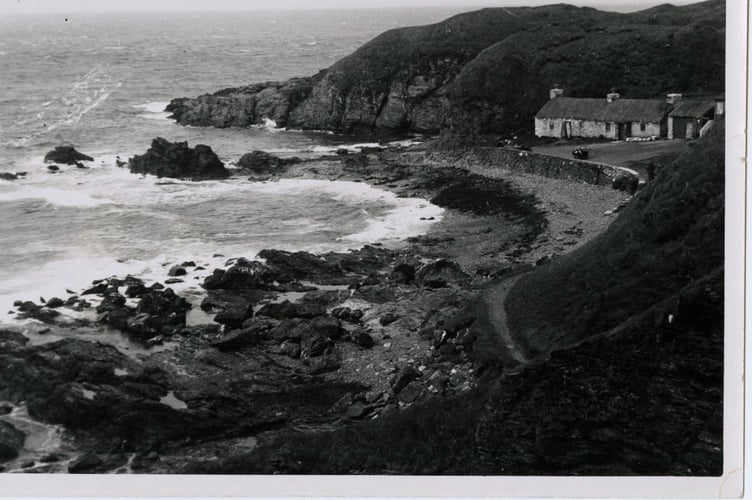
Back to the Niarbyl walk…
After spending time admiring the views south, we commence the descent towards White Beach (Traie Vane), stopping briefly to take in its beauty from above. Sometimes, you can hear the happy sounds of families relaxing or enjoying its natural assets: a wild mix of dark shingle, rugged sea caves and bright white quartz stones scattered along the tideline.
I always stand and admire the waterfall. The stream that forms it cuts through the glen behind the beach, tumbling across the stones into the sea. In wet conditions, it becomes even more impressive!
There is a cottage on White Beach, standing completely on its own, fairly near the waterfall, which I always find of interest. It is a historic, isolated fisherman's shelter-cum-cottage and is a somewhat rugged remnant of the working heritage of this part of the coastline.
It is privately owned and is not available as a holiday let or open to the public, which obviously must be respected. However, I think the idea of a weekend in its solitude, with just the beach, waterfall and wildlife for company, would be very tempting!
After spending a little time meandering around the beach, the next section is the climb back up to connect with the footpath.
Similar to other areas of the walk, and indeed in various areas of these precious national assets, there has been a historical lack of investment in the maintenance of public footpaths. It is really good to see that, following Tynwald approval, a much-improved programme of maintenance is planned going forward.
Recently, some good work has taken place to improve accessibility in a number of areas. I expect that, similar to the Forth Bridge painting, it will become an ongoing process, but so be it!
Following the footpath around, whilst once again admiring the views to the south, we have two choices: one takes us down to the beach at Niarbyl, or the other takes us to the café and bus connection area. My usual choice is the former, as the beach area and cottages are of real interest.
Often, people are taking advantage of nature by enjoying the opportunities on or beneath the water or exploring this area. Wildlife, such as the occasional basking shark (typically between May and August), grey seals and various seabirds, can be observed, and opportunities also exist for anglers.
Niarbyl, in Manx (Yn Arbyl, meaning ‘The Tail’), is one of the finest examples of the scenic beauty of our island. The name describes the low, rocky tail of land projecting into the sea. It was a quiet fishing outpost.
It is actually world-famous from a geological perspective. It is home to the Niarbyl Fault. A visible line marks the collision point where two ancient continents (Gondwana, representing southern England and Africa, and Laurentia, representing North America and Scotland) met around 480 million years ago, closing the ancient Iapetus Ocean.
(I had no idea about this until I was studying Niarbyl for this piece!)
Of much more recent fame (was it really 1998?) one of the historic fishermen’s cottages gained international recognition as the cottage of Ned Devine in the film ‘Waking Ned’, as well as featuring in earlier television productions.
I love the film and have heard stories of people visiting Ireland because they thought that was its location. I have also personally met visitors from the USA who had travelled to the Isle of Man specifically to visit Ned’s cottage!
I am so pleased that a tenancy for the Niarbyl Café has recently been awarded and, after further work, it will be open again for business from springtime next year. It has been so disappointing to have seen it vacant for such a long time.
When I have walked past, the bus, which takes in the route west or in reverse, has been standing waiting in the hope of attracting passengers. So, I look forward to it being part of a ‘joined-up’ operation.
As stated last week, references to a café on the site go back to 1927. Good luck to the new tenants!
One famous person who shared my, and many others’, fondness for Niarbyl was Florrie Forde, a legendary Australian music hall and pantomime star. She spent her summers performing at the Derby Castle in Douglas for nearly 40 consecutive years.
During these long summer seasons on the island, she stayed at her own little cottage retreat, tucked away in this special spot…
Have I encouraged you enough to spend a little time at Niarbyl?