
Between October 9-11, five stray dogs were brought into the Manx Society for the Prevention of Cruelty to Animals.
Three were microchipped but only one had up-to-date registration details which enabled us to contact the owner straight away.
The fact that two of the dogs were not chipped at all is both illegal, and part of a worrying trend – we’re seeing more and more unchipped dogs coming to us either as strays or for rehoming.
It has been a legal requirement in the Isle of Man since 2018 for dogs over the age of eight weeks to be microchipped (as is the case in the UK). This replaced the annual dog licensing system which exempted working dogs, whereas all dogs are now required to be chipped irrespective of their status.
An owner of an unchipped dog can face a fine of up to £500, as can an owner who fails to update their details; and anyone who fraudulently or negligently enters inaccurate information onto a microchip database may be liable for a fine of up to £1,000.
Microchipping is a simple, painless procedure that can only be carried out by a suitably- qualified practitioner, and it involves the insertion of a tiny electronic chip (smaller than a grain of rice) under the animal’s skin.
Each chip carries a unique code which can be read by a scanner, enabling information such as an owner’s address and telephone number to be accessed via a database. There are 24 different microchip databases covering Great Britain, with some offering a free update service and other charging a small fee.
The reasons why more and more owners are failing to chip their dogs are numerous: apathy; ignorance of the law; distrust of the technology involved; a worry that the procedure itself will be painful; and concern about the costs involved. Vets’ fees will vary, but the MSPCA charges only £20 to insert a chip into a dog or cat and to register their owner’s details.
Although it is not a legal requirement to microchip a cat in the island (unlike in England where it became law in 2024), it is arguably even more important for a cat to be chipped given most cats are able to roam freely and a significant number get lost.
So far in 2026 we have taken in 37 stray cats, and yet only 20 per cent were chipped and able to be reunited quickly with their respective owners.




The UK charity Cats Protection recently carried out a survey to investigate the reasons why chipping cats is declining, against the backdrop of cat ownership increasing from 10.2 million cats in 2025 to 11.7 this year.
The most common reasons for not chipping were the cat being an indoor only one, the cat not venturing very far, and the cat wearing a collar.
Collars undoubtedly have their uses, as long as they have a tag on them with an owner’s contact details, but we would only ever recommend that a cat wears a quick-release collar because of the dangers non-breakaway collars pose (from strangulation and choking, to jaw and paw entrapment).
Dogs should always wear a collar when in a public place to help with identification but, as with cats, a collar is not a replacement for a microchip. And care must always be taken to ensure a collar is correctly fitted and comfortable for the animal, and that it is not causing any skin irritation or hair loss.
Cats Protection is calling for more action from the veterinary world, and for a ‘chip check’ to be a routine part of a visit to a vet where a chip number isn’t already recorded on the animal’s veterinary records. As trusted professionals, vets are uniquely placed to raise awareness of the benefits of chipping and to address common misconceptions.
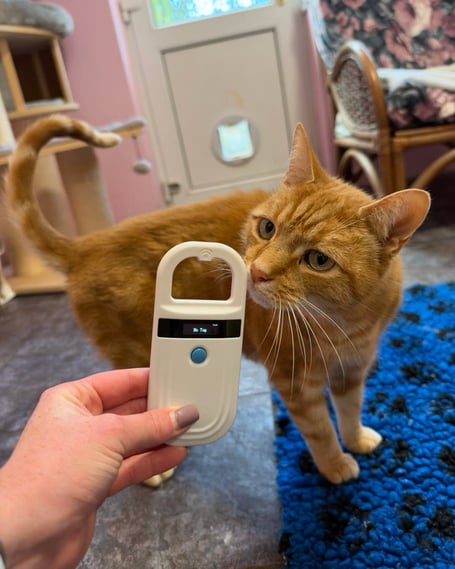
Rossi, our longest stay cat, has been the face of our recent social media campaign highlighting the importance of microchipping. This gorgeous ginger boy has been in our Cattery since November 2024 - a variety of medical issues, including arthritis and a mild heart condition, have put off potential adopters.
Although he is comfortable in his own room with his personal ‘cattio’, we would love to see him live out the rest of his life with a doting owner who understands his needs.