
Former tourism minister David Cretney explores what makes the Isle of Man unique and why farming could play a bigger role in tourism’s future.
The relationship between Isle of Man agriculture, fishing and tourism goes back to the heydays of the visiting industry.
Agriculture and fishing obviously predated tourism, but the emergence of tourism was very welcome for producers.
As a supporter of the Isle of Man as a destination, I usually write about the gifts left to us by previous generations, such as the Steam Railway, Manx Electric Railway, horse trams, Laxey Wheel, glens and much more. All of which add up to a unique offering.
Indeed, going back further in time, our history is remarkably rich for a small island, from prehistoric settlement, through Celtic and Viking rule, medieval kings and Lords of Mann.
From the Neolithic period, there are numerous prehistoric monuments, burial sites and stone circles. One of the most important prehistoric sites is Cashtal yn Ard in the north, a large Neolithic burial monument.
Christianity arrived relatively early, with missionaries visiting. The island became famous for its keeills, tiny early Christian chapels.
A particular favourite of mine is Lag ny Keeilley, near the beach on the western slopes of Cronk ny Arrey Laa. Reached via Eary Cushlin, it is best described as a challenging walk.
It is very worthwhile, with a peaceful atmosphere immersed in a beautiful natural place, with just the sound of the sea and the occasional sight of birds overhead or sheep grazing on the hillside.
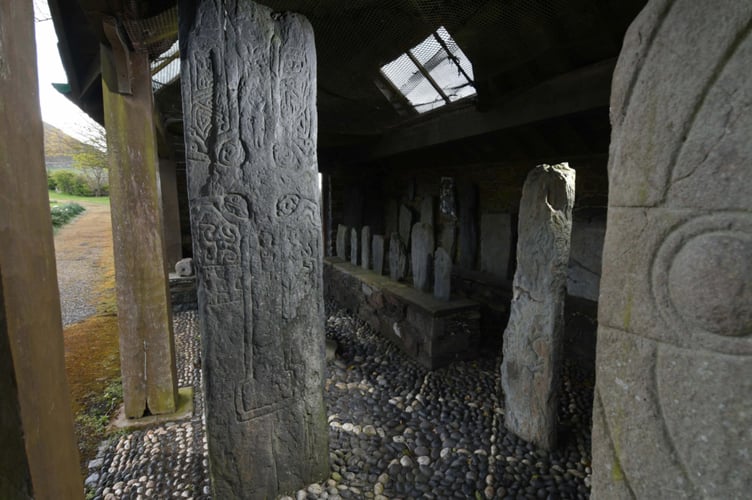
Another unique place is Maughold churchyard, where a number of Celtic and early Christian crosses can be seen displayed alongside others from the Viking Norse tradition.



The Viking period is one of the most influential and fascinating. From around the 9th century, Norse settlers and rulers became dominant.
Excuse my juvenile humour... When people talk about new residents to the island, I recall a message scrawled on a wall in a gents' loo relating to the somewhat derogatory statement when misused... 'King Orry was a come over'.
The island was perfectly positioned for our Viking visitors because of its geographic situation almost exactly between the major Viking territories of Ireland, Scotland and northern England.
I always think the Vikings receive something of a bad press because, in reality, they settled here and established a stable political system with, at its centre, Tynwald, the world's oldest continuous parliament.
Their influence remains particularly in place names such as Foxdale, Ronaldsway, Snaefell and so on.
The Isle of Man became the centre of a much larger maritime kingdom, the 'Kingdom of Mann and the Isles', including at various times the Hebrides, parts of the Scottish west coast and islands around Scotland.
Also of great importance, Peel Castle, Castle Rushen and other historic venues are of great tourism interest.
-(1).jpeg?width=752&height=500&crop=752:500)
From the original idea of the links between agriculture, fishing and tourism, some features of our island are of interest in particular as 'niche' elements that, taken together, contribute to our special island.
Without referring to the recent history, the unique horse trams fit in with other transport attractions as part of an attractive package.
On offer is Isle of Man produce, whether it be kippers or queenies, fresh vegetables, traceable meat products, farm to table from green fields with virtually no food miles, beer brewed to exacting standards of purity laid down in legislation, beautiful honey under our disease-free status, ice cream featuring fresh locally sourced double cream and butter, free-range eggs, award-winning Manx cheese and butter and, remind me, what is the best-value nutritional drink? ... Milk, of course, from Manx family farms.
Then, although I am Douglas born and bred, how nice it must be to stay in our lovely countryside in converted redundant farm buildings?
The 'boom' years for tourism, with the Isle of Man as a 'first choice' destination, were from the late 1860s to the outbreak of the First World War.
The development was a combination of railways, steamships and Victorian and Edwardian entrepreneurs.
The Douglas to Peel railway opened in 1873, Douglas to Port Erin in 1874, and Douglas to Ramsey in 1879.
At the same time, steamship services connected Douglas with Liverpool, Fleetwood, Barrow, Belfast and other ports.
Suddenly, the Isle of Man was accessible to the expanding Victorian middle and working classes. Douglas was transformed.
The visitors needed to be fed. The holiday economy supported thousands of Manx people indirectly.
A family might have converted part of their house into guest accommodation, taken in visitors in the summer, worked in a hotel, run a cafe, operated a shop, driven a cab, worked on the railways, worked on a Steam Packet boat or supplied food to hotels.
The latter certainly strikes a clear note with my family, though later than the original boom.
RW Cretney and Sons, operating from North Quay next to St Mathews Church, had a clear business model, offering credit to hotels and guest houses at the start of the season and being paid with interest at the end.
The Victorians and Edwardians wanted to be entertained.
Douglas responded with the Gaiety opening in 1893. The Derby Castle complex developed into a major entertainment attraction, including its famous ballroom.
The Palace, Villa Marina and numerous other venues followed or developed into major entertainment centres.
They enjoyed the 'seaside experience' with enormous crowds, 'promenading', deck chairs, bathing machines, Punch and Judy, donkeys, rowing boats, Camera Obscura, funfair entertainments, trains and trams.
Then mini-resort attractions were developed, such as Groudle Glen, Glen Wyllin, Glen Helen, Ramsey Mooragh, Silverdale, Laxey Glen Gardens, Port Soderick and so on.
Today, for a traditional seaside experience, Port Erin and Peel, with lovely sandy beaches, ice creams, cafes and activities, retain this charm, as do our national glens.
The 1950s and into the 1960s continued with mass seaside tourism.
Challenging times followed with the development of package holidays and guaranteed sun at bargain prices, firstly to Spain and then further afield to places we only knew about from our geography books.
We were very slow to realise visitors' tastes required something different from what had been acceptable traditionally.
Latterly, more specialist holidays with an emphasis on heritage, a range of events, our beautiful scenery... (back to our farmers again as custodians of the countryside), short breaks, golf and, of course, our motorsport offering have been the norm.
Coach holidays help particularly at 'shoulder times'. Rail enthusiasts, walkers, cyclists, nature lovers and those seeking a 'step back in time' to recharge their batteries remain popular.
Over the years, like our logo, 'whichever way you throw me I will stand', we have had to reinvent ourselves and pursue new drivers of our economy.
Which brings me full circle.
In our current uncertain, unstable world, there has to be an opportunity to combine the two sectors of agriculture and tourism.
If we increase the value and numbers of those coming to spend time with us, then our food producers will benefit. Our visitors love our countryside and our farmers care for it.
Over the ten years I was Minister of Tourism, the constant negative comment, which I still hear today, is the cost of access.
The difference is that government and the Steam Packet are more closely aligned than ever. Tourist deals definitely breathe new life into the industry and the economy.
A tourism department with a clear transport link, focusing all the positive aspects together under one roof - railways, events both sporting and cultural, heritage, glens, Villa and Gaiety, motorsport, sport, cruise visitors, marketing and promotion - could ensure maximum impact.