
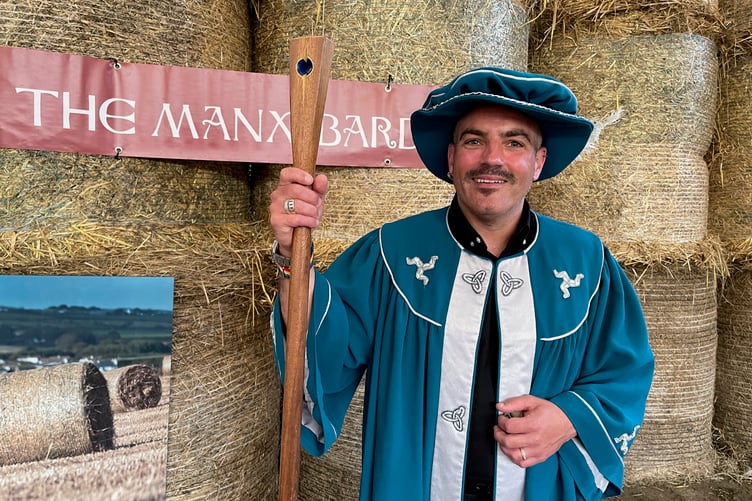
In this month’s Manx Bard column, Bradley Chambers discusses poets’ liking of birds.
Why do poets write so often about birds? These strange, diverse creatures which evolved from dinosaurs. From tiny hummingbirds to soaring albatross. The quirky wren, and the glorious bald eagle. Chickens, kingfishers, owls, starlings and parrots. The comical Shoebill. The deadly Southern Cassowary with its dagger-like claws. They certainly vary.
The Poetry of Birds is on my bookshelf; an entire book of bird poems, edited by former Poet Laureate Simon Armitage. So many poems about birds, but why? Maybe there is something magical in birds, or perhaps something deeply grounded in reality. Perhaps both. Poets return to birds continually. Birds represent something. They point to something.
Birds in poetry often symbolize freedom, transcendence, the human soul, and something spiritual. They frequently represent hope, joy, and inspiration but can also suggest darker aspects of life – such as fragility and mortality.

-(2).jpeg?width=209&height=140&crop=209:145,smart&quality=75)

Caged Bird by Maya Angelou contrasts the freedom of a wild bird with the restricted life of a captive bird. Are we quite as free as we think we are? I don’t think so. Wallace Stevens is a challenging poet. He managed to find ‘Thirteen Ways of Looking at a Blackbird’. Quite a feat.
‘The Raven’ by Edgar Allan Poe is a brilliant poem, in which he uses a bird to symbolize dark and endless grief. ‘Take thy beak from out my heart, and take thy form from off my door!” Quoth the Raven “Nevermore.’
What about the magpie though? They have a bad reputation. Aggressive, territorial and highly opportunistic scavengers which eat eggs and chicks. Surely the bad guys of the ornithological world.
There is another story to tell. Magpies are hugely intelligent (for a corvid). They have beautiful, carolling songs and can mimic human speech. You can Google a magpie which says, ‘You alright love?’, to hear what I mean: catching the Yorkshire accent brilliantly.
Then there are the vivid colours – iridescent green and blue in the sunlight, along with their striking black and white.
Two for Joy
No, I wish I had not seen you
in bracken clearing, strewn with wood
wish I’d not seen you, spying me
for to see you does no good
A sullen cumulonimbus
above - the static sky
and down here, in the shadows
I see your prying eyes
I hear you, lonesome magpie
unconcerned with my unease
rattle out a chattered phrase
between the aspen trees
You strut– a mocking, jaunty gait
the darkness dulls your gleam
an angel of calamity, as I look
down to Glenn Dhoo stream
In the valley, by the empty Phurt
from lemon-scented fern
emerged another magpie
flew up towards Slieau Curn
Transforming fortunes in an instant
One for sorrow, two for joy
catching rainbow, stretch of sun
struck the wings of my companion
in an instant he was gone
Comments
This article has no comments yet. Be the first to leave a comment.