
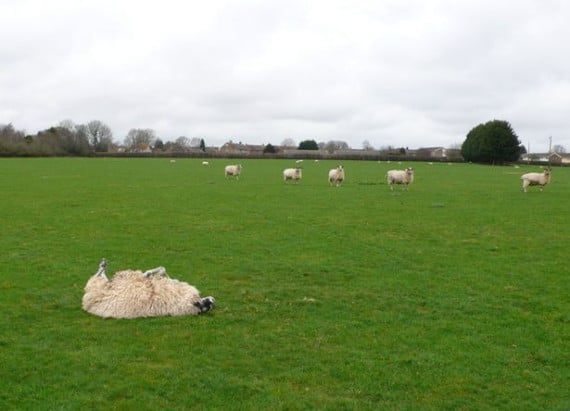
It is common at various times of year for sheep to get stuck on their backs and not be able to get up again.
As winter approaches the cause is most likely to be that their fleece has become waterlogged - a long wet fleece can weigh up to a quarter of the sheep’s body weight.
Once a sheep is cast in this position they are very vulnerable and they can die if left to their own devices because their bodies cannot function in an inverted position.
In order to digest grass sheep ruminate, which involves the use of a four-chambered stomach.
.png?width=209&height=140&crop=209:145,smart&quality=75)
The largest chamber, the rumen, is where the grass ferments and this produces gases.
A sheep needs to release these gases by belching every couple of minutes, but when a sheep is the wrong way up it can’t do this because the rumen is displaced.
A build-up of trapped gases slowly suffocates the sheep by blocking its oesophagus.
The gases also increase the pressure on the animal’s blood vessels which then restricts the blood supply to vital organs and limbs, making the sheep even less able to help itself.
You can easily save a sheep’s life by taking immediate action when you see one in this cast position.
Take a good hold of the sheep’s back by holding onto its fleece and slowly rolling it over, and then help it back on its feet.
Hopefully the sheep will then try to get up and steady itself, before walking away, but some need more help than others.
If the sheep keeps rolling back, you may need to hold it sitting in an upright position for several minutes while it regains the use of its limbs.
Once the sheep is up and about, watch it for a few minutes to make sure it has recovered, and encourage it to keep walking by following behind it quietly.
Walking will help the sheep’s digestive system and blood circulation to get back to normal.
Ideally you should let the farmer know what has happened so that they can keep a closer eye on the flock.
Please also be mindful of the Countryside Code - for example, stick to footpaths, close gates behind you, and keep dogs on leads.
But remember the one exception to keeping dogs on leads, namely when you are being approached by a herd of cows.
A dog can often provoke a defensive reaction in cows, particularly if there are calves in the field, and cause them to charge.
Most dogs will be able to outrun the cows, unlike their owners.
Two weeks ago a school teacher from North Yorkshire became the second member of the public to be trampled to death by cows in the UK this year.
He was walking his dogs on a public right of way near his home.
Last year the Health and Safety Executive investigated 43 incidents involving people being hurt or killed by cattle.
A dog was present in 18 of the 43 incidents reported, and in eight cases the dog was on a lead.
However, the mental and physical health benefits of dog walking far outweigh the risks, and dog ownership seems to have become even more popular as a result of the Covid-19 pandemic.
We have a waiting list of potential adopters looking for small to medium sized dogs to share their lives with, but we have three large dogs who are being overlooked. Jeff is a Ridgeback cross lurcher, and Dottie and Dodger are American Bulldogs.
They all need experienced owners who understand their breed-specific needs, and they should be the only pets in their respective households.
In return they will be loyal and devoted companions, who will enjoy long country walks (ideally observing cows from a distance!), then returning home to spend evenings curled up on the family sofa.
Comments
This article has no comments yet. Be the first to leave a comment.