

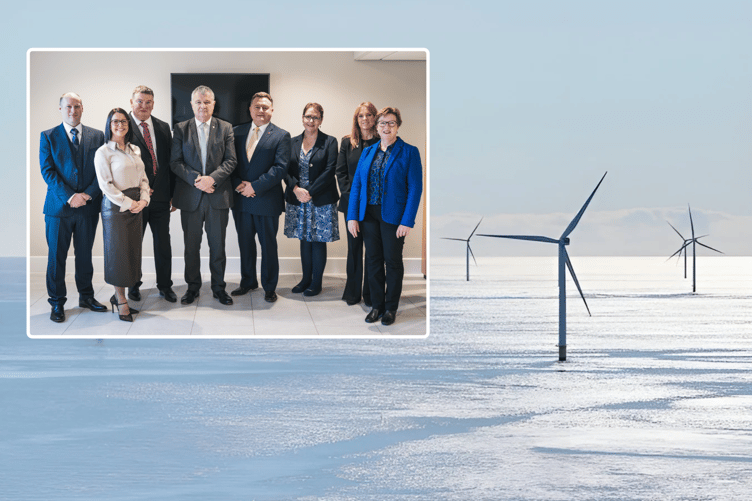
One of the first major decisions facing the new Council of Ministers will be whether to give the go-ahead to the Mooir Vannin offshore wind farm.
The public examination into the Ørsted project closed on September 9.
The independent examining body's final report and recommendation must be submitted to CoMin within 60 working days of the examination's conclusion, taking the deadline to early December.
Ministers will then have 30 working days to decide whether to accept the recommendation.
The Attorney General has advised that CoMin members can only participate in deciding whether to approve or refuse the application if they have not previously ‘acted in such a way as to appear biased’.
This includes ministers who have made public statements indicating a predetermined position, either for or against the project. They would need to declare a conflict and withdraw from the decision-making process.
In her manifesto, Claire Christian, who continues as Health Minister, said she opposed Ørsted's proposals.
She said that, based on the evidence available, she did not believe Mooir Vannin met the national interest test for a major infrastructure project and therefore ‘cannot support it in its current form’.
Michael Crowe (Rushen), a first-time MHK appointed Treasury Minister, said in his manifesto that he opposed offshore wind farms for the island.
He argued that the costs and long-term commitments involved offered a return that ‘simply doesn't stack up against more practical alternatives’.


If ministers are excluded because of conflicts, other MHKs would have to be appointed acting ministers for the decision.
So where do the remaining CoMin members stand?
New Chief Minister Chris Thomas previously voted against the government's offshore energy production strategy and has called for publication of the original agreement for lease awarded to Ørsted in 2015.
It remains unclear whether his previous position would constitute a conflict.
First-time MHK and new DEFA Minister Rachel Glover (Onchan) said in her manifesto that she was ‘genuinely undecided about Mooir Vannin’.
Fellow newcomer and Enterprise Minister Robert Cowell (Ramsey) said: ‘Any decision must be based on robust evidence, value for the Manx public and protection of our Island's long-term interests.’
He added that he would not support a project simply because the government had already invested time or political capital in it.
New Education Minister Sarah Maltby (Douglas South) expressed caution about large-scale wind farms because of their potential impact on landscapes, biodiversity and communities.
She said any support would depend on ‘clear and enforceable safeguards that guarantee long-term benefits for the Manx people’.
Jane Poole-Wilson (Middle), who continues as Home Affairs Minister, said she supported development of the island's territorial seabed in principle, provided it delivered demonstrable benefits.
New Infrastructure Minister Jason Moorhouse (Arbory, Castletown and Malew) said renewable energy options should be assessed according to their location and cost.
Both Mr Moorhouse and Mrs Maltby supported a Tynwald motion in May proposing that nationally significant infrastructure projects should ultimately require Tynwald approval.
The motion was defeated.