

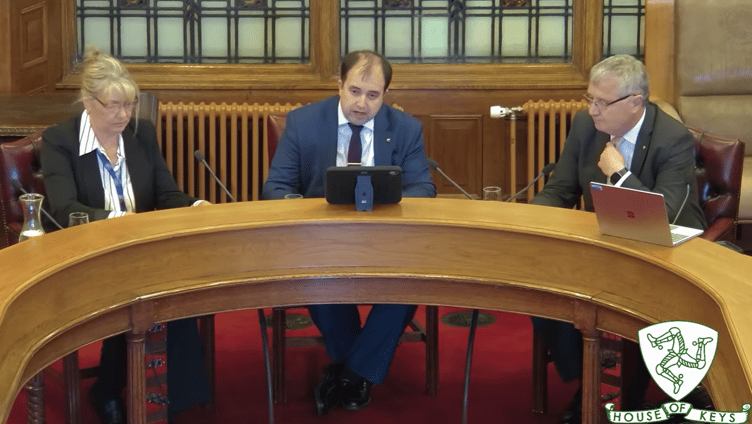
Kirrie Jenkins and Chris Thomas have set out contrasting approaches to leading the Isle of Man's next government, with housing, public services, the economy and restoring public trust among their priorities.
The two candidates for Chief Minister took part in a lengthy hustings in the Legislative Council Chamber on Thursday, answering questions from members of the House of Keys on how they would tackle some of the island's most pressing challenges.
Mrs Jenkins, the Arbory, Castletown and Malew MHK, called for a more collegiate approach to decision-making, arguing that the new administration should agree its priorities collectively after listening to evidence from different sectors.
Mr Thomas, the Douglas Central MHK, said the island had voted for change and that government needed to turn that mandate into action, pointing to his published policy statement and proposals for delivering improvements from the outset.
The hustings came five days before the House of Keys is due to elect its next Chief Minister at 10am on Tuesday, October 13.
Both candidates emphasised the need for government to work more effectively, but differed on how to achieve that, with Mrs Jenkins advocating a reset in relationships and Mr Thomas stressing the need for clear plans, deadlines and accountability.
Mrs Jenkins opened by saying the island's public finances, essential services and economy had a 'firm foundation', but needed to be strengthened.
She said the Isle of Man should be a 'safe harbour' in uncertain times, with government streamlined by removing duplication, unnecessary processes and delays.
'The Chief Minister should not be the person who has every answer,' she said. 'The Chief Minister should be the person who gets the right people around the table.'
Mr Thomas said: 'The island voted for change. Now we need to turn it into action.'


He pointed to his record in government, including increasing the personal tax allowance, changing the approach to setting the minimum wage and addressing an estimated £20m annual overspend at the Department of Infrastructure in 2022.
He said his record showed he was 'not a weather vane blowing in the political wind', but someone who worked with others to 'probe, work things out, and then get things done'.
Windfarm
-(1).jpeg?width=752&height=500&crop=752:500)
The candidates were asked whether they would support a vote requiring all nationally significant windfarm applications, on land or at sea, to receive final approval from Tynwald.
Mrs Jenkins response was simply: ‘Yes’.
Mr Thomas said the island needed to complete the consenting and parallel taxation processes lawfully, with an outcome that was publicly acceptable.
He said he had seconded a move for a referendum on the issue, adding that his record was ‘indisputable, undeniable’.
However, he warned there were significant legal risks to consider, given the existing leases, consenting regimes and the millions of pounds already spent.
‘We need a blended approach,’ he said.
‘Obviously we represent the public. We need to take the public with us in this by doing the right thing.’
Mr Thomas said the issue was ‘slightly more complicated than it first appears’ because of the legal and financial commitments already in place.
Housing and opportunities for young people
.jpeg?trim=0,313,0,312&width=752&height=501&crop=752:501)
Housing was one of the main areas of discussion, with both candidates acknowledging the need to improve affordability and give young people a realistic opportunity to build their lives on the island.
Mrs Jenkins said government first needed to establish what affordable housing actually meant for residents, arguing that what was affordable to some people remained out of reach for many others.
She called for a broader examination of the housing market, including empty properties, holiday homes, second homes and the factors pushing up land prices.
She also highlighted rising freight costs for building supplies, saying government needed to consider whether the Steam Packet was being used to support the wider economy.
'This is not a one-stop solution,' she said, adding that housing had to be a major priority for the next administration because it was causing problems for young people and families.
Mr Thomas proposed bringing a motion to Tynwald as soon as possible to clarify the island's affordable housing target, the funding required and how homes would be delivered.
He said the existing commitment to build, provide or facilitate up to 1,000 affordable homes over 10 years, beginning in April 2025, contained ambiguities that needed to be resolved.
He called for a housing and planning policy minister to bring together work across departments, local authorities and the Manx Development Corporation.
Mr Thomas also questioned whether the housing target remained appropriate if population growth differed from the assumptions behind the assessment of housing need.
On young people's prospects, both candidates said the Island needed to offer more attractive career opportunities.
Mr Thomas called for greater investment in apprenticeships and vocational training, rather than focusing primarily on university education, while Mrs Jenkins said the island needed to diversify its economy and make it easier for people to return after gaining experience elsewhere.
She described young people who studied away and returned with new skills as an asset to the island.
Public services and government reform
Both candidates said government needed to tackle duplication and improve co-operation between departments.
Mrs Jenkins said she wanted government to operate as one organisation rather than through separate departments working in silos.
She highlighted the hospitality sector, saying government should examine costs, staffing and demand, including fees, regulation, licensing, employment barriers and procurement.
She also called for faster decision-making, arguing that businesses needed government to respond more quickly to the challenges they faced.
Mr Thomas said reform should be judged by whether it improved outcomes for residents, including healthcare, education and transport.
He pointed to the need for clearer strategic priorities and accountability, alongside a culture in which departments worked together rather than pursuing their own objectives.
On public-sector staffing, Mrs Jenkins supported an evidence-based approach to recruitment and said government should examine where posts and processes could be reduced without damaging services.
Mr Thomas said unnecessary management roles and duplication needed to be addressed, arguing that the public service should be organised around delivering better outcomes rather than maintaining structures for their own sake.
The candidates also discussed child poverty.

Mrs Jenkins said the extent of poverty on the island had become apparent during the election campaign and highlighted free school meals as a measure that had particularly struck her.
She said government needed to examine the reasons for intergenerational poverty and consider measures including childcare payments, housing and the cost of living.
Mr Thomas argued that no single measure, including free school meals, would provide a complete picture. He called for work building on the poverty committee's recommendations, with experts identifying an appropriate indicator to measure progress.
Both said restoring public confidence would depend on government working together and demonstrating that it could deliver tangible improvements.
Mrs Jenkins said ministers and members needed regular communication, collective decision-making and a willingness to acknowledge when policies were not working.
Mr Thomas said the new administration should demonstrate by Christmas that it was acting on the issues residents cared about, including housing, healthcare and getting on and off the island.
Regulation, the Steam Packet and energy
-(3).jpeg?width=752&height=500&crop=752:500)
The future of financial regulation was another key issue, with Mrs Jenkins calling for a review of the Financial Services Authority.
Mr Thomas said the priority should be reducing regulatory friction rather than introducing fundamental new legislation.
He said the regulator and industry needed to understand each other's roles, arguing that the Island needed a regulatory environment that supported good businesses while maintaining appropriate standards.
Both candidates also addressed the Steam Packet and rising freight costs.
Mrs Jenkins said the next House needed to decide whether the company should primarily be viewed as an enabler of the economy or a source of income.
She argued that higher freight costs were putting pressure on businesses, including those in agriculture, and could ultimately be passed on to consumers.
Mr Thomas said the Steam Packet's interests were closely linked to those of the island, but called for a wider political debate about how sea services should operate and be funded.
He said the company needed to examine whether it could use fuel-price hedging to provide greater certainty over future costs, while warning that changes to the way services were funded would have implications for other spending priorities, including housing.
On energy policy, Mrs Jenkins said the short-term targets under the Climate Change Act should be reviewed in light of revised baseline figures, while retaining the longer-term ambition.
Mr Thomas said any major changes would need to take account of the legislation, adding that energy policy should focus on reducing costs, improving resilience and adapting to climate change.
He also called for a pragmatic, funded energy strategy.
The candidates differed on the Manx Development Corporation, with Mr Thomas saying its future could involve ending it, continuing it or changing its purpose. He said a development viability study should help determine whether it was the right approach to addressing housing need.
Mrs Jenkins said the island needed to rethink how it delivered apprenticeships and supported young people who left education early, alongside a more joined-up approach to education and the facilities communities required.
Decision due on Tuesday
The hustings also covered migration and border policy, healthcare, additional educational needs, emergency preparedness and economic growth.
Mr Thomas said an update on migration and border policy should be brought to Tynwald for debate in January, while Mrs Jenkins said government needed to distinguish clearly between illegal immigration and appropriate migration to fill skills gaps.
On a potential crisis, Mr Thomas highlighted existing work on food supplies and energy security, saying government needed to prepare properly and be willing to fund necessary investment. Mrs Jenkins said she would draw on experienced civil servants and private-sector expertise, with a longer-term approach to food security.
The House of Keys is due to meet at 10am on Tuesday to elect the next Chief Minister. Each candidate is expected to make a speech and answer questions before the vote.
A candidate needs the support of at least 13 of the 24 MHKs to secure the position. If neither Mrs Jenkins nor Mr Thomas can command that support, the process could extend beyond Tuesday, with the possibility of another member emerging as a candidate.
The vote will determine who leads the next Council of Ministers and takes forward the priorities outlined during Thursday's hustings.