
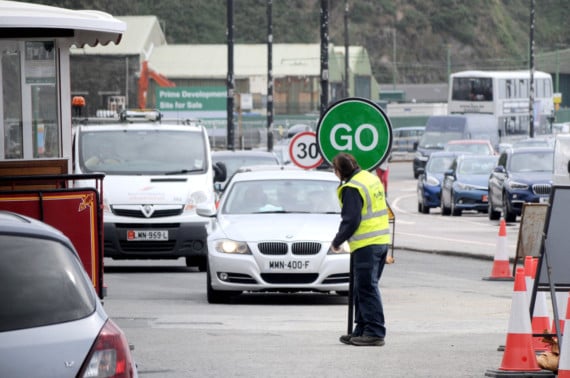
The £25m budget for the Promenade project has not factored in the estimated £800,000-to-£1 million cost of signals for the horse tramway.
Details have been revealed in the minutes of last month’s strategic project board meeting when it was suggested the horse tram service could be cut back to avoid the need for any signalling.
The Promenade reconstruction scheme has been dogged by delays and technical problems.
As part of the scheme, the Douglas Bay horse tramway is being relaid in a central corridor from Strathallan to Central Promenade. But at Esplanade Lane it will cross the road to run along the seaward side of the road as far as the Sea Terminal.
.jpeg?width=209&height=140&crop=209:145,smart&quality=75)
.JPG?width=209&height=140&crop=209:145,smart&quality=75)
.jpeg?width=209&height=140&crop=209:145,smart&quality=75)
At a strategic board meeting on December 6, the minutes of which have just been published, it was noted that ’the scheme budget did not allow for the estimated £800,000-to -£1m cost of signalling’.
Department of Infrastructure chief executive Nick Black said the over-riding concern must be the safety of both the trams and the public and any arrangements must have the approval of the railway inspector.
Director of highways services Jeff Robinson said he would support the lowest possible cost, ’even at risk of compromise to the horse tram service’ - and opposed changing the track design.
He pointed out that if service was reduced to just one horse tram on the promenade at any given time there would be ’no requirement for any signalling’.
The DoI told the Examiner that no decisions have been taken on signalling for the horse tramway - and there is no proposal to limit the horse tram service to one at a time.
A spokesman said: ’The horse tramway needs to be operated to relevant valid safety standards.
’These are enforced by HSWI, though a UK expert has been appointed by HSWI to take on the role of inspector of railways. Without his approval the line cannot operate.
’The department’s objective is to ensure that it can provide whatever signalling is needed to secure this approval at best value.’
The spokesman said: ’It is possible that if there are fewer tram movements then a simpler signalling system may be possible but there is no proposal to limit services to one tram at a time.’
Under the plans approved by Tynwald, horse tram services will operate mainly on the double track central corridor section - with the southern single track section on the seaward side used only on special occasions such as the arrival of cruise ships.
The spokesman said: ’The single track section will need some form of control to ensure that two trams do not meet each other.
’This may or may not be by signals but the inspector will be looking at a system that is adequate for any possible level of service that could be called for, however rarely that happens.
’Tynwald clearly voted for a continuation of the horse tram service so the signalling solution must be designed to allow this to happen.’
He said that the points being installed are capable of manual or remotely controlled operation, and ducting is being placed to allow any wiring that may be needed.
The spokesman said that while the approach has always been to install a tramway that could be upgraded to handle modern trams if that is wanted in the future, there is no intention to specify a signalling system that will control modern electric trams.
He added: ’We are planning to meet the railway inspector in the near future to obtain clarity about his views on how the standards might adequately be met.’
Signalling would not have been an issue - and progress on the reconstruction project speeded up - if Tynwald had backed plans to run the horse trams on the Promenade walkway.
Those plans prompted outcry from walkers, cyclists and other users of the walkway.
But Phil Gawne (pictured), who suggested the idea when he was DoI minister, told the Examiner: ’Had the Council of Ministers supported the planning application the department made during my tenure the works would have been completed by now.
’They chose not to support the department on that occasion and instead went with the view of the planning inspector.
’It would be wrong of me to second guess the decisions of the current department and Council of Ministers.
’All I can say is that this was always going to be a very difficult and unpopular project to complete and I hope that everything possible is being done to mitigate against the disruption the scheme is causing to business and the general public.’
Comments
This article has no comments yet. Be the first to leave a comment.