
The Isle of Man does not have a patron saint, but if we were to adopt one, St Patrick would be a strong contender (despite the fact we would have to share him with Ireland), for St Patrick is credited with bringing Christianity to these shores.
In ’Christian Tradition in Mann’, Mona Douglas wrote: ’Most people in this part of the world think of Christianity as coming from the East, but here in Man it came to us from the West, borne by the Irish saints, and was first established upon a small rocky islet off the west coast of our land.’
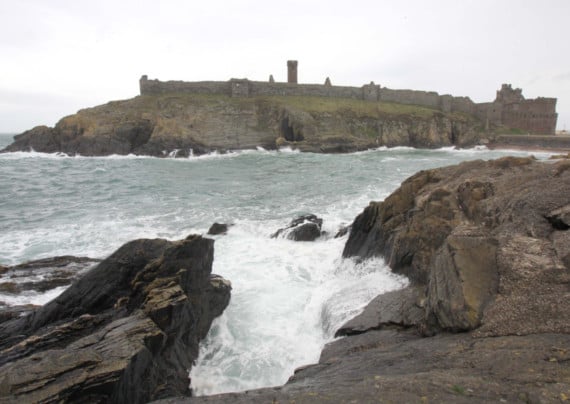
According to legend, Patrick first set foot on the Peel islet, where he built a church and which has ever since been called St Patrick’s Isle.
The remains of this earliest church can still be seen among the ruins of Peel Castle.


.png?width=209&height=140&crop=209:145,smart&quality=75)
St Patrick’s connection with the Isle of Man has to be prefaced with the words ’according to legend’ as there are no actual historical accounts of his ever having been here, other than stories that have been handed down the centuries.
It is said that St Patrick was returning from Liverpool to Ireland in AD444 with a band of 30 followers and landed in the isle of Eubonia (Isle of Man) where he found ’the people, as least the rulers, given to magic’.
But being overcome or convinced by his preaching and miracles, they were converted or else expelled from the Island’. (Sacheverell’s survey of the IoM, 1702).
St Patrick apparently stayed here for three years, converting the people by means of his preaching and his miracles.
He is said to have blessed the Isle of Man ’from end to end’, freeing it from toads, snakes and ’venomous beasts, visible devils and a multitude of magicians’.
This is a reference to the struggle going on in those days between Christianity and paganism.
The Isle of Man was the last resting place of Druidism and it was St Patrick who delivered the death blow by driving out Mananan-mac-Lheirr, the wizard king and his followers, who fled into the sea.
The historian Train wrote that, while in Man, the saint obtained ’fire from heaven to consume nine wizards clothed in white vestments, feigning themselves to be saints’.
Having established Christianity as supreme, he then appointed a bishop, Germanus, to oversee the further development of the Celtic Church.
There are several keeills (early churches) dedicated to Pherick (Manx for Patrick) and two parish churches bear his name â?? at Patrick and at Jurby.
In ’Portrait of the Isle of Man’, Canon Stenning noted: ’It is customary in the Isle of Man, in any matters dealing with all the parishes, to begin with Patrick and ’follow the sun’ round the island.’
Several holy wells also bear his name.
A.W. Moore wrote: ’On Corrin’s Hill, to the south of Peel, is Chibbyr Noo Pherick (St Patrick’s Well), which is said to have first sprung forth where St Patrick was prompted by divine inspiration to impress the sign of the cross on the ground.
He blessed the well, and the water is consequently supposed to be efficacious in all sorts of diseases, and as a preservative against the wiles of witches and fairies.’
Moore wrote about Chibbyr Pherick in Lonan where the saint is said to have stopped to drink on account of his horse having stumbled there.
If people passed this well and left nothing there, it was supposed that they would not be able to find their way home.
W. Cashen, former custodian of Peel Castle, related the legend that when St Patrick first came to the Isle of Man he crossed the channel on horseback, and, being pursued by a sea-monster, he put the horse up the steepest part of Corrin’s Hill.
On reaching the top, the horse stood still and a beautiful spring of water, at which both the saint and the horse refreshed themselves, sprang up at their feet.
This spring was consequently called Chibbyr Sheaant (Blessed Well), and the first Christians in the island are said to have been baptised there by the saint himself.
As in Ireland, St Patrick’s Day was celebrated here yesterday on March 17 and in former days, a fair was held at Peel, at which servants were hired for the year.
There is also an old saying relating to this day: ’On St Patrick’s Day, the ox to his stake and the man to his bed.’
This is thought to refer to an old country custom that on St Patrick’s Day, no light was to be lit once the sun had gone down.
It was supper at dark and then to bed, both man and beast.
A more sober contrast could hardly be found with today’s celebrations that usually revolve around record sales of Guinness.
Comments
This article has no comments yet. Be the first to leave a comment.