
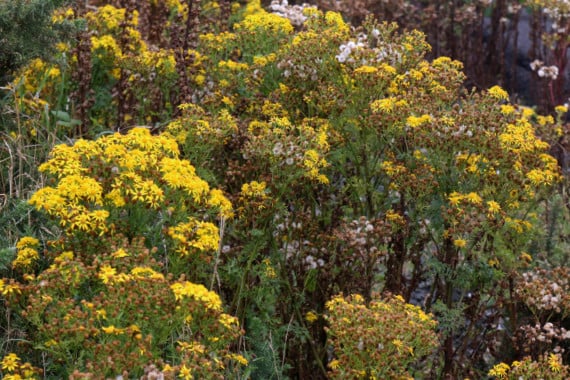
It is fair to say that cushag, more properly known as common ragwort (senecio jacobaea), is not universally popular even on the island where it is our unofficial national emblem.
It is a specified weed under the Weeds Act 1957. It contains toxins which can have debilitating or fatal consequences, if eaten by horses and other grazing animals and can cause great pain and suffering. People may also be at risk from ragwort poisoning through direct contact with skin.
At this time of year any cushag growing near land which may be used for livestock grazing or on fields used for the production of forage, should ideally have been pulled up and burned before the seeds from its yellow flowers can be distributed on the wind.
But, while many private landowners may have dealt scrupulously with their cushag it can still be easily spotted by anyone driving around the island, growing abundantly in many roadside verges which are the responsibility of the Department of Infrastructure. This has led to a number of complaints including the two readers whose letters have appeared in our papers.
.jpeg?width=209&height=140&crop=209:145,smart&quality=75)

.jpeg?width=209&height=140&crop=209:145,smart&quality=75)
So what is the current situation with cushag and why does it appear that it is not being dealt with effectively?
The Department of Environment, Food and Agriculture published a ’cushag code’ in July 2013 in which it states: ’This code does not seek to eradicate ragwort. Ragwort, as a native plant, is important for wildlife in the Isle of Man. It supports a wide variety of invertebrates and is a major nectar source for many insects including the rare heath bee-fly.’
The code has defined ’high’, ’medium’ and ’low’ risk areas. A high risk area is where cushag is present and flowering within 5m of land used for grazing by horses and other animals or land used for feed/forage production.
Under the Weeds Act 1957 the department, if satisfied that injurious weeds are growing upon any land, can serve a notice requiring the occupier to take action to prevent the spread of those weeds. An unreasonable failure to comply with a notice is an offence.
The code goes on to say: ’Responsibility for control rests with the occupier of the land on which ragwort is growing. When seeking to prevent the spread of ragwort it is expected that all landowners, occupiers and managers will cooperate and, where necessary, take a collective responsibility for ensuring that effective control of the spread of ragwort is achieved.’
The Department of Infrastructure has ownership and responsibility for control of weeds on its own land, which includes: the public highway, road verges (hedge base to hedge base) and Green lanes.’
This begs the question as to why the DoI is not setting an example to others, and preventing the problem from growing worse, by clearing it from its own land. A spokesman for the Department said:
’While Government is obliged to clear cushag from its roadsides and verges, it must prioritise this against many other demands on its budget and workforce. If the public has concerns about any particular area, it should contact the Department of Infrastructure via [email protected] or 850000. For advice on cushag, contact the Department of Environment, Food and Agriculture via [email protected] or 685835 or visitwww.gov.im/categories/home-and-neighbourhood/control-of-plants-advisory-service/injurious-weeds/.’
We shall leave the last word on the subject with Manx poet Josephine ’Cushag’ Kermode (1852-1937). Her poem, ’The Cushag’, seems to sum up how we should be treating our national flower:
Now, the cushag, we know,
Must never grow,
Where the farmer’s work is done.
But along the rills,
In the heart of the hills,
The cushag may shine like the sun.
Where the golden flowers,
Have fairy powers,
To gladden our hearts with their grace.
And in Vannin Veg Veen,
In the valleys green,
The cushags have still a place.
Comments
This article has no comments yet. Be the first to leave a comment.