
I am a big fan of the Commonwealth Games. This year's opening ceremony was held in Glasgow at the OVO Hydro indoor arena on Thursday.
Scotland has hosted the Commonwealth Games four times: in 1970, when they were held in Edinburgh; in 1986, when the event returned to Edinburgh; in 2014, when they were held in Glasgow; and again this year.
I was very fortunate to attend the 1970 Edinburgh Games as a 16-year-old supporter of the Manx athletics team. I remember distinctly the opening ceremony, held on July 16, 1970 at Meadowbank Stadium.
In particular, I remember the metaphorical hairs standing up on the back of my neck as, outside the stadium, the Scottish pipers tuned up in anticipation of their entry, with the stirring sounds of Scotland filling the air.
I was one of more than 27,500 spectators who welcomed 1,744 athletes and officials representing 42 nations. It was also a first for television, as the opening ceremony was broadcast live in colour, bringing the spectacle to millions of viewers in their living rooms.
The Games were officially declared open by Prince Philip, Duke of Edinburgh, and the teams were led into the stadium by Jamaica, who had hosted the 1966 Games.
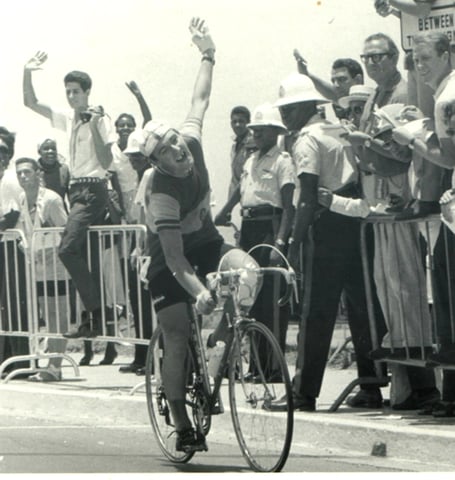
The Jamaica Games hold a special memory for Isle of Man sports fans. Peter Buckley was born in Peel and, although he had relocated to Oldham, remained a very proud Manxman who returned home regularly for training.
Peter Buckley celebrated his 22nd birthday in Jamaica while representing the island. He won the Isle of Man's first-ever Commonwealth Games gold medal in the gruelling 120-mile cycling road race.
He rode with tremendous determination, surviving a crash involving the leading group in the early stages before battling through tropical rainstorms among the mountain foothills.
He tackled slippery, winding, crumbling roads, potholes and even an unwanted puncture.
.jpeg?width=209&height=140&crop=209:145,smart&quality=75)
.jpeg?width=209&height=140&crop=209:145,smart&quality=75)
.jpeg?width=209&height=140&crop=209:145,smart&quality=75)
Many competitors crashed out, but Peter Buckley rode on to victory in a record time of just over five hours, finishing almost a mile ahead of the second-placed rider. The race certainly took its toll, and Buckley had to be helped from his bike at the finish line, soaked with both rain and sweat.
He later admitted just how difficult the race had been, particularly riding alone for the final 40 miles while battling extreme tiredness and even considering pulling out. Back home, he was greeted by thousands of cheering well-wishers at Ronaldsway Airport, where Peter quipped that the reception was ‘better than a Beatles welcome!’
A Government reception and presentation followed.
He went on to be crowned Isle of Man Sportsman of the Year in 1967 before returning to his demanding training regime in the hope of being selected for the next Olympic Games.
Along the way, he won the Manx International Road Race and secured top placings in both the Tour of Mexico and the Milk Race, Britain's premier amateur stage race.
Tragically, fate was to intervene. While out training in the Yorkshire Pennines in July 1969, Peter was involved in a collision with a loose dog and later died from his injuries. His ashes were interred at Peel Cemetery.
he 1970 Commonwealth Games saw a team of 13 athletes represent our nation. The defining highlight of the Games for the Isle of Man came from swimmer Alex Jackson, who won the bronze medal in the women's 200 metres freestyle.
Representing the island in the men's road race were cyclists Nigel Dean, who finished sixth, Ernie Potter in seventh, Brian Roche in 16th, together with Colin Bowen and Mike Kelly, who competed in both the road and track events. Mike produced a standout performance in the 10-mile scratch race, securing an impressive eighth-place finish against a world-class field.
In athletics and race walking, Alan Callow finished 13th in the men's 20-mile walk, while Parish Walk and Centurion legend John Cannell placed 15th. Unfortunately, Ian Hodgkinson did not finish.
In the sprint events, Brian Cowley finished sixth in heat three of the men's 200 metres and fifth in heat one of the men's 400 metres.
Representing the island in badminton were Peter Clague and Peter Kniveton, who both competed in the men's singles and doubles events. Anne Corlett represented the Island in the women's singles and also partnered Peter Kniveton in the mixed doubles.
Mike Kelly deserves further mention. Following the Edinburgh Games, he went on to represent the Isle of Man at the 1974 Commonwealth Games in Christchurch, New Zealand, competing in the sprint and pursuit events, as well as the men's road race. Once again, his standout performance came in the 10-mile scratch race, where he secured an outstanding eighth-place finish against another world-class field.
At the 1978 Commonwealth Games in Edmonton, Canada, Mike fought his way into the final of the 10-mile scratch race for the third consecutive Games, a remarkable achievement that demonstrated both his consistency and longevity at the highest level of Commonwealth competition.
Following the 1978 Games, Mike turned his attention to mentoring and coaching young cyclists.
Among those he helped was a future cycling legend, Sir Mark Cavendish, alongside many other talented riders who benefited from his knowledge and experience.
The Kelly family's involvement with both cycling and the Commonwealth Games was carried forward by Mike and Tina Kelly's son, Mark, who achieved the remarkable honour of also representing the Isle of Man at three Commonwealth Games.
Mark made history as the youngest cyclist ever to compete at the Commonwealth Games when, aged only 17, he took part in the 1998 Games in Kuala Lumpur, Malaysia.
He competed in the men's 20 km scratch race on the track, securing a highly impressive seventh-place finish. He also contested the men's 40 km points race and the 187.2 km road race. Like his father before him, Mark also had the honour of serving as the Isle of Man's flag bearer.
He went on to compete at the 2002 Commonwealth Games in Manchester, another event I was fortunate enough to attend. There, he finished 12th in heat one of the men's scratch race and also competed in the men's 187.2 km road race, which he unfortunately did not finish.
Mark was also involved in one of the most infamous incidents of the Manchester Games.
During the final of the men's 40km points race, an Australian rider, who was later disqualified, forced him into the barriers at the top of the banking. Mark slid around 25 feet down the track, triggering a major chain-reaction crash behind him.
Officials stopped the race for around 10 minutes. Despite the heavy fall and obvious bruising, Mark famously remounted his bike when the race restarted and battled on to secure a highly creditable seventh-place finish, demonstrating tremendous courage and determination.
One particularly sad memory of the Manchester Games for me was meeting Stephen Oake, a senior detective with Greater Manchester Police and the son of former Chief Constable Robin Oake, who was himself closely involved with the Isle of Man Commonwealth Games Association. Stephen was tragically murdered while on duty the following year, making that meeting one I have never forgotten.
Mark Kelly made his final Commonwealth Games appearance in Melbourne, Australia, in 2006.
He competed alongside fellow Manx cyclist and future Tour de France legend Sir Mark Cavendish, who won the gold medal in the men's cycling scratch race.
Mark Kelly reached the final of the men's 40 km points race and also competed in the men's road race, although he did not finish the latter event.
There are many more stories to be told of Isle of Man sporting heroes at Commonwealth Games level. For now, here is a round-up of medals won while representing our nation.
- Stuart Slack – Cardiff 1958 (Bronze), cycling
- Peter Buckley – Jamaica 1966 (Gold), cycling
- Alex Jackson – Edinburgh 1970 (Bronze), swimming
- Stewart Watterson – Edmonton 1978 (Bronze), shooting
- Nigel Kelly – Edinburgh 1986 (Gold), shooting
- David Moore – Kuala Lumpur 1998 (Silver), shooting
- Mark Cavendish – Melbourne 2006 (Gold), cycling
- Trevor Boyles and David Walton – Melbourne 2006 (Bronze), shooting
- Mark Christian – Delhi 2010 (Bronze), cycling
- Tim Kneale – Delhi 2010 (Bronze), shooting
- Peter Kennaugh – Glasgow 2014 (Silver), cycling
- Tim Kneale – Gold Coast 2018 (Silver), shooting
Good luck, Team Isle of Man, in Glasgow. Medals or not, we know you will represent our island in true sporting fashion!