
I am writing this in a muggy Manchester, luckily with a cooling fan in my room.
Soon off to the AO Arena, formerly the M.E.N. Arena. Thinking of home and hoping the weather improves for the 2026 Manx Grand Prix and Classic TT.
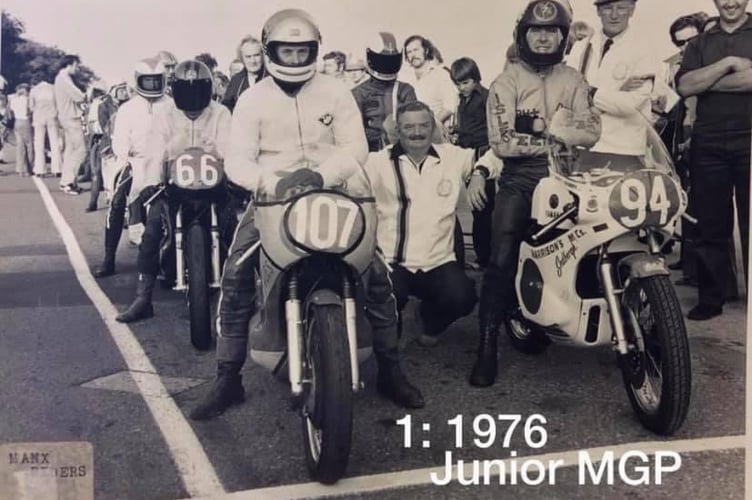
I was a newcomer in the Manx Grand Prix in 1976, 50 years ago.
A favourite photo is of myself next to Danny Shimmin and other Manx riders leaving on a practice lap.
It was a ‘different’ year for me. After a life-changing trauma in 1975, I took to drinking too much and wasn’t a nice person.
I took most of the summer off with one or two friends, much of which was spent on the wall opposite the Falcon Hotel, or diving and swimming in the sea nearby.
Obviously, I got myself together enough to compete in the Manx, which sadly didn’t go well, as my petrol tank split after a heavy landing at Ballaugh Bridge.
I felt a cold feeling in my groin region coming into Ramsey, discovering I was splashed with petrol. Although I wanted to bung some chewing gum on the tank to seal the crack and continue, the marshals rightly decided otherwise!
We have enjoyed a long, hot summer this year, although that itself has caused issues, most notably for those in agriculture.
Ironically, the summer of 1976 was a record breaker, spurred on by a massive, prolonged high-pressure system, with weeks of uninterrupted sunshine, drought and high temperatures!

It was also the year I did my first disco at ‘Allsorts’, the under-18s purpose-built disco in Wellington Street. I had been a big fan of Johnny Silver, the in-house Dutch DJ at the Cave Disco in the original Summerland, who would jump around and hit the roof in his DJ booth, something I attempted to mimic.
Some of those young people from Allsorts 50 years ago are still together, and I see them from the stage, still dancing and having fun.
Tonight’s night out for me is to see the Hollywood Vampires, which comprises Alice Cooper, Johnny Depp, Joe Perry and Tommy Henriksen.
The band was formed in 2012, and the name derives from a club of celebrities who would socialise in the 1970s, including John Lennon, Harry Nilsson, Keith Moon and Micky Dolenz. I saw the band in 2023, and tonight should be special!
Whenever I visit, I always call past the ‘Glade of Light’ memorial garden, built after the Manchester Arena bombing on May 22, 2017, where 22 people lost their lives after enjoying an Ariana Grande concert.
Those of us, as I have written here before, who were around in the 1960s and 1970s lived through special times in music and entertainment, when the visitor numbers justified organisations promoting acts for us to enjoy.
At risk of becoming a little boring, this is another reason to get behind the promotion of our island as a unique tourist destination. Then, as was previously the case, entrepreneurs would be more prepared to take risks, which would benefit the local population.
If we are wanting young locals to return, and younger, economically active people with skills we need to locate here, as well as the key issue of affordable housing, the night-time economy would become more buoyant and profitable for businesses.
Today, I thought I would look at the 1980s and since. Were you at the Palace Lido on May 26, 1984 when the Lido opened its hi-tech laser disco? Well done, Jimmy Gillespie, for encouraging this transformation.
It had lasers, sophisticated lighting, modern sound, dance music on a huge floor, and DJs including Stu Lowe, Mike Reynolds, Tony Rudd and Mark Beresford (what a nice guy he was). It went on to win the regional heat and UK national Royal Gold Discotheque of the Year title in 1986.
How about the ‘Hit Man and Her’ late-night TV show from the Palace Lido in 1989? Were you there? You helped put the Douglas nightclub on national television!
In the 1980s, there were numerous discos and clubs around the island. How many of these do you remember? The Cave, Nikki Dow, Hawaiian Bar, MGM, The Academy, Talons, Whispers, Dow Jones and more.
Paramount City was formerly The Crescent, and then Little Caesars. How good is it that, after all their hard work, the Quayle family have transformed and themed it and created a new life for this site to be enjoyed by a new generation. Many remember its previous life over two floors, downstairs for dance and rave music and upstairs for 1980s and 1990s pop.
The 1990s — yes, nearly 40 years ago — had a remarkable range of nightspots. Did you attend any or all of these?
The Tardis, which later became The Outback, is still a survivor in a challenging marketplace. Toffs in the Palace Hotel combined mainstream dance music and live acts. I went a few times, but I really wasn’t enough of a toff, really, although I know lots of people were!
I had forgotten, but downstairs in the Mannin, prior to its magnificent transformation under Keith Lord and family, was a nightspot called Reflections.
Again, I think this followed a number of prior identities. Indeed, I distinctly remember the premises hosting a cabaret and, as then Minister of Fun, ‘enjoyed’ the dubious honour of being the stooge for a knife thrower. Fortunately, even when he was masked, I survived to tell the tale!
The redevelopment of the historic Castle Mona Hotel has been ongoing over a number of years, and the inappropriate 1960s room additions have rightly disappeared. The premises has enjoyed a number of transformations over the years, including, in the 1990s, the successful Jimmy B’s and Studebakers.
The Castle Mona, before it was a hotel, was built in 1803/04 for John Murray, the 4th Duke of Atholl, who was Governor of the Isle of Man. The architect was George Steuart, who also designed the Red Pier and Ramsey Courthouse.
The building was constructed from white freestone brought from the Isle of Arran, and suggestions about the construction costs range from £30,000 to £40,000 - an enormous sum at the beginning of the 19th century.
The estate was much larger than we see today, with extensive lawns, gardens, terraces, a long entrance drive, lodges, stables, woodland and more. It was originally converted to a hotel around 1831.
Finally this week, a look at another building, not associated principally as a disco or live music venue, but because of its beautiful position. Diners in the evening, whether holidaymakers or residents, enjoyed magnificent sunsets whilst enjoying their food.
Closed in 2007, the Castletown Golf Links finally disappeared from the scene recently. It has sadly deteriorated over recent years in such a special location, so most will be happy to see a clean site awaiting a new development.
The golf course adjacent dates back to 1892 and is a really special part of our sporting infrastructure. It was originally designed by Old Tom Morris, then in 1913 by Dr Alister MacKenzie, who later became famous for his work at Augusta National in the US, and after the Second World War by Philip Mackenzie Ross, the architect associated with the famous Ailsa Course at Turnberry.
Looking forward to the next chapter on the former hotel site, complementing the special course.