
What was the first record you bought and do you remember where?
For ‘younger readers’, I’m talking about a 7” 45 rpm record known as a ‘single’.
They were first introduced in 1949 (which predates me!) by RCA Victor to compete with the Columbia 12” LP (long player). Originally designed primarily for single songs and jukeboxes, they became the standard format for pop, rock and soul singles from the 1950s through to the 1980s.
Prior to the ‘single’, the format and material used was a 10” shellac 78 rpm record, which made the newer version much more portable and durable than its predecessors. Using the expression ‘spinning a disc’, the new version circulated on your record player, radiogram, stereogram or music centre at 45 revolutions per minute. The original units, dating from the 1940s onwards, were considered an important piece of furniture in your front room, housing a radio and a shellac/vinyl record player inside a wooden cabinet. Later came reel-to-reel or cassette decks.
From the 1970s onwards came the ‘music centre’, a freestanding or tabletop unit featuring a turntable, cassette recorder and AM/FM radio receiver (often with built-in or detachable speakers). The later 1980s and 1990s evolution featured a stacked system, with features including dual cassette decks, a turntable, a CD player and a digital tuner.
Did you buy your preferred unit outright or did you rent?
My mum rented her TV from Colebourn’s in Victoria Street, and I don’t remember her ever having a fancy radiogram or the like. My dad had one, and it was admired as much as a piece of furniture rather than an entertainment provider!
Colebourn was founded in 1924 by TH Colebourn, and the business originally built and sold ‘Cleartone’ wireless radios before expanding into radiograms, record players, hi-fi systems and TVs. They became well known across the island for long-term rental contracts backed by their own field engineers.
Another provider, also based in Victoria Street, was Manx Radio Rentals, and the Manx Co-operative Society was another player from their Duke Street store, primarily through hire purchase (weekly payment plans) rather than open-ended rentals. Customers paid a deposit followed by weekly instalments, gaining full ownership once the final payment was made.
In the 1950s and 1960s, the Co-op also allowed customers to try out televisions and home entertainment sets in their own living rooms before committing to a purchase. Buying a high-value item like a radiogram through the Co-op was especially popular with local families because purchases earned a quarterly dividend (‘divi’) based on the member’s share number, effectively giving shoppers money back on expensive household goods.


As is often the case, I have drifted a little way from where I started…buying my first single!
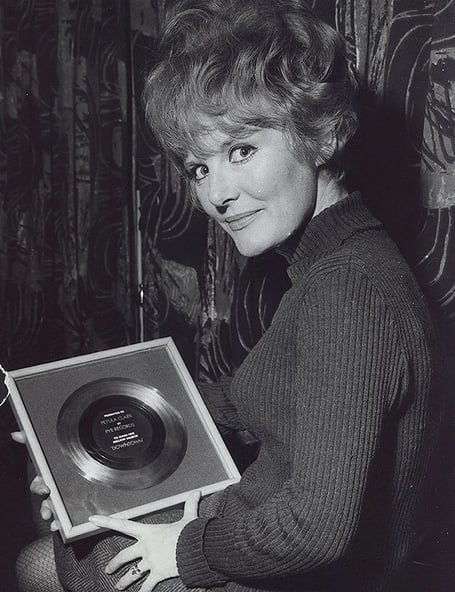
Well, it was ‘Downtown’ by Petula Clark, from 1964, written and produced by Tony Hatch, whose inspiration came after taking his first walk down Broadway in New York City, aiming to capture the bright energy of city nightlife.
Recorded at Pye Studios in London, the single featured top British session players, including Big Jim Sullivan and future Led Zeppelin guitarist Jimmy Page. The single reached number two on the UK Official Singles Chart in December 1964, spending nine weeks in the top 10. In January 1965, it topped the US Billboard Hot 100 at number 1, making Petula the first British female solo artist to top the US chart during the rock era. The song won the 1965 Grammy Award for Best Rock and Roll Recording.
Petula’s career spans more than eight decades. With more than 70 million records sold worldwide, she is the most commercially successful British female solo recording artist in history. She was born in Ewell, Surrey, on November 15, 1932 as Sally Clark and was given the stage name ‘Petula’ by her father, who joked that it combined the names of two former girlfriends, Pet and Ulla!
She made her radio debut at the age of nine in 1942 on the BBC, singing to boost morale for British troops during World War II. She quickly became a beloved national mascot, even performing in Trafalgar Square on VE Day.
Before turning 20, she had appeared in more than two dozen British films, including popular comedies like ‘The Huggetts’ series and ‘The Card’, alongside Alec Guinness in 1952. During her rise as a British pop and variety star in the 1950s, she performed live in the island at the Villa Marina in both 1953 and 1959.
In the late 1950s, she moved to France after meeting publicist Claude Wolff, whom she married in 1961. Recording fluently in French, German, Italian and Spanish, she scored massive European hits before her American breakthrough.
Teaming up with songwriter Tony Hatch, she became a leading voice of the British Invasion, and some of her major international singles included ‘I Couldn’t Live Without Your Love’, ‘Don’t Sleep in the Subway’ and ‘This Is My Song’, which was written by Charlie Chaplin.
In 1968, she made US television history on her NBC special when she touched the arm of guest Harry Belafonte during a duet, sparking a famous stand against a sponsor who objected to the on-screen contact. A year later, she joined John Lennon and Yoko Ono in Montreal to sing backing vocals on ‘Give Peace a Chance’.
She returned to the big screen in major musical roles, starring opposite Fred Astaire in ‘Finian’s Rainbow’ in 1968, which earned her a Golden Globe nomination, and opposite Peter O’Toole in ‘Goodbye, Mr Chips’ in 1969… a personal favourite of mine!
She also starred in other musical theatre epics, such as Maria in ‘The Sound of Music’ and the Bird Woman in ‘Mary Poppins’ in London from 2019 to 2023. She was appointed a CBE in 1998 and last week celebrated her 94th birthday…a true legend!
Where did I buy that single, aged 10 in 1964?
Well, it wasn’t Shocks. That was a really popular shop in Strand Street, which closed in 1997… and became Moochers. Remember that?
It could have been Kelly’s Records in Victoria Street, another well-remembered shop which stocked Manx folk music and local recordings alongside UK releases. Maybe it was Jim Mitchell’s Music Box, with branches in Douglas and Ramsey, known for weekly chart releases and top-20 hits. Jim was later a member of Douglas Town Council.
How about the original Boots? Who recalls going up a set of narrow stairs to a relatively small retail space, with the big advantage of individual booths where you could listen privately to the latest releases?
Hintons and HMV also had units in Douglas, but I know it wasn’t HMV, which operated from 1997 until its closure in 2016.
Does anyone remember the unique offering of LPs in the original Moochers in Wellington Street? I used to be employed by Viv and Mike Hooper, selling the records when the market first opened.
The fact is, I don’t remember where I bought my first record by Petula Clark, but I still enjoy its timeless optimism!
Fifty years ago, Mike and Viv trusted me to be a DJ in Allsorts Disco, the island’s only dedicated, purpose-built disco for under-18s, next door. Who would have imagined that I would still get the opportunity to spin discs, with two big events this Christmas!