
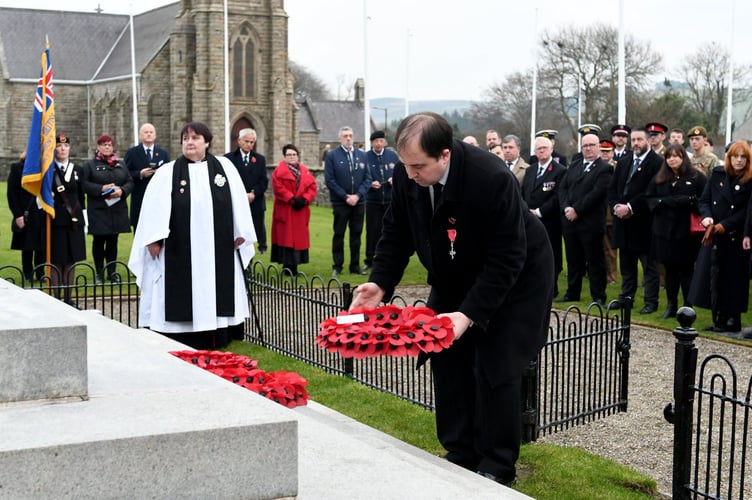
The island fell silent last week - firstly on November 8 for Remembrance Sunday, and then for Armistice Day on November 11.
It is important to learn from history, perhaps even more sharply focused in our current unsettled world, and I sometimes wonder whether we actually have done.
I am old enough to remember a number of conflict situations in my lifetime, with broadcast journalists reporting from the front line and also horrific images of genocides over the generations.
Many years beforehand, during the course of the First World War, 1,165 Manxmen out of a then-population of approximately 50,000 were killed.
Between 2,000 and 2,300 were killed, wounded, or missing (a high proportion of the population consisted of children and older adults due to young men traditionally emigrating for work).
This was a higher percentage than any other nation in the then-Empire, including the UK. A total of 8,261 Manx men enlisted in the Royal Navy, Army, and Air Force.
The island’s major tourism industry collapsed overnight, and the British government used the island to intern tens of thousands, notably at the massive Knockaloe Internment Camp, which held 30,000 civilian males. In Douglas, camps were situated in Hutchinson Square, the Promenade, and elsewhere, and among other places, Port Erin played its part.
During World War II, thousands of Manxmen and women served across the Royal Navy and Merchant Navy, including notable losses, one of which was TSS Mona’s Queen during Operation Dynamo in May 1940.
After attending the remembrance service at St Thomas’ Church in Douglas on Sunday morning, I went south to Port St Mary, where the anchor rescued from the ocean is placed in a peaceful setting in memory of those lost, and spent a little time there as a beautiful golden sunset formed a perfect backdrop.
In fact, this year at both ceremonies the sun shone brightly, even though it was chilly, against a lovely blue sky.



This was something of a contrast from last year when we could hardly stand on Douglas Promenade because of strong wind and rain.
However, I always think those young people who went from our island to far-off lands had no choice about the weather - they just had to ‘get on with it’.
The Manx National Roll of Honour records 494 Manx men and women who lost their lives during World War II.
Specific military service breakdowns list around 446 men and five women killed or missing on active service, alongside civilian air raid victims in Britain.
One particularly touching element of the National Service of Remembrance at the Royal Chapel at St John's is the reading out of a number of names of Manx personnel who did not return home.
The RAF constructed or utilised airfields at Ronaldsway, Jurby, and Andreas for coastal patrols, convoy escorts, and training.
In excess of 300 lives were lost in and around the Isle of Man in more than 200 local and navigational flying accidents.
Regarding enemy action in the island itself, historical records indicate no human casualties from German bombs in the Isle of Man, though local folklore occasionally recalls stray ordnance or minor incidents (such as a famous local anecdote of a single frog killed by a dropped bomb).
The island trained roughly 40,000-plus naval personnel in radar operation and medical duties, and hosted Army Officer Cadet Training Units.
Douglas Head housed a secret base for trainee codebreakers, and seafront hotels and boarding houses across the Island were converted into barbed-wire internment camps holding up to 14,000 people (including Italian resident aliens, Nazi sympathisers, and Jewish and political refugees from Germany and Austria classified as ‘enemy aliens’).
The Isle of Man has a long-standing reputation for generous giving to the Royal British Legion Poppy Appeal.
We consistently raise significantly more per head of population than the UK national average (yes, I know we aren't the UK!), frequently exceeding £1.60 to £1.79 per person compared to lower averages in the UK. The Isle of Man County Branch has won the Royal British Legion Poppy Appeal Trophy numerous times (surpassing 42 wins by the early 2020s).
As well as wearing a traditional poppy like others, I choose to wear a purple one remembering animals in war.
During the First World War, horses pulled guns, supply wagons, and ambulances. Dogs carried messages and were trained to take medical supplies to wounded soldiers, and some helped lay telephone wires. Camels carried wounded men, pigeons carried messages, and other animals played their part; they had no choice.
On my way to the Sunday service, I heard Judith Ley on Manx Radio in relation to this special time of remembrance. A piece I had never heard before - a variation on well-known words - was spoken. It touched me and I thought it should be shared. Taken from the Holocaust Memorial Day Trust website and written by Sylvan Kamens and Rabbi Jack Riemer:
We Remember Them
When we are weary and in need of strength, When we are lost and sick at heart, We remember them.
When we have a joy we crave to share, When we have decisions that are difficult to make, When we have achievements that are based on theirs, We remember them.
At the blowing of the wind and in the chill of winter, At the opening of the buds and in the rebirth of spring, We remember them.
At the blueness of the skies and in the warmth of summer, At the rustling of the leaves and in the beauty of autumn, We remember them.
At the rising of the sun and at its setting, We remember them.
As long as we live, they too will live; For they are now a part of us As we remember them.
As we head through autumn, we have had some really nice days with bright skies. It may be a little cold, but you can wrap up against that.
Among the things I most appreciate are the autumn colours from magnificent trees and reflections of such in the adjacent water. Having spent a little time this week in the arboretum near the National War Memorial, we should be so grateful for those who left our little island, some never to return.
-----------------
It was good to hear from Lindsay Quayle, who was in charge of the hotel between 1987 and 1994 and has happy memories of this beautiful spot.
Indeed, she would love to hear from you about your memories for a project she is working on, with a proposal to publish a book next year.
This will coincide with 40 years since she came back to the island and took over the hotel.
She already has some lovely stories and wants the book to be about the people who visited the Ballacallin and the village of Dalby, together with St James' Church - a historic, small Anglican church on the roadside, commissioned in 1839 by Bishop Ward and designed by architect John Welsh.
Beyond traditional worship, the site acts as a local hub, housing the Dalby Community Hub and a village shop offering Manx and Fairtrade produce. There is a range of events held on the site, including, of course, the World Bonnag Championships, held annually. Why not contact Lindsay on 422853 or by email at [email protected] with your thoughts?