
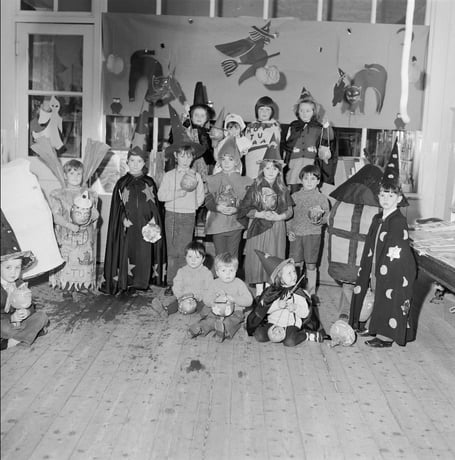
It’s that time again … do you have memories of Hop-tu-Naa as a child?
I certainly do! No pumpkins from America then! We called door to door with our carved turnips, or ‘moots’.
Inside was a small, real wax candle that had been lit before setting off. As we walked along, I can still recall the ‘aroma’ of burning turnip.
How did you carve yours, or did your parents take on the responsibility for this potentially hazardous operation? It was a pudding spoon for me, a bit blunt and hard work!
Calling around our neighbourhood, we would sing about Jinny the Witch. I cannot remember what, if anything, I received for my efforts. I think it might have been a few pennies to put towards some fireworks, which, as a 10-year-old, I could go and buy at the local shop!
There are many adverts for Hop-tu-Naa events taking place throughout our island this year, more than I can ever remember. They are all over social media, with exciting and sometimes scary images of what can be expected. If you are a Facebook fan, take a good look!
For this piece, I hope Culture Vannin don’t mind me sharing some of their online information, which is really interesting about all things Manx and always worthy of a skeet!
The origins and traditions of Hop-tu-Naa
Hop-tu-Naa marks the Celtic New Year (Samhain), originally Oie Houney or Hollantide Eve, signifying the transition from summer to winter. Traditions include songs, dance, recipes and stories about the legend of Jinny the Witch.
In the late 19th century, it was frequently called ‘Thump the Door Night’ because local youths would go around banging on neighbourhood doors with heavy cabbage stalks to demand food or money (or simply to cause mischief!). The shift to officially calling the evening Hop-tu-Naa only gradually solidified between 1912 and the 1930s.


A few things I have learned include the fact that gorse bonfires would be lit to ward off bad fairies, and that it was a tradition to steal the first salted herring from a neighbour’s house.
That reminded me of my dad putting down a big stoneware crock of salted herrings for him to take out and ‘enjoy’ over the winter. I was, I’m ashamed to say, as a genuine Manxie, never a fan. So, although I enjoy spuds cooked various ways, I wouldn’t be having them with salted herring! The way I do enjoy a herring is if it’s smoked into a kipper!
Other things I had never heard of included the fact that girls would guess the name of their future husband by making ‘Soddag Vallo’, or dumb cake (flour, eggs, shells, salt and soot!). The cake was baked and eaten in silence, and then the girl would walk backwards to bed to dream of her future husband!
They could also fill their mouths with water and hold salt in their hands, then visit their neighbour to overhear a conversation and listen for the first man’s name mentioned. It does seem like a lot of effort to me … Don’t have nightmares!
Ash reading
Have you heard of ash reading? Before sleeping, families smoothed out the hearth ashes flat. In the morning, if a footprint was found pointing towards the front door, it foretold a death in the family; if it pointed inwards, it predicted a birth.
Spooky words in Manx Gaelic
Culture Vannin have kindly translated a few spooky things into Manx Gaelic for us:
- Turnip – moot, of course
- Witch – buitch
- Ghost – scaanjoon
- Black cat – kayt doo
- Wizard – druightagh
- Bat – craitnag
- Magic – obbee ys
- Skeleton – ushylagh
Something that doesn’t have Hop-tu-Naa connotations is the use of Ghoolish on Corporation vehicles. Not spooky at all! It is actually the Manx Gaelic name for the town, now city, of Douglas!
How about Jinny the Witch?
It is said that Jinny the Witch’s real name was Joney Lowney and that she lived about 300 years ago in a cottage on the Ballaglonney back road, near where the Mount Murray Comis Hotel is today.
Joney was poor and used to go around the neighbourhood begging for food. It was noted, though, that bad luck often fell on those who refused her. ‘The cows would dry up, the horse would go lame, the hens wouldn’t lay’, and Joney got the blame.
But she was also known for doing good deeds. She gathered herbs in her apron and made potions with them. With each curse or cure, Joney’s reputation grew.
One night, a traveller arrived at Joney’s door. She offered the man some supper and made up a bed on the floor. As he drifted off to sleep, he saw strange shadows on the wall. He fancied he saw Joney stepping into a big basket and, with a whoosh, the basket, with Joney in it, flew out of the door.
Thinking he was dreaming, the man fell back asleep and slept soundly until dawn, when he saw Joney return with a whoosh and step out of the basket, which was full to the brim with fresh herring!
Soon, the story was all over the neighbourhood. Joney’s reputation as a witch, able to get her own way by magic, began to spread.
But she went a step too far when she upset one of the most powerful men in the island. She had gone along to the Bishop’s Mill at Braddan, where the bishop’s miller, William Corrin, was distributing sacks of flour to the poor.
When she saw the poor quality of the grain being used, she rebuked the miller in front of a large crowd of people.
‘You should be giving the best to the poor, not that rubbish!’ she shrieked.
At those words, the mill machinery stopped dead, and no one could get it going again - ever.
Joney was arrested and charged with practising witchcraft. She was found guilty and locked up in Peel Castle for 14 days.
She was also fined the sum of £3 and ordered to stand at the market cross of the four main towns - Castletown, Peel, Ramsey and Douglas - dressed in a long white sheet with a notice pinned to her chest saying ‘For practices in sorcery and witchcraft’ in big letters.
Her punishment might sound harsh, but, in fact, Joney got off very lightly. If she had lived in England or Scotland, she could have been hanged or burnt at the stake.
After her release, she returned home and, as far as we know, lived quietly ever after …
Hop-tu-Naa events this year
As I suggested earlier, there are more Hop-tu-Naa events advertised this year than I can ever remember. A few include the Groudle Glen Railway’s ‘Not So Scary Hop-tu-Naa Trains’, featuring steam train rides through the glen, a visit to Jinny the Witch’s lair, gifts for the kids and seasonal treats.
Other events include the Great Laxey Mine Railway, the Hop-tu-Naa Festival at Cregneash, a free March of the Zombies from Villiers Square in Douglas city centre, the MSPCA’s Bark in the Dark charity walk at South Barrule Plantation, and a Hop-tu-Naa party night hosted by Heroes on the Water at the Manx Legion Club in Douglas.
And so much more … Have a look on Facebook, as there are lots of other events for your spooky entertainment!
And don’t forget to get a supply of refreshments in for your ghostly-clad young visitors!