
Even the most ardent of cat lovers has to admit that their feline friend can be very aloof at times, and some recent research in Hungary has concluded that cats don’t need their owners emotionally at all.
That’s pretty devastating if you feel you have a close bond with your cat – are devoted cat owners simply deluding themselves?
The Hungarian study placed 15 therapy cats in a room either with their owner, a stranger, or both in what the researchers called a ‘strange situation test’.
They measured the cats’ attachment to their owners, anxiety when their owner was absent, and acceptance of a friendly stranger.
.jpeg?width=209&height=140&crop=209:145,smart&quality=75)
.png?width=209&height=140&crop=209:145,smart&quality=75)

Signs of attachment in cats included staying within a metre of their owner most of the time, when not exploring or playing, and watching their owner who was instructed to carry toy building blocks between two tables.
The same measures were used to track how the cats behaved with a stranger, with the results showing no significant difference in response.
There was also little difference in anxiety behaviours (such as hiding under a chair or following a person to the door), or lack of them, when an owner or stranger left the room.
And the cats in the study accepted a stranger into their space as enthusiastically, or unenthusiastically, as they did their owners. Friendly cats are likely to be just as responsive to a chin scratch from an owner or a stranger, and wary cats are likely to be equally uncertain of both.
The researchers concluded that cats can chose to be sociable with humans but they don’t depend on the help or security we provide.
This is because most cats are able predators and capable of catching their own food, even if they spend most of their time asleep on the end of their owner’s bed.
Over the centuries clever cats have learned that it is advantageous to be around humans, either because they could supplement their diet with human food scraps, or because our houses and farms came with an abundance if their main prey – rodents.
This feline independence is in stark contrast to the generally dependent behaviours shown by most dogs.
The researchers likened dogs’ reliance on human support to the relationship young children have with their parents. Like children, dogs can become anxious when left alone, they like to follow their owners, and they view their owners as a ‘secure base’ to which they can return when they are frightened.
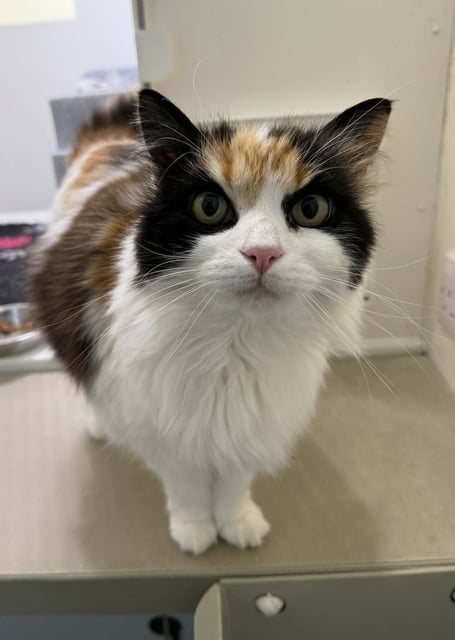
Pretty Izabella, who is also known as Izzy, is a 10-year-old girl who knows her own mind and who likes to have the upper hand in her relationships with other cats (most of whom she doesn’t like) and humans.
That said, she can be very friendly and she enjoys human company, having lived with an ‘at home’ elderly owner who has, sadly, recently died.
Izzy is used to having access to the outdoors, away from busy roads, but she can’t be adopted by anyone living in Port Erin in case she tries to make her way back to her previous home.
Cats are notoriously territorial, and having marked their domain they like to return to it.
Although Izzy seems to pride herself on her feline independence, she does need to accept a helping hand when it comes to grooming because she has a beautiful long-haired coat.
As she gets older she will find it increasingly difficult to self-groom the top of her back, or to detangle badly knotted hair, and so her owner will need to give her a gentle brush on a regular basis.
As with all our adopted animals, Izzy will go to her new home having had a health check from a vet, and she is vaccinated, microchipped and spayed.