
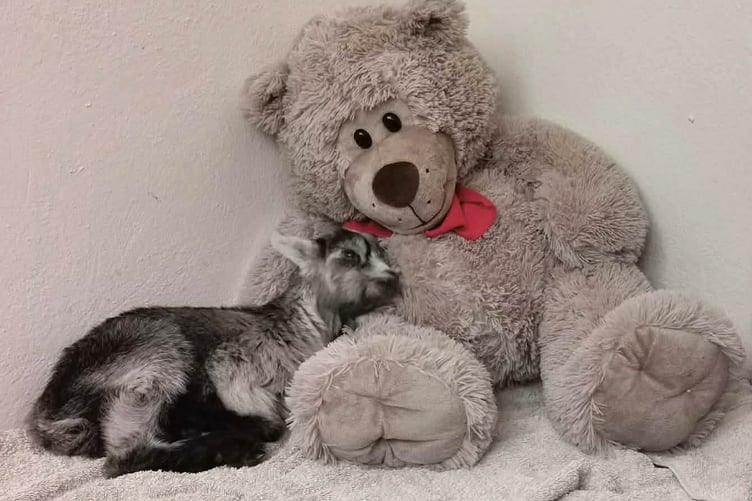
Meet Dolly, the feral goat kid.
She was brought to us a couple of weeks ago by a member of the public who said he had found her by the side of a road in Laxey, with no sign of her mother.
Dolly was about a week old and infested with hundreds of ticks, which meant that she was constantly scratching and agitated.
It’s possible that, even if she had been re-united with her mother, the infestation could have led to chronic anaemia and killed her – something that sometimes happens with feral kittens and young hedgehogs. It’s estimated that a third of feral goat kids die either from disease or predation.

-flat-bird-table.jpg?width=209&height=140&crop=209:145,smart&quality=75)
.jpeg?width=209&height=140&crop=209:145,smart&quality=75)
But Dolly was a survivor. Although she was skinny she had a zest for life and soon started to drink specialist milk from a bottle. In between feeding and sleeping, she allowed the MSPCA team to remove the ticks - some had buried deep into her skin and some were the size of a five pence coin.
Dolly spent a few days being nursed by a member of staff and they became very attached to each other, but goats are a very tricky animal to keep and we were fortunate that a local small holder agreed to take Dolly.
In the longer term, once she has been weaned, she will live with two other female goats who also started life as feral kids, in a paddock with very high, goat-proof fencing.
Whilst parts of the UK (Northumberland and Snowdonia, for example) are home to herds of native wild goats, called the British primitive goat, the ‘free-ranging’ goats in the Isle of Man originated from domestic stock and so, technically, they should be classed as feral rather than wild.
The goats’ ancestors are believed to have been a small privately-owned herd of around 20 European Mountain goats that escaped, or were released, about 75 years ago. Over the years, this herd is likely to have bred with other species of goat that were released as unwanted pets.
The island’s feral goats are a fairly common sight in the Dhoon and Laxey areas, and they seem to enjoy using the railway lines to move around that part of the coast.
There isn’t a credible estimate of feral goat numbers given the difficulty of surveying the terrain, but it is likely that there are between 100 and 200 animals.
Given the feral goats are a non-native invasive species, technically any animal that is captured should not be released back into the wild, and they are not protected by the Wildlife Act 1990.
Most residents view the goats as welcome neighbours but some do not, and there have been many calls for a cull over the years.
The Department for Environment, Food and Agriculture accepts that there has been little population management and that there is an ‘academic interest’ in the management of the goats, but that no formal evaluation is taking place at the moment.
The Department points out that there is a balance to be achieved between animal health protection and damage to woodland, versus the benefits that the goats bring – for example, unlike sheep they can graze the steep, rocky coastal cliffs which is of benefit to the chough (the only corvid with a red bill).
Whilst there are divided opinions about the feral goat population, goats have been favoured by many farmers over the years and they were encouraged to accompany flocks of sheep and herds of cattle.
A goat’s presence was, and still is on some farms, seen as a beneficial one because as a ‘wise beast’ it has a heightened sense of danger and can, for example, lead a flock or herd to shelter when bad weather is imminent.
Let’s hope wisdom prevails over the feral goats, and they can continue to be a beneficial part of the Manx landscape.