
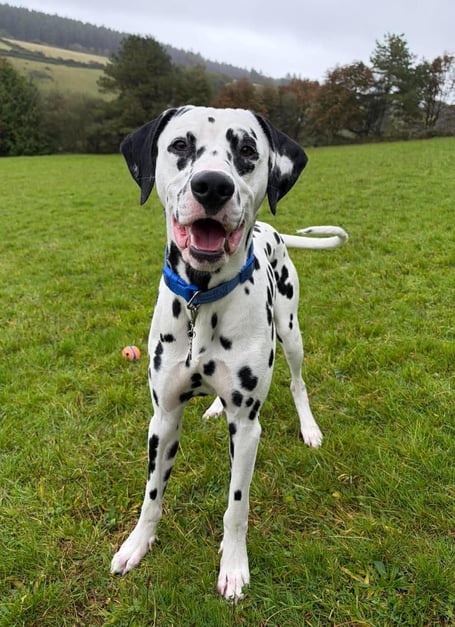
Meet Sparky (not Spotty!), a 10-month-old Dalmatian who has just arrived in our Kennels. We haven’t had a Dalmatian for rehoming since 2011 and so he’s a rarity, and this is reflected in the relative lack of popularity of the breed in general.
Most readers of this article will not be able to see a Dalmatian without instantly linking this distinctively-marked breed (whose spots are usually either black or brown) with the much-loved Disney classic ‘101 Dalmatians’ which was released in 1961.
As is so often the case (think ‘Lassie’ and the popularity of rough collies in the 1970s) the film generated enormous demand for the breed and this is when its population levels were at their highest.
But the Dalmatian is not just a 20th century cinematic phenomenon. It is steeped in history, although its exact origins are open to speculation and various theories suggest ties to different regions and cultures.
Some experts believe that the breed’s roots can be traced back to ancient Egypt, where spotted dogs are depicted in art and hieroglyphs. Others suggest connections with ancient Greece and Rome, with spotty dogs depicted on contemporary frescoes being used for hunting and guarding purposes.
One of the most compelling theories links the Dalmatian dog to Dalmatia, a region along the Adriatic coast in present-day Croatia.
The Dalmatian’s presence in Europe became more pronounced during the Middle Ages and the Renaissance when it was often associated with nobility and used as a carriage dog, running alongside horse-drawn carriages to protect them from bandits and other threats.
The number of dogs accompanying a coach demonstrated the wealth or status of its occupants. This role developed the Dalmatian’s endurance, agility and protective instincts which are still breed traits in modern day dogs.
The coach dogs of the Middle Ages lived alongside horses all their lives, not only running alongside them as they pulled a coach but sleeping with them at night to protect them against theft.
This close association, and natural affinity, with horses is probably how the Dalmatian found a new role in the 19th century as a ‘firehouse dog’ in the United States.



.jpeg?width=209&height=140&crop=209:145,smart&quality=75)
In the days before motorised fire engines the fire service used horse-drawn trucks, and the Dalmatians would run ahead of the trucks to clear the way and alert the drivers to dangers ahead, showing great bravery. Even after fire engines became motorised, Dalmatians were kept by many US fire stations as mascots.
So, why has the population of this much-loved historic breed, with its unique appearance and stand-out good looks, declined so much over the past couple of decades?
The answer lies predominantly in the fact that it was bred to be an energetic working dog, with endless stamina, and not a family pet.
Sparky is a perfect example of his breed. He is truly stunning to look at, and he adores people, but he is completely lacking in boundaries.
His boisterousness, and in particular his new-found reactivity towards dogs he doesn’t know, just became too much for his previous owner, who recently developed health issues which impacted on her ability to give Sparky the training he needs.
But he’s still a puppy, and he responds well to praise, rewards and routine, and so he will make the prefect addition to a new home as long as his future training is focussed and consistent.
His new home will need to be a very active one, with owners who have the time to invest into helping Sparky understand that life can’t always be lived entirely on his terms.
Thankfully a breed trait that Sparky hasn’t inherited is deafness – approximately 20% of Dalmatians are deaf in one or both ears due to defective genes. Although Sparky may not have any hearing issues, he chooses what he wants to hear (‘selective deafness’) depending upon what he wants to do!