
In the aftermath of yet another heatwave, and in the likelihood of another, we have further cautionary ‘hot dog’ advice following on from a previous article that cautioned against midday walks on hot pavements or sand, advised against encouraging your dog to play on very warm days, and suggested leaving your dog at home at this time of year when you need to go out in the car.
Avoiding heatstroke is a better approach than having to deal with it.
The hot weather makes us do things that we wouldn’t normally do, perhaps because we’re not particularly accustomed to extreme heat.
The advice not to plunge straight into very cold water, be it in a river, a reservoir or the sea, applies both to humans and dogs, because the temperature shock can cause loss of muscle control, and heart rate and blood pressure spikes.
But another summer hazard for dogs is less obvious because it’s one that us humans enjoy – namely, giving them treats like ice-creams, ice lollies or BBQ leftovers.
Ice-cream might appear harmless and a quick way to cool down a hot dog, but dogs generally don’t digest dairy products very well, especially if they’re not used to them.
In some dogs even a small amount of ice-cream could cause diarrhoea which will lead to dehydration – the exact opposite of what’s needed when it’s hot.
Moving on to ice lollies: some may include ingredients such as xylitol, chocolate or raisins that are poisonous for dogs and, at the very least, could cause vomiting which, once again, is dehydrating.
And BBQ foods may seem harmless but sausages, burgers and the sauces they come with may contain onions, garlic, chives or leeks which can all be hazardous to dogs. Simply changing a dog’s diet so suddenly can cause digestive upset, even if the food isn’t intrinsically toxic.
Healthy dogs can usually eat ice and drink cold water without any issues. And if an owner wishes to offer their pet something frozen, it should be what the dog eats as part of their normal diet.

.jpeg?width=209&height=140&crop=209:145,smart&quality=75)


This could be a piece of frozen carrot, for example, or a Kong filled with frozen gravy.
It goes without saying that access to shade and plentiful fresh water are the most effective ways to keep a dog, or any pet for that matter, comfortable in hot weather.
Cats are generally better able to cope in hot weather than their canine counterparts but elderly, overweight and flat-faced felines will need extra care.
Flat-faced dogs such as pugs, French bulldogs, Shih Tzus and boxers are particularly susceptible because their ability to release heat through panting is restricted and they can only perspire through their paws.
Most pet owners will already be aware that wet food left out for pets quickly attracts flies that lay eggs in a matter of minutes, and so any left-over food needs to be removed straight away.
It’s also helpful to be reassured that some pets may eat less than usual in hot weather, and that this is not always a concern if they are otherwise bright, drinking normally and behaving as expected.
However, if a pet stops eating completely, becomes lethargic, vomits repeatedly, has diarrhoea, drools excessively, appears weak or seems confused, an owner should seek veterinary advice.
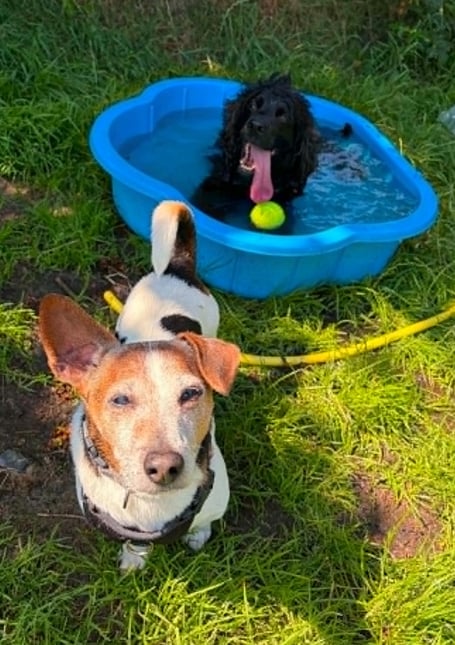
As you can see, Wilson, the eight-year-old cocker spaniel, is doing his best to keep cool in a paddling pool.
He’s a naturally very active dog and so he could easily overheat if we indulged him in as much exercise as he would normally need. He is still looking for an energetic new owner who is happy to rehome him along with his best friend, 13 year-old Jack Russell, Harvey.
We’re very surprised that these two dogs are still with us because they are such lovely boys, but they are one of three pairs of dogs in our kennels at the moment and pairs are a problem - double the amount of care needed, and potentially double the cost. But you also get double the pleasure!