
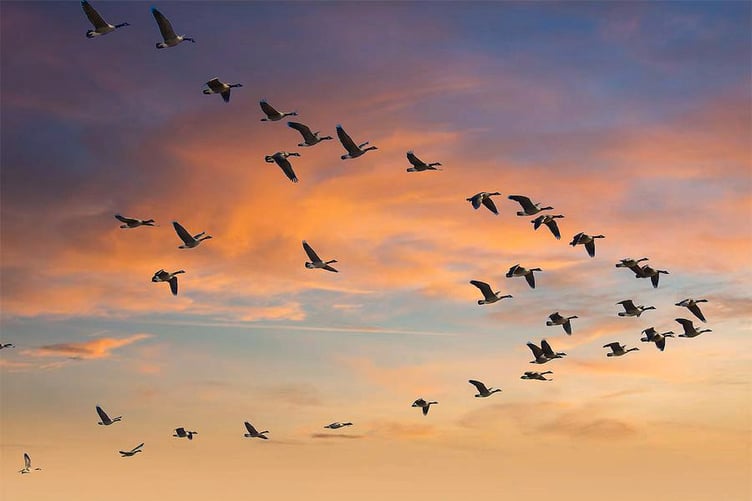
September marks the start of the traditional autumn migration season for birds that fly to warmer, southerly climes for the winter months.
Swallows and house martins are usually the first to leave, followed by gannets and turns, undertaking perilous journeys of many hundreds of miles to places as far away as South Africa.
The graylag goose, though, is usually one of the last to leave and this lagging behind accounts for the ‘lag’ in its name. Many move south or west in the winter, although some are resident and live here all year round.
Despite their reputation as being late migrants, there does seem to have been a lot of geese activity over the last couple of weeks. It’s one of the wonders of autumn to see birds flying in a ‘V’ formation across the morning and evening skies, often at quite low levels, constantly communicating with each other in a cacophony of honking.
Some commentators are suggesting that earlier than usual migratory activity is a sign that we’re going to have a harsher than normal winter…let’s hope that’s not true.
Back to the birds themselves: what does a graylag goose look like?
As the ancestor of most domestic geese (the white ones) it shares a similar body shape in that it is one of the largest of the goose family, with a rotund, bulky body, and thick and long neck, and a large head a bill.
Their legs and feet are pink and their bills are either pink or orange; and their plumage is greyish brown in colour with pale fringes on the feathers.
Numbers of graylag are swelled at this time of year by visiting migrants from other parts of the UK and from Iceland, who leave their summer breeding grounds and spend some time living alongside our feral population. If you’re lucky you may also spot the odd pink-footed goose as it makes its way south.
Why do geese fly in a ‘V’ formation (also known as a skein)? The most likely explanation for this behaviour is that the formation reduces the energy needed to fly, with each bird riding on the air current caused by the wings of the bird in front.
.jpeg?width=209&height=140&crop=209:145,smart&quality=75)

.jpeg?width=209&height=140&crop=209:145,smart&quality=75)
Saving energy in this way could make the difference between surviving a migration, or not. Given the bird in front doesn’t benefit, each bird in the group will take its turn as the lead bird in an amazing display of aerial acrobatics.
You may not consider the blackbird to be a migratory species, given we have so many in our gardens all year round, but many fly across the North Sea at this time of year. They leave colder climates in Scandinavia to settle in the UK, although some continue with their journeys further south to France and Spain.
While these birds are arriving in the UK, many resident breeding blackbirds will be on the move too, heading south in search of milder conditions. So, it is likely that you could spot Scandinavian blackbirds feeding alongside local birds, and whilst they are difficult to tell apart it is just about possible with careful observation.
Male Scandinavian blackbirds are generally longer winged and have a dusky black appearance, whereas the local birds are generally shorter winged and a glossier black.
Female Scandinavian birds will be longer winged too, and somewhat darker than their shorter winged, warm-brown resident cousins.
Autumn is a truly magical month for bird spotting, and for marvelling at the migratory species and the journeys they have been on – their navigation skills and their stamina.
But, sadly, this activity also heightens the spread of avian influenza, a disease that has had a devastating impact on birds over the last few years. A timely reminder, then, that if you come across a wild bird that seems unwell you need to take precautions such as wearing gloves, and phone ahead if you’re taking the bird to a vet so that quarantine procedures can be put in place.