

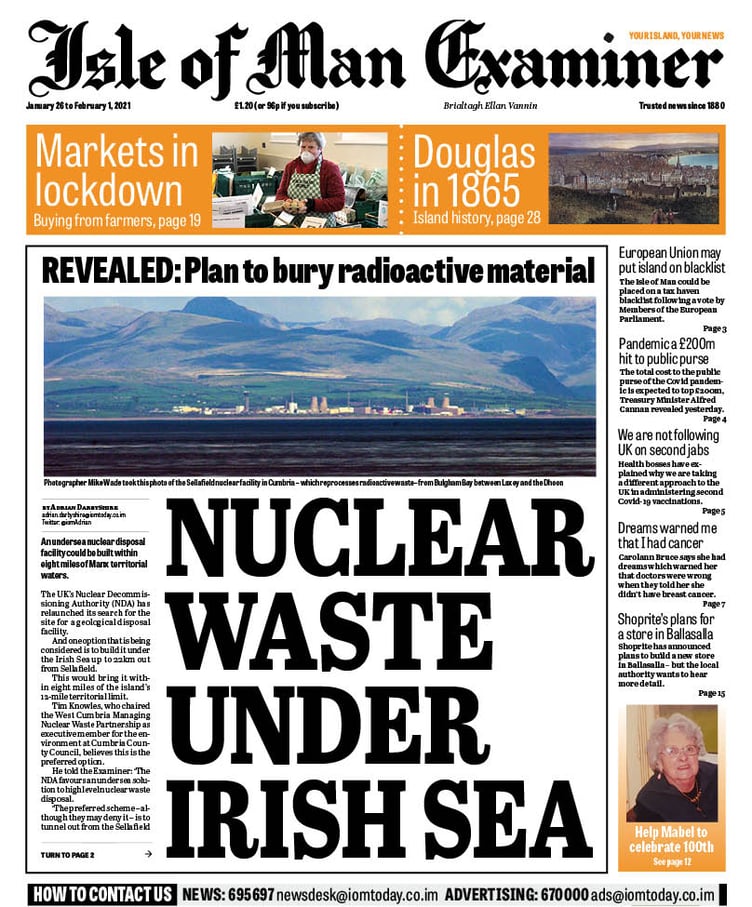
Almost 50,000 people have signed a petition against the testing of deep geology under the Irish Sea.
UK Government organisation Nuclear Waste Services (NWS) plans to test the geology offshore of Copeland in western Cumbria, around 45 miles from the Isle of Man, but the blasts from the seismic air guns used will have effects across the Irish Sea.
It is looking at ways to dispose of hot nuclear wastes and under the Irish Sea is being ‘actively considered’, according to petition starter Radiation Free Lakeland, which runs the campaign Lakes Against Nuclear Dump (LAND). Seismic testing is preparation for the ‘delivery of a geological disposal facility’.
The Sellafield debate has been a big issue in the Isle of Man because of its proximity to the island. Environmental groups here have campaigned against development there.

-and-Aoife-Cogan-(right).jpeg?width=209&height=140&crop=209:145,smart&quality=75)

.jpeg?width=209&height=140&crop=209:145,smart&quality=75)
The government has also campaigned against the plant.
The seismic testing is due to take place from August 1 to investigate the geology off the coast of West Cumbria for a sub-sea high level nuclear waste facility known as a geological disposal facility.
On Tuesday, the executive of Copeland Borough discussed the petition of over 48,000 signatures and there was a demonstration ahead of the meeting outside the Copeland Centre, Whitehaven.
Radiation Free Lakeland has said it is ‘grateful for the opportunity’ to speak to the council executive but argues that this meeting to discuss the petition and the seismic testing costing the public £7.5 million should be heard by the full Copeland Borough Council.
Marianne Birkby, co-ordinator of Radiation Free Lakeland, said: ‘The full council has been denied a voice at every stage of the decisions.
‘Even the decision to join the partnership with Radioactive Waste Management Ltd and Nuclear Waste Services was taken by just four people on the council executive.
‘The full council along with the public and neighbouring Irish Sea countries have had no voice as to whether or not the damaging seismic survey in this supposedly protected area of the Irish Sea should go ahead.’
The campaign group commissioned a report into Nuclear Waste Services’ seismic undemocratic and damaging seismic testing plan.
The report, written by marine expert Tim Deere-Jones, concludes that the NWS has adopted ‘a very secretive approach’. It said NWS has avoided public consultation, peer consultation (with academics, marine wildlife groups, government agencies across Irish Sea), and the public disclosure of documents.
The report said: ‘In claiming that the survey is being conducted for a “scientific or educational purpose”, NWS is misrepresenting the true purpose of the survey which it specifically to further a commercial proposal to construct a sub-seabed infrastructure, a nuclear waste dump, rather than for the disinterested pursuit of scientific knowledge.
‘All the research conducted by NWS has been desk-top using third-party sources rather than first-hand on the ground field research.’
NWS senior project manager for geosphere characterisation, Chris Eldred, said to this: ‘A deep Geological Disposal Facility (GDF) will protect future generations from the risks of keeping hazardous radioactive waste in surface stores for thousands of years. It is one of the largest environmental protection projects in the UK.
‘To help us with this vital work, we will undertake surveys to provide a better understanding of the deep geology beyond the coast, while doing everything we can to minimise any environmental impact.
‘These surveys will use sound waves, the same technology that’s routinely deployed world-wide in industries such as offshore wind, carbon capture & storage, and major infrastructure projects, and along the lines of that used in medical ultrasound imaging.
‘We are committed to environmental protection and have complied with the all the processes relating to any permissions required for the surveys.
‘We respect all views and welcome constructive, peaceful dialogue with all who are interested in learning about the GDF process.’
Comments
This article has no comments yet. Be the first to leave a comment.