
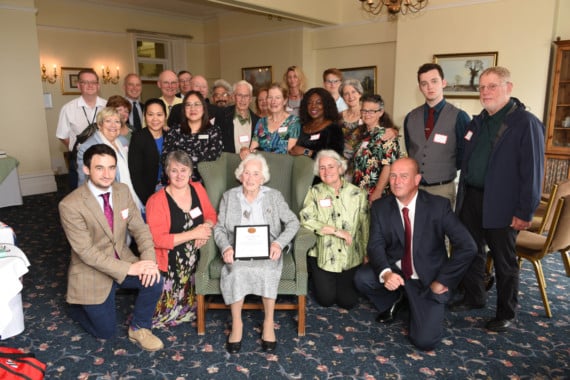
Sitting in a chair in Elder Grange nursing home with her daughter by her side, Ann W. Grace is a special lady.
Recently decorated by the American Red Cross for her dedicated services in the Pacific during the Second World War, she really has led an extraordinary life.
Ann grew up in Massachusetts with her six siblings who were initially home schooled before her mother decided to go back to university.
She said: ’Prior to that, she had been teaching us at home, so I didn’t go to public schools, I was taught by my mother.
.jpg?width=209&height=140&crop=209:145,smart&quality=75)


’She called up the local school department. She had been a qualified teacher so she said she wanted eight desks because she was going to teach her children at home.
’So they sent eight desks, and we had had this bay window. The window was gone and the desks were there.’
Later on, Ann went to Radcliffe College which is part of Harvard where she was lectured by the great Russian sociologist Pitirim Alexandrovich Sorokin, best known for his role in the development of social cycle theory.
After she graduated, Ann went on a training course to become a buyer in Boston.
Then she moved onto New York where she became a copywriter.
By this time, the war has well under way.
While at Harvard, she met her future husband, Henry, who was also at Harvard on the night of his farewell party before he came back to the UK to help the war effort.
She said: ’I decided I wanted to take another look at him and everyone I knew who had joined the Red Cross had gone to England or to the Continent [Europe]. So I thought oh, I’ll join up too.
’But things had moved faster than I realised. Instead of eating an English breakfast, I found myself in the Hawaiian islands.’
After training, Ann pictured below found herself being sent across the South Pacific on a boat called the Titulinka as the American army pursued the Japanese across the ocean.
During this time, she visited many islands but one sticks out particularly in her mind.
’I think the most exciting, most interesting experience there was when we went to one of the islands and a man, supposedly a chieftain came out to meet us on two boats tied together with a bridge across.
’He was standing on the bridge, absolutely stark naked, except for blue stripes all over, he was painted blue and he was welcoming us.’
Ann explained how during this time, she learned how to hide in fox holes when Japanese aircraft swooped down to attack and that if a plane crashed. If a plane crashed, the plane and bodies would be looted. She said it was ’awful and a terrible way to treat humanity’.
Ann explained that the group she was attached to would have been the front line support in the event of an American invasion of Japan.
She says: ’Fortunately for us, the atom bomb was dropped. We had no idea what it was all about, we couldn’t comprehend it or its effect. This next day the Roman Catholic priest gathered us all together and said this was the most terrible thing for humanity to have done, just awful and we began to realise that something terrible had happened.’
That experience leaves Ann determined that the world should never engage in war and that the lessons of the past have to be learned by today’s leaders.
After the war, Ann went back to America, to Seattle. She had many letters waiting for her from her future husband and he then came to visit America many times.
Ann said: ’Henry claimed he kept coming to America to look up his old friends but anyway he saw enough of me and I saw enough of him to know we wanted to marry.
’In fact, I was sitting on the steps of a plane at Boston Airport when he proposed to me. Again, not very romantic, but it did for us.’
After their marriage, Ann and Henry moved around a lot because of his engineering qualifications being much sought after.
This included stays in Hong Kong and Nyasaland (now Malawi) before they settled in the UK to have children.
Tragically, Henry had an accident while cliff climbing in Cornwall and died.
So how did Ann end up in the Isle of Man?
She explained: ’I had a friend, whose life had been similar to my own, moving about, neither of us had ever been to the Isle of Man.
’So we took a holiday here, but we got here on a Sunday, and in those days, all the shops were closed on a Sunday.
’So we went from an estate agent window just because we were curious how people lived. Then we found this flat, and I just fell in love with it, it has an incredible view, so that’s how I ended up here.
’I bought it for no reason other than the island is so beautiful.’
Before we finished, Ann had a few words she wanted to say to the Manx people.
She said: ’I want to say, I bought my place in 1993, and since that time, I have found the local people are most thoughtful and generous, they couldn’t be nicer.
’When I find myself talking to a born and bred Manx person, I’m very happy, because there is something special about the local people in the island.
’I think it’s because they have such a mixed ancestry themselves so they understand strangers, they are truly remarkable. And the scenery here is just gorgeous.
’My daughter says "the Isle of Man is like an undiscovered treasure".’
Comments
This article has no comments yet. Be the first to leave a comment.