

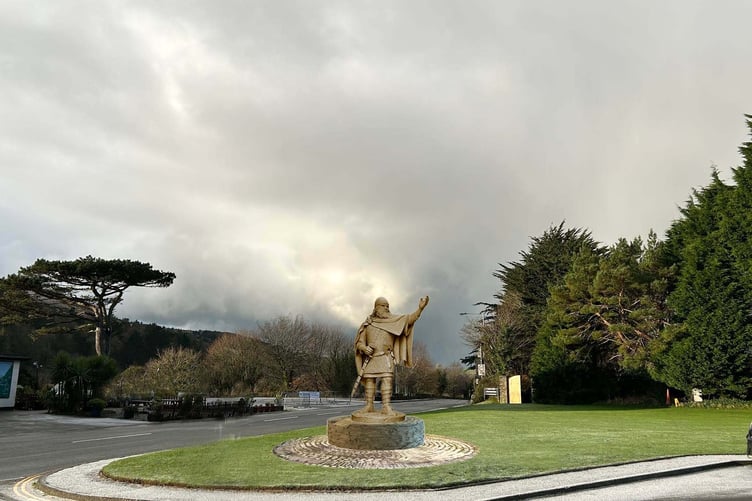
Manx National Heritage (MNH) appealed against the decision in August last year to allow the plans at St John’s to proceed.
The application (25/90193/B), submitted by Tynwald president Laurence Skelly, was unanimously approved by the planning committee in July despite being recommended for refusal.
However, MNH lodged an appeal having previously objected to the sculpture, expressing concerns about its historical accuracy and claiming the applicant had ‘fallen into the trap’ of conflating folklore with heritage.



.jpeg?width=209&height=140&crop=209:145,smart&quality=75)
That appeal has now been dismissed by Environment, Food and Agriculture Minister Clare Barber, following a recommendation from independent inspector Frances Mahoney.
She said: ‘The proposal positively contributes to the cultural and landscape setting of Tynwald Hill through the introduction of a modest, symbolically significant sculpture that enhances public appreciation of the island’s Norse heritage.
‘Its scale, siting and design are considered appropriate to the context.’
Mrs Barber accepted the recommendation that the appeal should be dismissed and the application approved, subject to conditions.
The conditions include that an archaeological Written Scheme of Investigation (WSI) must be submitted and approved by DEFA.
If any historic or archaeological features not previously identified are found during the works, those carrying out the development must leave them in situ and report them to the Department within two working days.
In its appeal, MNH said the planning committee had ‘disregarded’ its concerns.
It said: ‘The appeal is made following the Planning Committee’s decision to approve the application and, in doing so, to disregard the professional opinion and recommendations of MNH and the Planning and Development Control Directorate of DEFA, which were grounded in policies set out in the Isle of Man Strategic Plan.’
The appeal went on to set out reasons why the application should have been refused.
It said: ‘In particular, the written submission of MNH drew attention to the negative effect of the proposed development on the setting of a site of archaeological interest and the omission of any planning statement demonstrating how the applicant had considered the impact of the development on the surrounding environment.’
MNH also raised concerns about the potential for damage to and disturbance of Tynwald Hill, one of the most important archaeological sites on the island.
MNH questioned the historical basis of associating Godred Crovan with the Milky Way and the title ‘King Orry’, citing 19th-century myth-making and a lack of evidence in medieval sources.
However, local historian Charles Guard insisted the site had been very carefully considered and said an archaeological assessment had already concluded the specific plot was ‘unequivocally clear’ of archaeology.
He said Godred Crovan was a ‘historically attested’ figure and the sculpture would not affect the main Tynwald site.
The statue, which will stand at just under 3m in height including its plinth, has been privately funded.