
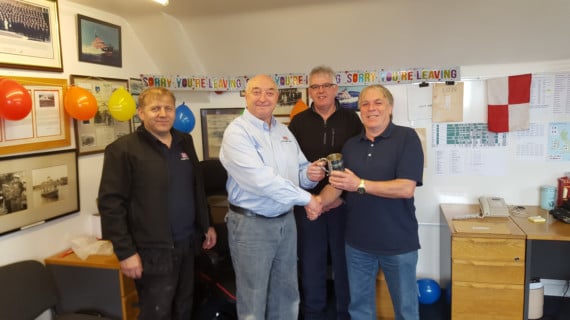
After being involved for an astonishing 47 years, Michael Kneale has retired from Port St Mary lifeboat.
When he joined, aged 17, in January 1970, recruitment was certainly more casual than it is today.
’Like many likely lads around the harbour at that time, I had unofficially been invited out on the occasional exercise even before that,’ he said.
In all the hundreds of services, requiring courage, steely nerves, intense focus and determination, it is the memory of a crew member’s smelly feet that stands out.
.jpeg?width=209&height=140&crop=209:145,smart&quality=75)
Michael’s first ’away’ trip on the lifeboat Colby Cubbin II (a 47-foot Watson with twin 40hp diesels and a top speed of eight knots) was a salutary lesson.
The boatyard in the Menai Straits had completed a re-fit and a crew had to go and bring it home.
This meant ferry and train travel and an overnight stay.
He said: ’The crew celebrated their night away in traditional style - I tried to keep up with the hardened quaffers.
’It was with vague surprise much later, to find that the crew were sharing beds in the guest house, arranged nose to tail - the only time I ever had to sleep with another man’s smelly feet under my nose.
’’An early start with the hangover from Hades got even worse when one of the engines stopped as the boat passed Puffin Sound, 15 minutes after leaving.
’The mechanics aboard agreed that if the yard couldn’t make the engine work at re-fit, they’d take the boat home and sort it out themselves. So, they carried on with the one engine, at less than five knots. I wished I were dead for the next ten hours.’
starship
Two years later the Watson was replaced with what he said seemed like the Starship Enterprise at the time. The 54-foot Arun class lifeboat ’Gough Ritchie’ had twin 460hp diesels and a top speed of 19 knots.
For some years it was the only fast lifeboat in the North Irish sea and Michael remembers one unusual nine-hour shout - to another lifeboat.
’Four days before Christmas 1984, Norman Quillin got a phone call from RNLI HQ, at 4am, requesting we go the aid of the Workington lifeboat, which had collided with a fishing vessel it was trying to help and damaged its own rudder, making the boat impossible to control in the gale.
’We found the Workington boat anchored in breaking seas not far from its home port and managed to tow it in - their crew didn’t seem too happy for some reason. The fishing vessel washed up on the beach and its crew scrambled ashore before it broke up.’
Johnny Williams was appointed coxswain in 1987 and Michael was first deputy and then became full second coxswain in 1996.
Michael’s father Philip was for many years on the lifeboat branch committee, serving as chairman 1977 to 1982. His brother Tony was also on the crew 1972 to 1986 as assistant mechanic.
In 1998 the station was allocated the Trent class lifeboat Gough Ritchie II.
The Trent has performed dozens of services. With twin 840hp diesels, it has a top speed of 25 knots - three times what the old Watson could make.
casualties
’This high speed can’t always be used of course,’ he said. ’If the weather and seas are bad, caution is required to preserve the boat and crew. There’s no point in creating your own casualties.’
Dave Richards was appointed coxswain in 2002, when Johnny Williams retired aged 55. A change in policy means and crew now go at 65, which is why Michael has been able to serve for over 47 years.
Michael has received two framed RNLI letters of thanks for his part in particular shouts.
In April 2000 the Trent was launched to assist a home-built sail boat Maggie Ellen in difficulty not far from the Morecambe Bay gas rigs.
Michael and George Platt jumped across to board the yacht when Johnny Williams managed to get the Trent momentarily alongside it.
The other letter was for Michael’s action as coxswain helping a large beam-trawler.
’It was 20 miles east of Langness, with its rudder locked hard over to port so couldn’t make any progress in the near gale. The trawler, 10 times the weight of the lifeboat, was very slowly towed into Port St Mary and manoeuvred with difficulty alongside several other beamers sheltering at the breakwater.’
He said: ’All lifeboat crews deal with a huge variety of maritime emergencies but tend to remember those at the ends of the spectrum between success and sadness.’
In 1976 Eric Quillin and Michael rescued a girl being blown outto sea in a toy dinghy.
frightened
’She was outside the Carrick by the time the inshore lifeboat reached her. She’d had the sense to stay in it but was very cold and frightened.
She was taken back to her mother on the beach. He said that ’the joy, relief and gratitude in that lady’s face’ confirmed his commitment to the service.
He said: ’It’s all a team effort, both at sea and fund-raising ashore. More volunteers at all levels are always needed for this very worthwhile cause.’
Comments
We've recently changed our login process. If you have an account for commenting, you will need to re-register on the login window.
This article has no comments yet. Be the first to leave a comment.