
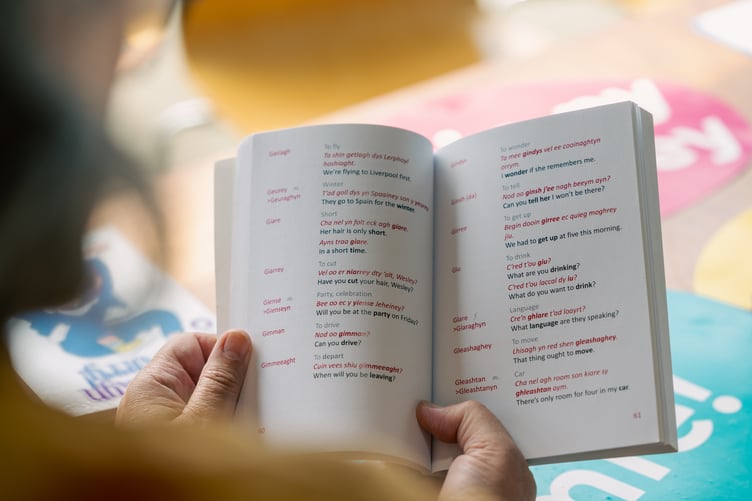
Each month, Culture Vannin’s Manx language development officer, Ruth Keggin Gell, contributes a column to Island Life.
I'm surrounded by flashcards, games and teaching materials. Scoill Souree – Culture Vannin's Manx Language Summer School for adults – has just taken place, and as we sort through everything, it’s got me thinking just how far Manx language resources have come in recent years.
We now have a great range of resources to support people learning Manx. Whether you’re a fledgling learner, a confident speaker, or someone who wants to learn independently, there’s something for everyone.
Culture Vannin’s website LearnManx.com is a learning hub which brings together thousands of resources. You’ll find things such as a spoken dictionary, where you can hear the pronunciation of vocabulary; Podcast Gaelgagh – an engaging ‘podcast’ where two learners are taught Manx in real time; and even a chatbot where you can practise your reading and writing skills.
The website also hosts our four-part Loayr Gaelg (Speak Manx) course materials, including 40-plus hours of supporting sound files.
Prefer videos? There are hundreds on the Learn Manx YouTube channel, covering a wide variety of topics. If reels are more your thing, social media accounts such as @un_ockle, @ceol_eoin_macuilleam and @bunscoillghaelgagh regularly share fun and interesting content. Manx Radio also broadcasts programmes and podcasts in and about Manx.
Online games are another great way to practise or pick up new vocabulary. LearnManx.com/games brings together scores of games, including some created by Skimmee Gaelgagh – the Department of Education, Sport and Culture’s Manx language service, who teach in the island’s schools. For younger children and families, look to the website of Manx language charity Mooinjer Veggey (Little People).
If books are more your thing, Bridge Bookshop, the Book Company and Manx National Heritage stock a range of Manx language books and learning materials, including those from charity Yn Çheshaght Ghailckagh (Manx Language Society) – the largest publisher of Manx language books.
Meanwhile, the Gaelg Corpus, run by Possan Ronsee Gaelgagh (Manx Research Group), is a brilliant, freely-accessible repository of Manx texts: more than two million words have been digitised with many more constantly being added! We're also seeing growing interest in apps and artificial intelligence as learning tools, adding to an already-rich collection of resources.
‘Mind Your Language!’ runs until October 4 at the Manx Museum. Culture Vannin and Manx National Heritage co-curated this exhibition, which is a great introduction to Manx. It’s been designed with accessibility in mind, making it enjoyable for as many people as possible.




Those interested in academia could read Manx Revivals, a special issue of the International Journal of the Sociology of Language, edited by Lewin and McNulty. Bringing together articles from academics and practitioners, the issue represents an important milestone in Manx language studies and is freely-accessible online.
One last resource that I must mention is yearofmanx.im, where you can find out what’s going on, and how you can be involved in Blein ny Gaelgey, the Year of the Manx Language. Gow shiu ayrn – take part; ta Gaelg son dy chooilley pheiagh – Manx is for everybody!