
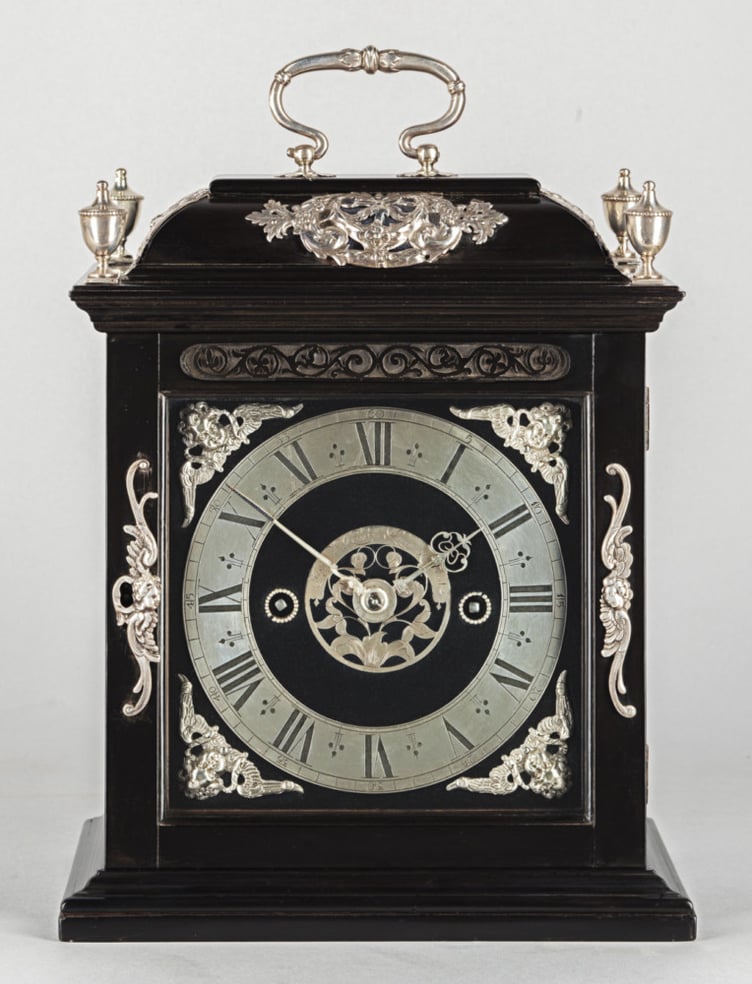
Some of history’s most significant British timepieces dating from 1500 to 1800 are now on display in the Manx Museum in an exhibition.
The exhibition features 30 different examples, including a Gothic lantern clock, made by blacksmiths from 1500, plus watches.
This collection has many royal connections.
The silver and gilt David Ramsay astronomical verge watch (c1618) puts modern ’complicated’ watches in their place.

.jpeg?width=209&height=140&crop=209:145,smart&quality=75)

The dial of this watch shows the hour, the day (sign, name and deity), the month (name and date) together with the sign of the Zodiac, the age and phase of the moon, and the planet hour.
It bears an engraving of a portrait of King James I and is signed, ’David Ramsay Scottes me Fecit’.
There is also the bedside table clock, Queen Mary’s turtle-shell Tompion (c1693), styled from the design of Daniel Marot and Louis XIV’s court in Versailles.
Tompion billed Queen Mary II £40 for this clock on an itemised account dated August 16, 1693.
Another exhibit, the Joseph Knibb ebony-veneered table clock with tic-tac escapement (1677) was part of King George III’s collection and was presented to his surgeon, Thomas Beckett.
It then remained in the Beckett family until it was sold to the collection of the renowned Isle of Man watchmaker, George Daniels.
Taking pride of place in the exhibition is the John Harrison of Barrow Longcase Clock (1726), made famous through global interest in the Longitude Prize.
It was originally created as a land-based clock against which to calibrate his sea clocks. Following Harrison’s addition of his gridiron pendulum, this became the most accurate clock in the world for 150 years.
The exhibition has been sponsored by philanthropist Dr John C Taylor OBE.
Born in Buxton, Derbyshire, in 1936 and schooled at King William’s College in Castletown, Dr Taylor returned to the island in 1977 to bring up his young family.
He founded Strix in 1981 and made numerous world-changing inventions including kettle controls now used a billion times a day.
He retired and left the company, which still operates from the Isle of Man, in 1999.
Dr Taylor has more than 400 patents to his name and has since focussed on philanthropy and passing on his knowledge to future generations through talks, lectures and endowments.
He has also built a home - Arragon Mooar House in Santon - which is elliptical in shape, because in his words, ’building a circular one would have been too easy’.
’I’ve always loved clocks and my interest started at a young age when I would watch my father, who was an engineer and inventor,’ said Dr Taylor.
’He would boil clock mechanisms in a pan to release built-up grease and then scrub and clean the metal until he breathed new life into the gear wheels and got them working again.’
Dr Taylor has since built up a collection of early clocks and watches from the British Isles that tell many stories of great design, metal work, furniture making, entrepreneurialism, engineering and timekeeping.
’Hand-made English clocks, many dated and numbered, were in fact the first mass-produced luxury items, heralding the start of the industrial revolution,’ Dr Taylor said.
intricate
’Not only is the craftsmanship astoundingly intricate, it amazes me that such wonderful works of art could be created to such a high specification, when spectacles were rare and clockmakers had to make their own tools.’
Kirsty Neate, head of professional services for Manx National Heritage, said: ’The exhibition would not have been possible without the support and collaboration of Dr Taylor, and his team, to whom Manx National Heritage is extremely grateful.’
Dr Taylor added: ’Most people state that the world’s greatest invention is the wheel.
’The wheel is the servant of mankind, but mankind is slave to the clock so therefore, surely, clocks are the most important objects ever invented.’
The Luxury of Time exhibition runs at the Manx Museum, Kingswood Grove, Douglas, until Sunday, May 10.
It is open daily from 10am to 5pm with free admission.
Dr Taylor will give a lecture on March 5 at the Manx Museum, with all proceeds to Manx National Heritage.
Tickets cost £10.
Dr Taylor will also be leading an exclusive guided tour of the gallery on April 9. See www.manxnationalheritage.im for details.
Comments
This article has no comments yet. Be the first to leave a comment.