
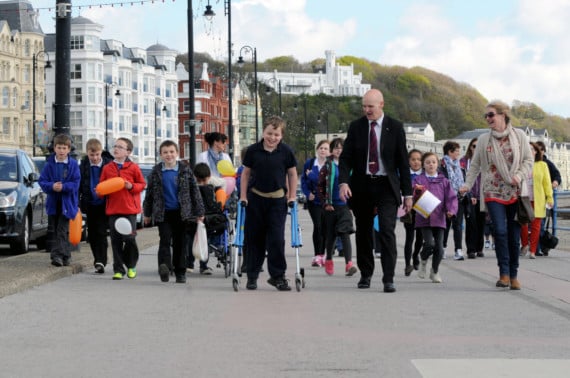
You may have seen Sara Lalor-Smith’s heartfelt plea on Facebook just before Christmas for people to consider the possible consequences of drinking and driving.
It’s something that she and her family know about only too well.
In 2013 their son, Mark, then just 10 years old, was knocked down and seriously injured whilst the family were on holiday in Turkey, writes Julie Blackburn.
Six years later it is clear that the nightmare of Mark’s accident and its aftermath is still fresh in their minds.
-(1).jpeg?width=209&height=140&crop=209:145,smart&quality=75) Why are roads still icy after gritting? Isle of Man winter treatment explained
Why are roads still icy after gritting? Isle of Man winter treatment explained Airport had ‘no option’ but to close as safety concerns explained after disruption
 Live updates as schools and airport shut amid icy conditions across Isle of Man
 Decision on Isle of Man schools opening to be made in the morning
Sara recalls: ’The first week of the holiday was perfect. The day that it happened we had been on the beach and it was glorious.
’We had taken a video of Mark standing balancing on a lilo in the swimming pool; we were even talking about renting somewhere there to retire to.’
That evening they set off to walk to a nearby restaurant for a meal. Unbeknown to them, earlier that day an English woman had hired a car and had it delivered to a bar where she and her much younger Turkish boyfriend were drinking.
At just about the time the family were setting off, he decided to take it for a drive.
Sara says: ’The car was only delivered at five o’clock that day and at quarter past seven we went out for our meal and he came round the corner and ploughed into us.’
It missed Julian, Mark’s older brother, Terence, and his sister, Courtney, and caught Sara a glancing blow that left her badly bruised but otherwise unhurt.
Mark took the full impact.
’It scraped him along a wall and left him in the road,’ says Sara.
It left Mark with horrific leg injuries: ’The only thing left holding his legs together was the main artery. They said it was the worst injuries they’d ever seen in a child’, says Julian.
Mark was taken to a university hospital two hours away. At that stage, says Julian, they ’didn’t know if Mark was going to live or die’.
The following evening air ambulance medics arrived. Although the Turkish hospital was an excellent, well-equipped facility, Sara adds: ’It was just such a relief.’
Mark was not ready to travel until the following day and even then it was not certain he would survive the trip.
The plane was too small to take other members of the family so, after giving a statement to the police, they caught a later flight to Gatwick followed by a four-hour drive to Alder Hey.
Sara recalls: ’Mark was taken into ICU and they didn’t bring him round till the Sunday.
One of the first things he said when he was brought round was: ’Are we still going out for our tea?’ He had no idea what had happened to him.’
Mark spent three months in Alder Hey.
Sara says: ’He underwent around 25 surgeries, one lasting 24 hours in which his right leg was amputated above the knee. His left leg lost much of the skin, a lot of muscle and 17cm of his shin bone.
Three fantastic surgeons, however, managed to save the leg.’
After the acute phase of Mark’s treatment was over the family was left to face the long-term consequences.
Julian says: ’It changed our lives completely because we used to be a very active family.
’We used to go out and walk up hills and go up Snaefell and do all sorts of stuff and that just came to a complete halt.
’When you decide to go out you’ve got to really think about access at the other end and the bigger Mark got the worse it got.’
Sara remembers a trip to the cinema where the access was so tricky that ’when I eventually got to our seats I cried’.
Then there was the added expense, ’hundreds of thousands of pounds’, to restructure the house so that Mark could get around’.
But the family kept going. Julian says: ’We bought a motorhome so that we could all go the Point of Ayre and do old-fashioned things like flying a kite. And we haven’t let it stop us doing holidays with Mark: we’ve been to Las Vegas and done the Grand Canyon.’
The mental effects are harder to quantify.
Mark still has no memory of the accident but his parents can remember it all too clearly and Sara says that for a while after they came home from hospital her head ’wasn’t right’.
Julian says: ’Mentally Mark was for a while affected by it but not anymore.
’He’s a happy lad, he’s really content with his life: he wouldn’t change it which is really extraordinary.
’He goes to Castle Rushen and he loves it and he’s going to be able to learn to drive soon and that’s going to change his life.’
They have accepted that Mark is never going to be walking everywhere: he’s going to need a wheelchair for probably 90% of the time.
He’s got a prosthetic leg which he can use for short distances but he finds it heavy and painful.
And what of the drink driver who caused this devastation to their lives?
Julian went back to Turkey to give evidence when his case was being heard in court: he was given three years’ imprisonment, later reduced to two and half.
Julian adds: ’But he has appealed and the appeal hasn’t been heard yet so he’s still out there.
’He and his English girlfriend have set up a restaurant together. Once he was sentenced it helped a lot: even though he’s not in prison we felt that there was some justice there. But when I was in court he didn’t even apologise to me: that would have made a huge difference.
’Instead he was saying Mark wasn’t that badly injured and trying to turn it around, saying that we might have been at fault.’
I ask them what they would say to anyone who thinks it’s OK to get behind the wheel after a drink or two.
Julian says simply: ’We’d probably tell them our story.
The impact on people’s lives is so severe, why do it when you can get a taxi home or a bus?’
And he adds: ’If we can just stop one person from drinking and driving then it will have been worth putting our message across.’
Comments
This article has no comments yet. Be the first to leave a comment.