

‘I’m afraid to tell you there’s no money left’, outgoing Labour chief secretary Liam Bryne famously wrote in a note to his Lib Dem successor in May 2010.
Whoever forms the next Isle of Man government after the general election should perhaps not be surprised to find a similar note waiting for them.
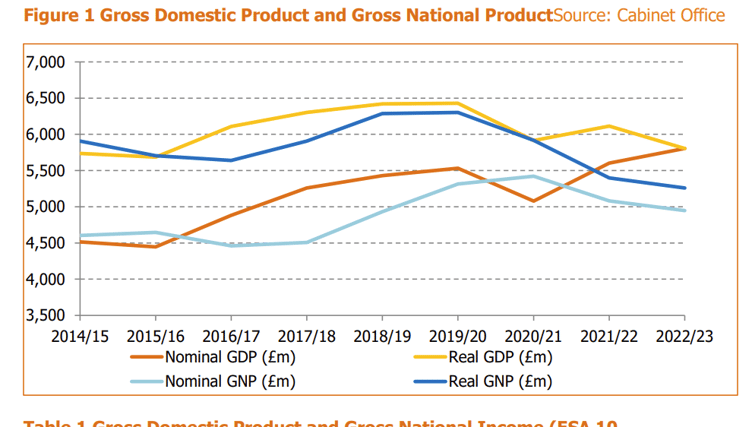
Figures for national income have shown a downward trend in recent years.
Gross Domestic Product fell by 2.5% in real terms in 2023-24, following a 5.1% drop the year before.
However, Gross National Product, which includes net income earned from abroad, saw an increase of 7.8% after three years in negative territory.
Last October, the then Treasury Minister Alex Allinson insisted there was no evidence that the island was in recession.
But having been sacked as Treasury Minister and announcing he is not standing in the general election, Dr Allinson adopted a rather different line when he spoke in support of the Mooir Vannin windfarm project.
Giving evidence at a public examination meeting in July, he cited the island’s real-term contraction in economic output as a reason why the island should seize the revenue raising opportunity that the windfarm presented.
He warned: ‘Unless our island innovates, invests and diversifies its economy we will continue along the path of managed decline’.
That same month, a pre-election presentation Chamber of Commerce highlighted some stark figures on the state of the island’s finances.


.jpeg?width=209&height=140&crop=209:145,smart&quality=75)
The Manx economy, it warned, has been in decline since Covid, experiencing one of the most severe contractions in living memory and losing 1,000 jobs from key sectors.
So how perilous a state are our public finances in?
Since the last election, the Manx economy has been buffeted by external forces.
In September 2021, the public finances were still reeling from the impact of the Covid pandemic. Five months later, Russian’s full-scale invasion of Ukraine precipitated a cost of living crisis by sending global energy and food commodity prices spiralling.
Other actions - or possibly inaction - are firmly in the gift of government.
Wage settlements, Manx Care funding, the public sector headcount, have all put further pressure on the exchequer.
The structural deficit rocketed to £217.4m during the pandemic, because of excess costs and lost income.
It has fallen since but remains around £100m.
A Tynwald scrutiny committee report last year castigated a system that ‘normalises overspending’.
The scale and cost of government has grown beyond what taxpayers can sustain, it warned, while Treasury has relied on drawing down reserves to fund government spending.
The 2026 budget relies on the use of some £126m of reserves, following a £110.6m drawdown the previous year.
Drawdowns are now planned to reduce each year to £93.9m, then £76m, £55.6m and £35.8m in 2030-31.
But the total value of reserves is expected to rise overall over the next five years because of strong investments.
And latest figures show that central government’s operating account ended the last financial year £40.8m ahead of budget, thanks to better than expected income tax receipts.
Continued high employment and healthy tax receipts show the economy has largely withstood external shocks.
But the next administration must do more to rein in overspending government departments, control headcount and put an early end to relying on rainy day reserves to shore up public finances.