
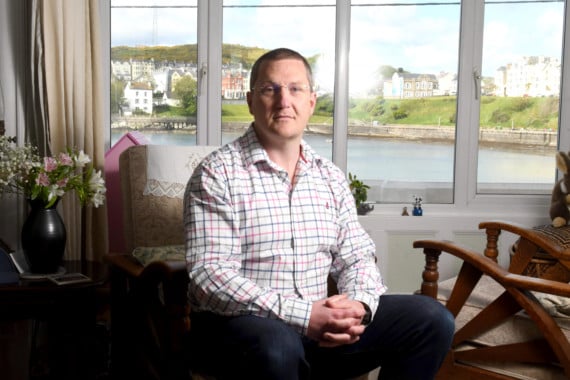
A man who has lived with ME since 2010 says that the current level of health care for the condition and other invisible illnesses is ’medieval’.
Craig Morris is from ME Support IoM, a charity set-up in 1988 to provide support and information for those with ME/chronic fatigue syndrome and fibromyalgia, their families or carers and anyone affected.
He started to feel the effects of myalgic encephalopathy (ME) in 2010 just after he acquired his dream job, when he caught glandular fever on a school trip to London. This developed into ME.
He said: ’I collapsed after our hockey team had just won the league and I thought I had a cold, but realised I couldn’t walk back to the car or drive home. I knew instantly that I was seriously ill, but I couldn’t get my doctor to take me seriously - he said he didn’t know anything about ME when I suggested it was something like that and he asked me to look it up on the internet.

.jpeg?width=209&height=140&crop=209:145,smart&quality=75)
.JPG?width=209&height=140&crop=209:145,smart&quality=75)
.jpeg?width=209&height=140&crop=209:145,smart&quality=75)
’I sought a second opinion, they said the same thing. I saw a third doctor who had knowledge of ME but unfortunately he suggested I was a hypochondriac. In the end, the breakthrough came when a friend who had read law helped me get a diagnosis and wrote a letter to persuade the government to get me seen by a specialist service [for ME] in Liverpool.’
Mr Morris said that by the time he was given a diagnosis in July 2011, the damage had already been done.
’I was told to walk for an hour-and-a-half a day and I was doing it, but I can’t walk now. Even sitting up in a wheelchair is incredibly difficult,’ he said.
’There have been major consequences to my health as a result [of a late diagnosis]. The reason why I’m bringing this up now is that it’s still happening - people are ringing me up for advice because they or their GP don’t know what to do and it’s really upsetting, especially young people, who are not being helped.
’The charity is completely overwhelmed, there’s not many of us with the knowledge to explain what to do and that’s why we need the government.’
Mr Morris said that many people still believe ME and chronic fatigue is seen as psychological and not physical.
He said: ’It’s difficult to talk about and people in the health care systems can be sceptical - I remember ringing up the emergency help line at Noble’s Hospital and they said: "ME isn’t fatal". It’s hard to put into words how difficult it is.
’So many other ME patients have given up. It’s a very bleak situation at the moment.’
Mr Morris said on the Tynwald debate: ’It dispelled so many myths about ME. I hope it will be the start of transforming things instead of having the medieval treatment that we get, we can give other people around the world hope. There are lots of ways to help manage their condition and help them get back to work.’