
People who suffer from long-term Covid-19 and other ’invisible’ illnesses have spoken out about how the government needs to provide urgent support for them.
Health Minister David Ashford MBE has previously expressed that advice from the NHS on treatment for long Covid was ’bitty’, when asked in November 2020 about what was being done by the Department of Health and Social Care for giving clear advice.
He said: ’It’s not a case of we can treat everyone the same and put them on the same pathway.
’The simple fact is that with so many different things we’re seeing with this long Covid, every patient is going to have to be treated as unique and dealt with on an individual basis.’
.jpeg?width=209&height=140&crop=209:145,smart&quality=75)
.jpeg?width=209&height=140&crop=209:145,smart&quality=75)

Those experiencing long Covid report a variety of symptoms, with surveys suggesting fatigue is the most prevalent issue for patients. Other symptoms include shortness of breath, chest pain or tightness, memory or concentration problems, insomnia and rashes.
A student, who wishes to remain anonymous, caught Covid at university. They still struggle to walk up stairs, six months after contracting the virus.
She said: ’All my tests come back normal so [DHSC] don’t offer any support after that.
’ I am constantly being told that they won’t know how to help for at least a year and in the meantime I’m left with breathing difficulties and constant pain.
’I think it’s partly because of my age that doctors don’t take me seriously. If this continues, I won’t be able to go into the career I was set on.’
Another anonymous long Covid sufferer said: ’Some of us have been dismissed as "well" because tests come back clear and then we are denied treatments.
’There are also GPs who are treating us for a range of disjointed symptoms. Some are trying to treat disjointed symptoms separately, but we need them to consider all of our symptoms in one appointment.
’I think the government needs to establish a more structured approach to diagnosis and referrals to ensure consistency across our island.’
A Tynwald sitting is to take place next month to discuss care services for chronic fatigue syndrome, or myalgic encephalomyelitis (ME) with Liberal Vannin party member Lawrie Hooper MHK pledging his support behind a radical change.
In 2018, previous Health Minister Kate Costain offered some hope for ME sufferers when funding was agreed by DHSC for ME services.
The DHSC told the Manx Independent regarding ME and chronic fatigue: ’Funding for a locum psychologist was agreed a couple of years ago and the individual commenced in post late 2019, but unfortunately left the island last year. He had begun to establish the service and provide support for some patients; the intention has been to fill this post but Covid restrictions have made recruitment to the island [in this area as in many others] very difficult.
’We are advertising for a permanent health liaison psychologist.’
Last Thursday, during a Covid media briefing, Dr Henrietta Ewart explained more about treatment for long Covid at Noble’s Hospital and how care for ME sufferers was being prioritised.
She said: ’There is a working group that is established, looking at pathways and services for long Covid and we’ve got a meeting coming up in the next week or two.
’There is very good guidance from the National Institute of Health and Clinical Excellence [in the UK], which will give us the blueprint to work from.
’There are some issues around people who have respiratory symptoms in the weeks following Covid, where there is now very good evidence about the sort of investigations and interventions that they need.
’Then of course there are other people whose condition goes on for varying lengths of time. Fortunately the number of people affected does drop-off over time, although for some people it is a very prolonged process and they do need the right support based on a disciplinary team to do an overall assessment and then referring people into those services, or providing them with support for self-management that is appropriate of symptoms because it can vary quite a lot between individuals so it’s not one size fits all.’
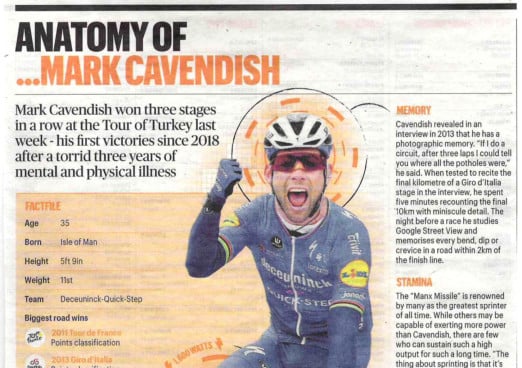
Manx cyclist Mark Cavendish spoke about his experience of a similar illness, Epstein-Barr virus (EPV), last year. Cav was first diagnosed with EPV, which causes infectious mononucleosis (or glandular fever), in April 2017 after experiencing ’unexplained fatigue’ during training.
He announced his recovery in 2019 but said he had been ’in a dark place’ and diagnosed for clinical depression in August 2018.