

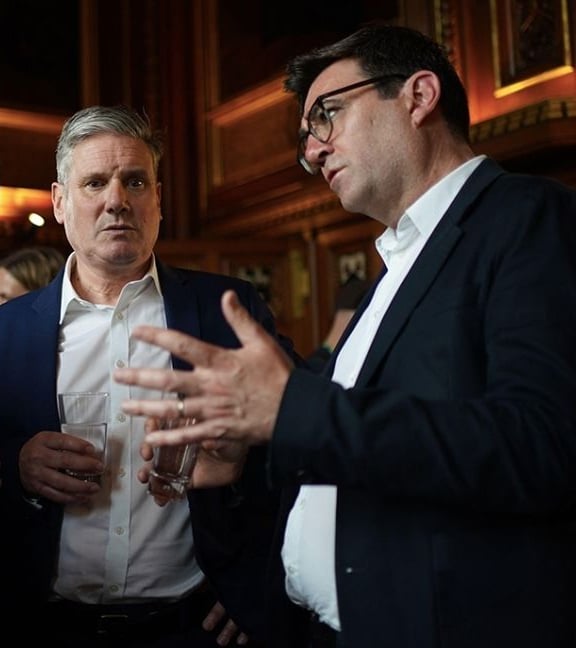
Tipped to be the UK’s next Prime Minister, Andy Burnham is no stranger to the Isle of Man and Manx politics.
As Health Secretary during the Gordon Brown administration in 2010, he played a pivotal role in the island’s battle to save its Reciprocal Health Agreement (RHA), as former Treasury Minister Eddie Teare recalls.
He said: ‘I found that Mr Burnham was at least prepared to listen and be pragmatic.
‘Initially he stuck to the department line until he was approached by constituents who voiced concern with the proposed abolition of the RHA. He has a good political antenna.’

.jpeg?width=209&height=140&crop=209:145,smart&quality=75)
-(1).jpeg?width=209&height=140&crop=209:145,smart&quality=75)
Former Manchester Mayor Mr Burnham, who returned to parliament after a resounding victory in last week’s Makerfield by-election, is widely expected to replace Kier Starmer as Prime Minister.
The UK’s Department of Health had announced in 2008 that it intended to terminate the RHA, which had been in place since 1948.
It was a move that would have meant an end to free NHS care in the UK for Manx residents travelling across - and free hospital treatment for UK visitors to the island.
A campaign to save the deal, which was due to end on March 31, 2010, was soon mounted.
It highlighted how the chronically ill could struggle to obtain health insurance to travel to UK. Concerns were also raised by Armed Forces veterans.
And campaigners highlighted the injustice of the UK retaining reciprocal health agreements with countries like Azerbaijan while potentially scrapping one much close to home.
The Department of Health had made up his mind and refused to discuss the matter further.
But then in January 2010, the Mr Burnham agreed to a meeting in Whitehall with a Manx delegation led by the then Chief Minister Tony Brown and Treasury Minister Eddie Teare.
They were to come away disappointed. The Health Secretary restated his government’s position that the deal no longer represented value for money for the UK and its taxpayers.
He did, however, agree to monitor and review the impact of the ending of the RHA.
And then in March that year Mr Burnham announced that the agreement had been given a six-month reprieve.
He also confirmed that the £2.8m given by the UK government to the island for elective treatment would be its last payment.
Mr Burnham said: ‘We believe that we have arrived a position that not only represents value for money but also ensures arrangements for travellers on temporary visits remain as they are today.’
A new deal was subsequently signed under the new Coalition government later that year.
Although the saving of the reciprocal deal was ultimately seen as a victory for the island, Mr Teare said the net cost of the agreement to the Isle of Man was well over £1m.
‘I felt that this money could have been better spent on our own patients on the island,’ he said.’
He said a ‘plan B’ had been in place for a small addition to ferry and air fares to cover the costs of hospital treatment.