
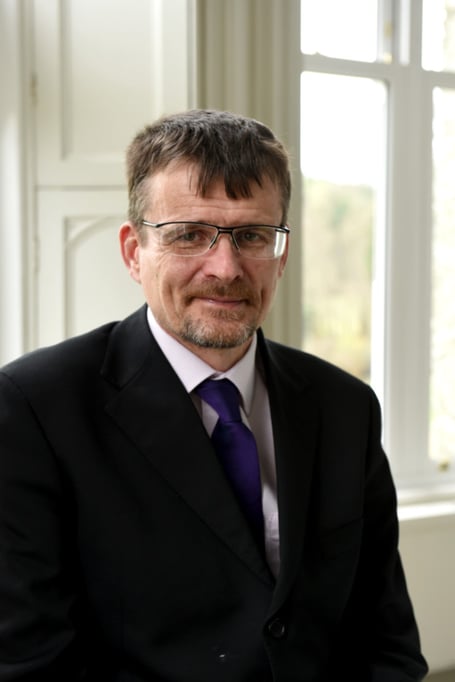
Graham Clucas is a man who has experienced first hand how mental health problems can scar an individual.
He was sectioned and imprisoned as he struggled with his illness.
Graham learned to read and write only when he was 40 and now he’s doing a PhD.
So it’s clear that he has managed to transform his life - and he is now dedicated to helping others do the same.
.jpg?width=209&height=140&crop=209:145,smart&quality=75)

The 49-year-old is the founder and community leader of Quing, a mental wellbeing charity that tries to build up an individual’s strengths.
Graham explained how Quing, which he set up in 2017 and is based at the Old School on Finch Road, Douglas, works.
’We’re a charity but we’re not a traditional charity,’ he said. ’It’s a group of people seeking healing together.
’All of it is co-created by the community members, the directors don’t tell them what to do - we’re told by members. We have a group of people who are training to be peer mentors, and we have other people who nip in and out.
’It’s very non-hierarchical, it’s very immersive, you don’t come and work for us, you join the community.
’Most organisations, you have a big pyramid with a guy at the top and the pyramid gets bigger and bigger - we’re like a set of hands holding the community, supporting it.’
For Graham, growing-up on the island was particularly hard.
’As a kid, I never really fitted in,’ he said.
’I got into drink, got into drugs, got into crime. I spent a number of years sectioned in the old Ballamona, then Care in the Community came out, which it turns out was Care in Prison.
’I was heavily medicated by the psychiatric service and it just felt like all it did was slow the process down.
’I’ve engaged with every service that you can think of - and those you haven’t. In the end, in 2005, as I walked out of the old Victoria Road prison, I’d had enough, so tried to engage with other services and then realised it wasn’t doing me any good, so I walked away. I’ve been clean and dry for the last 15 years and it was a journey of healing.’
The experiences Graham had throughout early adulthood made him determined to study more about mental health, so that he could help people suffering from their own mental health issues.
He left the island for a while and on his return he wanted to change methods in the mental health care system.
’I’d been working in the UK for about five years - I went away to train as a psychotherapist in and around London,’ he said.
’When I got back, what I was used to working with wasn’t here, so I was looking for a local provider and thought about setting up a recovery community and was laid off. Quing has happened in the last three or four years.
’Often you think about going to see a psychiatrist to heal you, but that’s not their job - it’s their job to manage your symptoms.
’It took me a while to work that one out. I was diagnosed with bad dyslexia when I was 35, had to learn to read and write when I was 40. I went to do a masters degree and I’m in the middle of doing a PhD at the moment. If I can change, anyone can.’
Graham is adamant that mental health care should focus on strengths rather than weaknesses.
’It’s about finding what you’re good at and building on that, so that problems become less,’ he said.
’If there’s loads of problems, there’s nothing good and it’s all out of balance. If you build lots of good things into people’s lives, then the problems become weightless. For me, it was learning that I actually have control of some stuff, but I don’t have a lot of control over stuff outside of that. It’s learning the acceptance of that. I’m not ignoring it, I just have to accept I have no control. Often that’s the thing with anxiety.’
Quing recently received a donation of £10,500 from the Manx Lottery Trust to help train peer mentors. In the last two years, 62 people have completed its four-day peer mentor induction programme, with 15 going to train for a qualification in peer mentoring.
’At the moment, we’re an accredited education centre and we double-up the qualifications in peer mentoring.
’We’re also in the process of becoming an accredited therapeutic community, which is a way of helping people grow, rather than treat problems. We have counselling and a peer-led community which gives people the space to practice what they’re learning. We also have social spaces, and it all works as a synergy to move people forward.’
Graham said the people who go to Quing are receiving care which will enable them to reintergrate into society with more awareness of how their emotions affect their decisions.
’What we do a lot at Quing is help people to manage their emotions,’ he said.
’It’s really easy to medicate emotions. It’s harder to teach people to relate to them. My own journey came from developing what I call emotional intelligence.’
Ultimately, forming relationships with others is an aspect which Graham said is prominent in the community-led approach at Quing.
’It’s about how you get connected, and figuring out what you’re good at,’ he said.
’If you don’t have any relationships whatsoever, come down to Quing and have a conversation, we’ll help you find them. Stay connected.’
For more information about Quing, visit www.quing.im, or email [email protected].
Comments
This article has no comments yet. Be the first to leave a comment.