
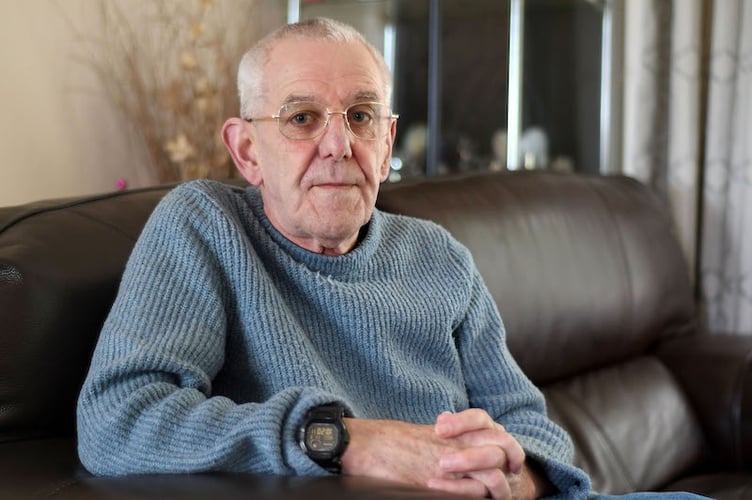
A caring husband has criticised the government and Manx Care over an apparent failure to accommodate vulnerable people in an emergency situation.
John McLaughlan and his wife Irene both had to go to Noble’s Hospital in an ambulance as there were no options available for someone to care for Mrs McLaughlan, who is disabled.
Mr McLaughlan said: ’I became unwell and had to phone an ambulance.
’As I am the main carer for my disabled wife, I thought that if I had to go to the hospital, my wife would be taken care of.

.jpeg?width=209&height=140&crop=209:145,smart&quality=75)
.jpeg?width=209&height=140&crop=209:145,smart&quality=75)
’While waiting for the ambulance I received a phone call from the social work department at Noble’s, and the social work department said the paramedics would need to bring Irene to the hospital with me in the ambulance and if I was admitted, they would need to find her a bed.
’I just couldn’t believe it... It was just one nightmare after another. The paramedics ended up having to put Irene in a chair and wheeling her out to the ambulance, and I felt embarrassed, but I thought - it’s not my fault, this is government again, they don’t tell you anything.’
Regarding the apparent lack of resources for vulnerable people to be cared for in their own homes when their carers take ill, Mr McLaughlan, who lives in Ballaugh, said: ’I find it very difficult to understand that there is no emergency back up plan for cases such as my own, especially taking into consideration that there are an estimated 8,000 carers in the island ranging in age from school children through to elderly pensioners looking after a loved one.
’Yet if the carer takes ill there is nothing in place for the most vulnerable in the island.’
He described his wife as being left confused and upset by the situation as she didn’t fully understand what was going on.
He recalled a time when emergency help was in place.
He said: ’In the past when I have been unwell my wife would have been taken to Leonard Cheshire in Ramsey and looked after by the staff there, but unfortunately the Manx government put a stop to that several years ago when they stopped disabled people going there if they were over retirement age.’
Mr McLaughlan sent a letter on October 12 to Teresa Cope, chief executive of Manx Care.
shortages
He received a response from a member of the Older People’s Community Social Work Team, rather than Mrs Cope, stating that because of staff shortages and Covid, unless the situation was critical or an emergency case they would be unable to help.
He said: ’If [they] consider that my situation isn’t classed as critical or an emergency, then God help every carer on the island, because if the ambulance had not brought my wife to Noble’s with me that day she would have been left at home for several hours unable to do anything.’
When asked what he thought should be done about the problem, he stated that the government should build a small unit somewhere to accommodate the vulnerable in an emergency situation and to use as a respite place for disabled people.
A Manx Care spokesman told the Manx Independent: ’Manx Care is unable to discuss individual patients’ cases, or respond to requests about their specific circumstances.
’However, more broadly, Manx Care does take situations like this very seriously and fully appreciates the stress and discomfort which circumstances like this could cause to individuals, to carers, and to our community.
’In line with the recommendations made in Sir Jonathan Michael’s independent review into the provision of health and social care in the island, Manx Care is currently looking to develop a range of community-based facilities that support people to be able to remain in their own homes.
’Our "Home First" strategy is seeking to understand why people are not able to remain in their homes, as well as what prevents them returning there after a period of hospitalisation or illness. That strategy also looks to identify any gaps in community services that need to be addressed.’
The spokesman added: ’We’re also committed to developing a carers strategy that will support individuals and their carers to develop anticipatory care plans, which will ensure that plans are in place for emergency situations as well as ongoing support.
collaboration
’This work is being done in collaboration with our teams of health and social care professionals, but also our communities and the third sector, and we will use feedback such as this to ensure services being provided are the most appropriate for members of our community.’
lManx Care’s development of a carers strategy, Page 5.
Comments
This article has no comments yet. Be the first to leave a comment.