
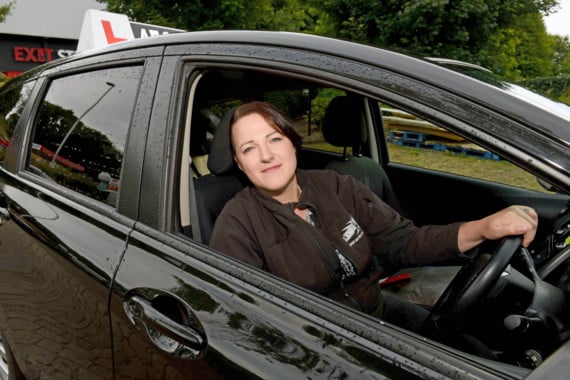
Joni Dillon, 35, owner and instructor of Sayle-Thru driving school has just completed a course in Neurodiversity which primarily looks at helping those on with a Autistic Spectrum Disorder and its associated conditions.
This week she sat down with Sam Turton to discuss why she wanted to do the course.
Joni said: ’I seem to be getting a lot of people who have anxiety or similar problems.
’As I’ve become more established I seem to have gained a reputation for being someone good with people who maybe just need a little more time.



.jpeg?width=209&height=140&crop=209:145,smart&quality=75)
’There just doesn’t seem to be anyone who really specialises in neurodiversity assistance.
’I try to make people feel relaxed and try to work with individuals and communicate on their wave length, it’s not them who have the issue, it’s me who has the issue if I can’t explain it to them.’
Joni explained her course was led by a man who is autistic and some of the other instructors who were taking the course, were also on the spectrum.
The paperwork from her course shows it focused on understanding conditions and symptoms, how they to assess an individual’s aptitude and evaluating if an individual is ’ready/able to begin learning to drive’.
The course is run by the Driving Instructors Association, which as well as teaching instructors, also focuses on career development to ensure instructors are aware of the most up to date developments.
One of this is how much more openly mental health is discussed.
Often when an individual has neurodiverse needs, it pairs with other issues such as ADHD and dyspraxia.
Joni explained: ’So we were taught how these conditions can affect how people drive and how they learn to drive.
’We discussed the importance of communication and listening so you understand a person and what works for them.’
Joni explained one of the reasons she believes the issues of mental health and conditions affecting drivers may not be so well understood in the island is due to our small size and general lack of resources for further development training for driving instructors.
So she decided to pay for herself to travel to the UK and pay for the course, which she admits makes the overall cost, including travel, quite expensive and may restrict driving instructors going on such courses.
I asked Joni why she had wanted to be a driving instructor.
Her answer surprised me.
She said: ’I didn’t want to be a driving instructor, I wanted to be an ambulance driver.
’So I thought it would be good to do advanced driving courses and things like that and then I thought in the mean time, while I wait for a job to come up, I’ll train to be a driving instructor.
’I thought I’d just do the course and become a driving instructor, it was meant to be a go between job, but I absolutely love it.’
Joni has been helping people learn to drive for nearly 10 years, including eight years as her own boss.
’Once I started, I really liked it, because it’s more about teaching, not about driving,’ she said.
’I never thought I’d be a teacher because I used to get intimidated by large groups when I was younger.
’I don’t now though, but it’s all one to one and every student who is there, wants to be there so it isn’t a battle with them.’
Joni explained the most enjoyable part of being a driving instructor is the initial meeting people and seeing how they develop and progress right "thru" to becoming a safe driver.
She added: ’But at the same time, you do build up a relationship with people and it’s then sad at the same time when they pass because I suddenly stop seeing them, so that’s a little sad.
’Also with being self-employed, I get no holiday pay and have to keep on top of my paperwork too that’s not so great.’ Joni lives in Gordon, by Glen Maye with her husband Neil, and their daughter, who is four.
They share their home with dogs, cats, kittens and chickens and a chick her daughter called Halloween.
Joni said that while the course focused on people with conditions such as ADHD and autism, she believes the experience and insight she gained will be beneficial to all of her current and future students.
She said: ’I expect any tips and techniques I can improve and expand on could quite possibly help with more main stream pupils as well. What works for one person may not work for another . It is entirely irrelevant what box you may have been placed in, all of us are different.’
Comments
This article has no comments yet. Be the first to leave a comment.