
Learning how to keep our special bees free of diseases
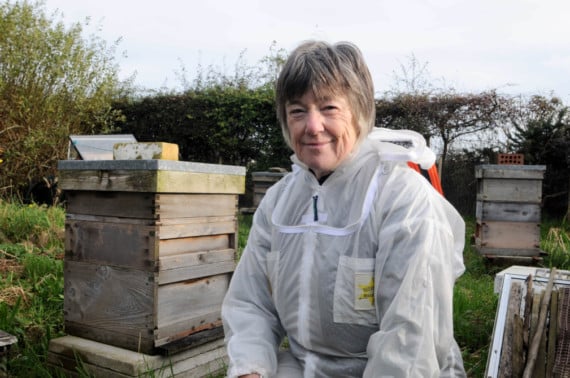
Cilla Platt has been championing the cause of the bee population on the island for many years. Here she explains to Julie Blackburn why our bees in the Isle of Man are so special.
Sometimes it’s the little things in life that are important and bees would certainly come into that category.
They have been around on the planet for millions of years, playing their vital role in pollinating plants and it’s only now that they are under threat that we are learning to stop taking them for granted.

.png?width=209&height=140&crop=209:145,smart&quality=75)
Bees on the Isle of Man are especially precious as local bee enthusiasts, with the aid of government legislation, have managed to keep them free of a number of diseases which plague other bee populations around the world.
Cilla Platt, who is education officer for the Isle of Man Beekeepers’ Federation, explained: ’Thirty years ago the government were very far sighted, with the aid of the beekeepers at the time, and banned the import of bees to the Isle of Man because one or two of the major beekeepers at that time could see diseases coming up through Europe so we were able to shut the door in time and we’re trying to keep it shut.’
The legislation also applies to the import of second-hand equipment such as hives from the UK and other parts of the world: ’These can also bring disease with them which our bees are lucky enough to be free of on the Isle of Man.
’Chief among these is the varroa mite.’
In order to keep reminding the public of the vital importance of following this legislation Cilla and other members of the Isle of Man Beekeepers Federation talk to a lot of people at the major agricultural shows and the Food festival.
Cilla said: ’For the past two or three years I have also been going round a lot of primary schools: the more people that know something about bees, however little it is, the better.
’I always say please tell everybody you know not to import bees into the island.
’Actually there’s a hefty fine but to us beekeepers it doesn’t matter because the first person who brings bees to the island will bring varroa - there’s no ifs or buts - you’ve only got to bring a matchbox full of bees and we will have varroa.
’And it spreads like wildfire.’
In the UK, beekeepers routinely spray their bees with chemicals to rid them of the varroa mite.
On the island this is not necessary, which is obviously better for the bees and better for the purity of our local honey, which is exceptional.
If you want to be sure of buying genuine Manx honey, Cilla had the following advice: ’Go to a beekeeper: I sell every jar I can do at the door and I do try very hard to have a few pots set aside for the two shows and the food festival.’
In her role as education officer for Isle of Man Beekeepers Cilla has also been running courses for the last 14 years for anyone who would like to learn about beekeeping. These are becoming increasingly popular as she explained:
’To start with I got very few people coming on the course and then, at the same time as allotments got popular, beekeeping did as well and the numbers came up from two or three people the first time I ran the course to up to 30.
’Having said that only about a quarter of those will actually take up beekeeping because, once they’ve done the course, they realise what’s involved and that is, in my eyes, very important.’
The beginners’ course in beekeeping usually starts after Christmas with two evenings a month learning the theory.
Cilla goes on: ’Once the students have done that we then invite them to come to our bee breeding teaching apiary and there we do a series of practicals.
’We’re lucky enough to have an apiary manager now, Roger Putnam, who looks after it and has organised volunteers plus himself to be at the apiary every Saturday afternoon.
’Because of this the students realise they can just drop in any time on a Saturday afternoon and ask questions and look at bees and it’s worked incredibly well.’
Armed with the necessary knowledge, if students do want to go on to keep bees themselves, Cilla has one more piece of advice:
’A lot of folks think they’re going to set up in their own back garden which is a nice idea but you really must talk to your neighbours first because neighbours can be wonderful until you get a hive of bees all they can think of is "sting".
’And, when you’re a new beekeeper, that can happen because you’re not quite sure how to do it all and you’re learning on the job.
’Really the best thing to do is to find someone who has a smallholding, a plot of land, or a farmer with a field and keep them there.
’We’re very lucky on the island in that people do offer places to keep bees and mostly by the end of the season those who wish to take up beekeeping have found somewhere to put them.’
Cilla added: ’Bees are amazingly intelligent.
’We think that they’re just little insects that bumble around the place but they do not: that’s how they’ve been on this planet for hundreds of millions of years.’
Let’s make sure we do our best on the island to preserve our own special bees and keep them around for a bit longer.
â?¢ You can find more information about beekeeping courses and a list of beekeepers on the island who sell their honey to the public at www.iombeekeepers.com.
The beekeepers will be holding a Honey Convention on Saturday, November 4 at St John’s Methodist Hall and members of the public are welcome.
There will also be a talk by Mark Winston entitled ’Bee Time Lessons from the Hive’ at Noa Bakehouse on October 30 at 7.30pm. Admission is £5.
Comments
This article has no comments yet. Be the first to leave a comment.