
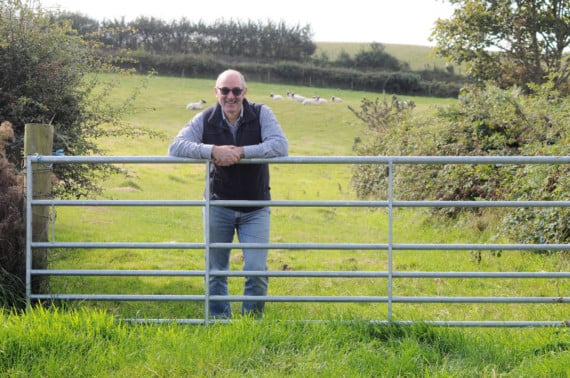
Food & Farming talks to Paul Crocker about combining a career in investment management with farming and why a carbon tax could be good news for Manx farmers.
I’ve had an obsession with farming for most of my life. To me it’s like a drug, says Paul Crocker.
As an investment director with FIM Capital, Paul spends much of his time visiting companies, in the UK and Europe, researching their investment potential on behalf of his clients.
He brings this same rigorous approach to his farming.

.jpeg?width=209&height=140&crop=209:145,smart&quality=75)
.JPG?width=209&height=140&crop=209:145,smart&quality=75)
.jpeg?width=209&height=140&crop=209:145,smart&quality=75)
A lot of Paul’s research into the way he farms has a historical perspective.
He has a collection of old books about agriculture going back to the 1800s and has learned a lot about farming practices in those days. Given the increasing focus on the environment, he now sees lessons there for both farmers and businesses.
’They didn’t have cheap oil and they didn’t have coal in those days: they did things differently and didn’t damage the environment or impact nature.
’I think going forward when you look at what businesses are doing, they can see they will have to prove to all their stakeholders that they are environmentally clean. In agriculture in particular, I think that a lot of those old practices, mixed with modern technology, are going to be integrated and that’s one of the things that we’re doing here.’
’Here’ is the 60 acres in Bride on which Paul keeps his flock of 70 pure bred Shropshire sheep. Paul and his wife, Wendy, live in a cottage in the heart of the village and their land is in pockets in the surrounding countryside.
’We started with a bit of land, then some people wanted me to graze their land, and then we acquired more, so everything’s all over the place,’ he says.
For the last few years Paul has been experimenting with herbal leys and more recently added a mycorrhizal fungi seed dressing with some very interesting results, as he explains: ’I sowed my first herbal ley about six years ago and we measured the humus levels in the soil two years ago against an area where we didn’t use a herbal ley and the humus levels are increasing.
’I’ve been using the Clifton Park seed mix which dates from 1890s but this year I’ve tampered: I did a small area where I dominated with chicory and that hasn’t worked so well initially.
’On another area, which was nine and a half acres dressed with mycorrhizae, the results have been interesting.
’I’ve been a bit shocked at the results because I’ve got a very vibrant ley but unfortunately every weed seed has also benefitted from the mycorrhizae. I’ve had some redshank which was five feet tall.
’I’m now starting to top it but interestingly, in the areas which I have topped, within four or five days the diverse herbal ley has recovered quickly and is thriving.
’The plan is to top the majority but allow so some of the weeds to remain with their seeds as a food source for the birds over the winter.’
Paul also discovered something interesting about his sheep, who enjoy the herbal ley and thrive on it: ’If you can keep them on a pure herbal ley there’s less of a parasitic worm problem but as soon as I took them off and put them on conventional grass I then had a massive problem. The transition I have to make now is to get everything across to a herbal ley.
’If I can avoid using worming products the knock on effect is quite considerable, in terms of less damage to the beetle population for example, and it lowers my costs.’
Looking after the environment is not just a personal choice: in broader environmental terms Paul believes it likely that a carbon tax will be introduced and this has informed his choice of companies to recommend investing in.
He explains: ’What you’re looking for is not a company that’s in complete denial because carbon taxes will become compulsory.
’Those businesses that are prepared will fare very well but those that haven’t will hit a brick wall.
’We stress test every single company in which we consider investing that reports its emissions against a carbon price of £200 a ton.’
Paul believes that this may ultimately benefit Manx farmers: ’Farmers here are competing against massive industrial farms which are using enormous quantities of fertilisers, chemicals and heavy machinery. They’re not in a level playing field: those people have got economies of scale and a serious carbon footprint.
’But, once you put a carbon tax into the mix, that changes the dynamics of everything. Suddenly the ’prairie type’ approach has a hidden cost and I really do believe that long term the whole of the British Isles will be in the right place to prosper from this transition because grass grows well and it sequestrates carbon.
’The problem globally is there aren’t enough people managing land with carbon in mind.
’If the farmer is managing the land in environmentally sensitive ways and the grassland is longer term pasture, he is sequestrating carbon which is something that may be sold and there is growing demand from business for carbon off-sets.’
Paul began his own farming adventure when he was 12, as he recalls: ’My parents moved out to the countryside, there was no one my age in the village and I was bored to tears over the summer holidays.
’Then the farmer came along and asked my father if I wanted to drive the tractor and of course I wanted to drive the tractor!
’I got one short drive and then I was labouring and that was it: I loved it.’
Travelling a lot for work means enlisting Wendy’s help to look after the animals but there is no getting around it at lambing time: ’It’s four to five weeks of sleep deprivation.
’But I love it. It’s the most wonderful sense of calm you get in the lambing shed, even though you’re shattered.’
Paul is the only one on the island breeding Shropshire sheep: he has eight tups with two breed lines and is bringing in a third.
He explains the reason why he chose Shropshires: ’I’ve been a member of the Rare Breeds Trust since I was a teenager and I wanted to do something that would help develop a breed that was struggling.
’I was looking at all sorts of different breeds, then someone told me: "You’re doing it wrong: whether you’re looking for a new breed of cattle or sheep, it’s the same process as if you’re looking to find a partner- if you don’t like the look of them, it ain’t gonna work!"
’I just love the look of the Shropshires.
’Their meat is excellent, they can be finished on grass and they’re a totally unique breed in that they don’t damage trees so, from an environmental perspective, it completely opened up the options because I’ve got a small coppice in one of the fields in which the sheep graze.
’I believe I’ve got the right sheep and I’ve got the right grassland and together I’m sure, in five or 10 years’ time, I’ll be able to demonstrate that I’ve got the perfect combination.
’Or the epitaph on my headstone may just say: ran out of time,’ he adds with a laugh.
And he goes on: ’Farming is an addiction: there’s times when things are going wrong, you’ve got problems with animals and you think: "why bother?" but everyone’s in the same boat and you just learn to live with it.
’I think farmers are probably the most resilient people on this planet because they get a kick from every single angle and they just bounce back.’
What are herbal leys?
Herbal leys are a complex seed mixture of grasses, legumes and herbs, which bring a range of benefits to forage, livestock health and soil fertility.
They can often include a mixture of up to 17 species and the idea is that, by having a very diverse mix of grasses and broadleaved plants, you can feed the animals for a longer period of time purely from that grassland because different plants are coming out at different times.
Some also have anthelmintic properties.
They are also self fertilising, including legumes which fix nitrogen in the soil.
What is mycorrhizal fungi?
Mycorrhizal fungi live in the soil and come into direct contact with plant roots, adding to the plants’ ability to gather nutrients and water from the soil through the fungus.
In exchange, the plant feeds the fungus sugars it produces during photosynthesis.
There is a theory that when you continually plough and add artificial fertiliser it depletes the fungi and a lot of highly cultivated soils are believed to be mycorrhizae deficient.
Shropshire sheep
Shropshires were the main breed of sheep used to colonise New Zealand and Australia when they started sheep farming but their popularity waned and they nearly became extinct in the 1970s.
In the 1990s they discovered a farmer in France had a small flock of Shropshires, happily grazing in his apple orchard, and the benefits of using them to graze alongside tree planting programmes were realised. This has made them especially popular with Christmas tree farmers and has seen their numbers start to increase again.
Comments
This article has no comments yet. Be the first to leave a comment.