
’Trigger stacking’ is a concept used in the animal behaviour world that refers to a build up of multiple stressors that eventually lead to a significant reaction.
In a dog this could result in aggression, or, conversely, a complete lack of self-confidence. In a cat it could cause a range of issues that an owner may not associate with stress. Some of these issues are physiological ones, and some are psychological.
The first of the physiological signs of stress is cystitis, or feline idiopathic cystitis (FIC).
Signs include straining to urinate, passing blood in the urine and house soiling.


.jpg?width=209&height=140&crop=209:145,smart&quality=75)

The second sign is feline influenza (or feline calicivirus, FCV, or feline herpes virus, FHV) which is caused by a suppression of the immune system, and which results in a cat having respiratory problems.
And the third is feline inflammatory bowel disease (FIBD) which causes a cat to vomit, go off their food, and have diarrhoea.
Psychological reactions to stress include aggression, acute shyness, house soiling, and over grooming.
Animal behaviourists believe that cats feel emotions and that they are motivated by feelings of joy, fear, anxiety, frustration and depression, and that negative emotions elicit a stress response.
But cats are also very good at hiding their stress, until the triggers become over-stacked and result in a big stress response, which is why a cat owner needs to understand what lower level triggers affect their cat, so that they can take remedial action.
The presence of other animals is a frequently-observed stress trigger.
Rather than wait for an obvious sign of strained, fear-based fight or flight behaviours, an owner should assess a cat’s relationship with other animals through the presence of positive behaviours.
These include mutual grooming, sleeping alongside each other, and happily eating together.
Going to the vets is not one singular stressful experience for a cat, it’s lots of little ones: being confined in a cat carrier, travelling, being in a waiting room alongside other animals, experiencing strange smells, having a vet prod and poke them, and possibly being injected with a needle.
Cats who don’t like being handled can appear to be ’good’ while at the vets, but this is likely to be due to the suppression of behaviours rather than a cat being happy with, or accepting of, the experience.
Make sure you cover your cat carrier with a towel or blanket, and place some of the cat’s bedding inside it so that they are reassured by a familiar smell.
Whereas a visit to the vets may be unavoidable, unless your vet can come to you, an owner can take steps to reduce stress ’stackers’ by ensuring their home is set up to meet a cat’s needs.
A cat should be provided with a safe place where they can hide, and positive, consistent human-cat social interaction where children respect the cat’s boundaries. In multi-cat, or multi-pet, households cats should be able to eat, toilet, sleep and play in separate areas.
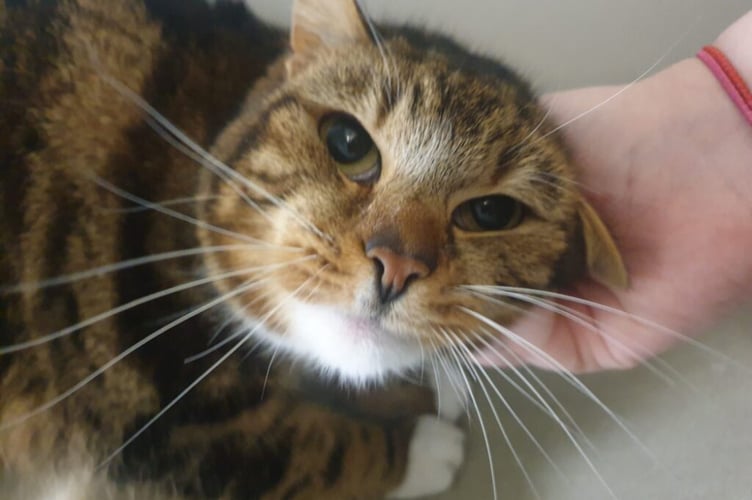
Four-year-old Clopin would very much like to be the only pet in his new home.
He’s used to a quiet life, and only came to us for rehoming because his owners had to move into rented accommodation and couldn’t take him with them.
He is a little shy when you first meet him, but is a big softie once he’s reassured, and loves a cuddle and a good scratch behind his ears.
Being in a cattery environment is stressful for most cats, although we do our best to minimize this by providing areas to hide, and by keeping bedding in a pen for as long as we can to allow a cat’s scent to permeate.
But the best solution for de-stressing our cats is for them to be adopted quickly, and to spend as short a time as possible with us. You can find adoption forms on our website, or make inquiries by calling the cattery team on 851672, option two.
Comments
This article has no comments yet. Be the first to leave a comment.