
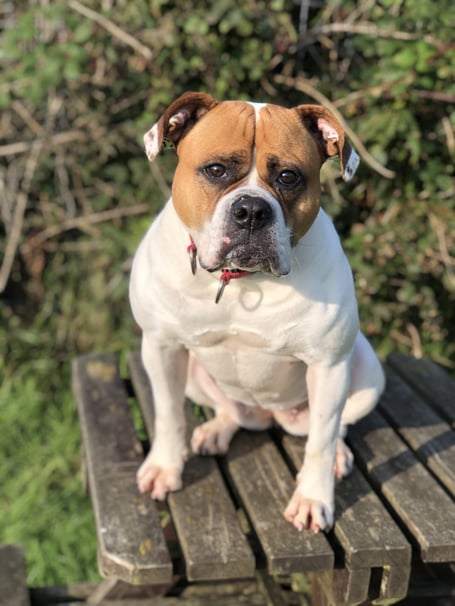
We said good-bye to Dodger last week - after spending most of 2020 with us, he finally found his ’forever family’ and is now the centre of attention in a loving new home.
Our other American bulldog, Dottie, is still with us though.
It is significantly harder to rehome large dogs like Dodger and Dottie because most people want small dogs in the mistaken belief that they will be easier to handle.
It’s worth remembering that dachshunds and jack russells regularly top the list of dogs who are most likely to bite a human.
.jpeg?width=209&height=140&crop=209:145,smart&quality=75)


Dottie will need an experienced new owner because she can be unpredictable around people she doesn’t know, but once she’s settled into a new home her insecurities will lessen.
She’s only two and so she’s still developing, and learning what to do in situations where she feels uncomfortable. Building up a trusting relationship with her new owner will give her the confidence she needs to relax around strangers and to enjoy new experiences.
Dottie is very affectionate and responds well to reward-based training - she likes to please and loves being praised.
She needs only a moderate amount of exercise and, as is the case with most dogs, she does not need lots of high energy stimulation.
The kennels team are very careful when they use toys and balls with our rescue dogs, ensuring that they don’t over-excite them and make them hyper.
Lots of dog owners use tennis ball launchers, or flingers, and think that they are providing fun and exercise in equal measure.
But these flingers come with a health warning, and the veterinary profession is concerned about the mental and physical damage they are causing some dogs. Repeated ’throw it, chase it, catch it’ exercise involves increased arousal which can result in a sharp rise a dog’s heart rate and adrenaline levels.
Adrenaline itself should be released in short bursts, such as during a one-off chase, and longer periods increase cortisol levels which can take several days to return to normal.
Adrenaline and cortisol both play a role in the regulation of behaviour. Promoting increased production of both over a prolonged period can trigger problematic behaviours such as a no ’off switch’, a lack of ’frustration tolerance’, and unpredictability.
Other behavioural issues caused by the ball flingers include a reluctance for a dog to walk by their owner’s side because they always want to be ahead, anticipating the throwing of a ball and an inability to show self-control when presented with a ball, or in the area in which the owner normally flings the ball.
Added to this, repetitive chasing in this way is simply not a natural activity for any dog, and if the potential behavioural issues are not enough of cautionary warning about ball flingers the physical issues associated with using one also need to be considered carefully.
High speed impact, uncontrolled twists and turns, and rotatory force on joints can cause a multitude of injuries. And a dog may not even be warmed up before such vigorous exercise is undertaken.
There is so much more an owner can do with a ball or toy to work their dog mentally and physically. A ball detox may be needed for a few weeks before exploring other ball-based activities, such as hiding a ball for a dog to find. This is a simple form of scent training but it can be much more complex, and internet sites such as www.scentworkuk.com are very informative.
With or without scent training Dottie will make her new owner very happy, sharing walks even on the darkest of winter days.
She’ll then be equally happy sitting in front of a fire watching television, enjoying being a loyal and loving companion.
Comments
This article has no comments yet. Be the first to leave a comment.