
Last week’s article described the perils of walking in the countryside in relation to the risks of contracting Lyme disease, and over the last few days the UK national press has been awash with headlines such as ’horror summer of blood-sucking ticks that can cripple and blind you’.
This week’s article should not be interpreted as yet another reason to avoid walking in the countryside - far from it.
We should all enjoy our natural environment as much as possible, but take the necessary precautions to avoid any problems associated with it.
Those of you who visited our agricultural shows this summer cannot fail to have been impressed by the behaviour of the cattle (bulls, cows and calves) that were competing in various classes. They seemed perfectly content munching away at their hay, despite hoards on onlookers and inquisitive children.


.jpeg?width=209&height=140&crop=209:145,smart&quality=75)
.jpeg?width=209&height=140&crop=209:145,smart&quality=75)
It’s all too easy, then, to assume that such benign bovine behaviour can be expected all the time, but that’s not the case.
When walkers encounter cattle in a field the latter’s behaviour can be very different - at best they can be curious and move towards walkers simply to find out more about them; and at worst they can be aggressive and potentially dangerous.
The NFU and the Ramblers’ Association give the following advice:
â?¢Take the best route and avoid a footpath with cattle on, or near, it if at all possible; and, if you have to enter the field, stick to the fence-line even if the path takes you through the middle.
â?¢Never pet calves.
â?¢Ensure that the animals see you and don’t surprise them.
â?¢Don’t panic and run if you feel threatened - just walk on quietly and try to keep your body facing the cattle.
â?¢If you have a dog, and the cattle have started to show signs of aggression, let the dog off its lead so that it can run away and divert the cows away from you (it is likely that the cattle are objecting to the dog more than you, and the dog will be able to run faster than you can). This is the only time that the Countryside Code advises that a dog should be let off its lead around livestock.
Another piece of advice that most experienced ramblers will know about is to carry a whistle, which will startle the herd and buy you time to find an escape route.
Another suggestion is to always carry a walking pole or stick with you which you can stretch out to make yourself look bigger, and potentially more scary, in the eyes of the cattle.
Cattle attacks on people are rare, but they do happen and 70 fatalities have been recorded in the UK since 2000.
But don’t let this put you off exploring the wonderful Manx countryside, and enjoying long dog walks along our excellent footpaths and bridleways.
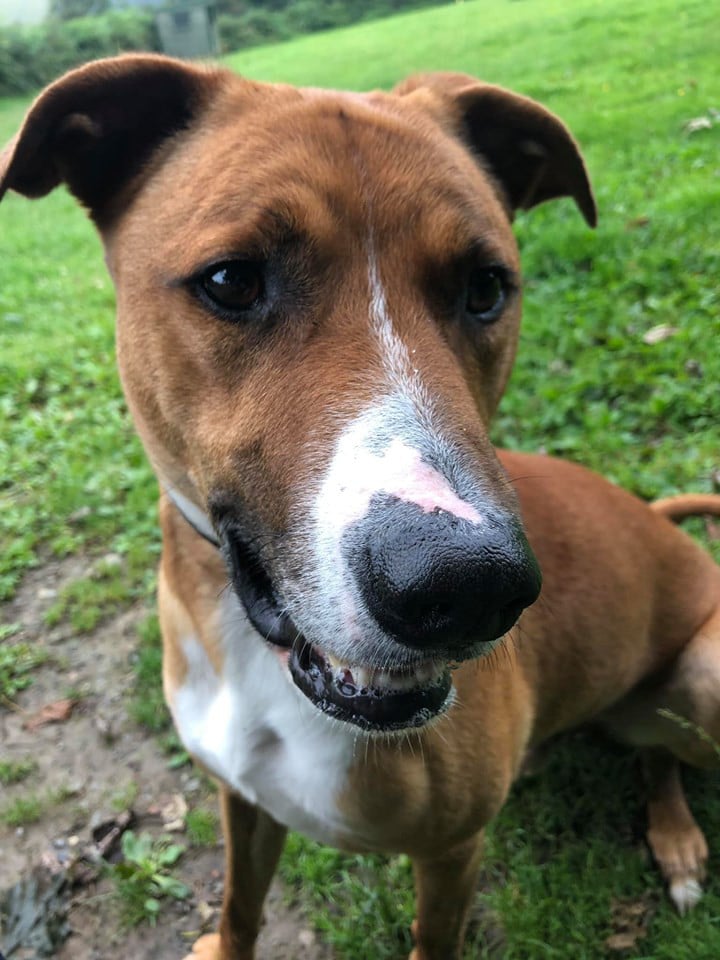
Jeff would love to accompany you on these walks, making them even more enjoyable and purposeful.
He’s a four-year-old, large lurcher cross with tons of energy who would really suit a rural life-style.
He needs new owners with equal amounts of energy and a certain amount of physical strength to cope with his exuberance.
He’s a big puppy who needs the opportunity to develop into a wonderful, loyal and loving companion.
Comments
This article has no comments yet. Be the first to leave a comment.