
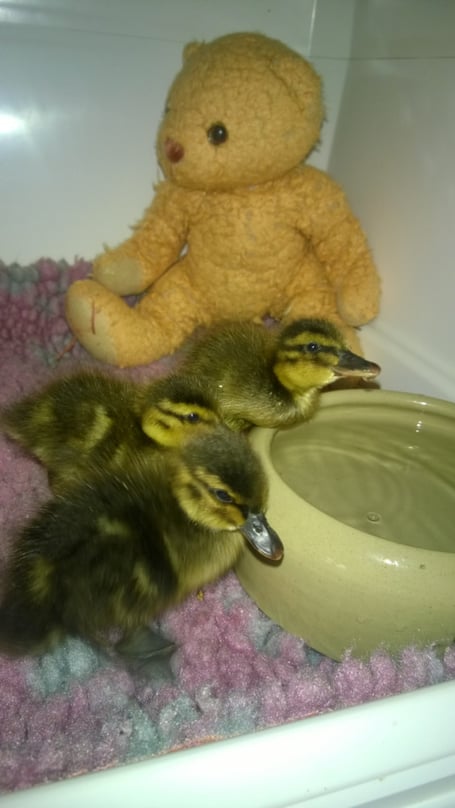
Despite the late arrival of spring, baby bird season is now upon us and we have started to see a variety of youngsters coming into our aviary.
Ducklings are usually the first species to start hatching, and this year is running true to form with several being brought to Ard Jerkyll in the last few days.
Please don’t automatically think that a lone duckling has been orphaned or abandoned - it’s likely that its parents and siblings will be close by, and the best course of action is to observe the young bird for as long as possible (ideally for at least an hour).
If it is in immediate danger from a predator or passing vehicles, carefully relocate it to a safe place nearby if this is possible.
-(1).jpeg?width=209&height=140&crop=209:145,smart&quality=75) Why are roads still icy after gritting? Isle of Man winter treatment explained
Why are roads still icy after gritting? Isle of Man winter treatment explained Airport had ‘no option’ but to close as safety concerns explained after disruption
 Live updates as schools and airport shut amid icy conditions across Isle of Man
 Decision on Isle of Man schools opening to be made in the morning
It is vital that the parents should still be able to see and hear their offspring, and so it needs to be placed out of danger but near to where it was found.
However, if the duckling is clearly injured it will need to be taken to a vet for treatment, before it comes to Ard Jerkyll.
When they arrive at Ard Jerkyll young ducklings are kept in heated incubators, and although they can swim from day one of hatching they are at risk of drowning, and so they have to be supervised when they swim.
The rest of the time they have a bowl of shallow water to drink from.
When they are old enough they are moved to the outdoor aviary pens where they can develop their swimming skills in large water troughs before being released back into the wild.
Ducklings do well when they are reared in captivity, not least because they are fairly self-sufficient as soon as they hatch, but other species of bird are more of a challenge because they need regular hand-feeding.
Members of staff take these birds home with them so that they can be fed from dawn until dusk, as they would have been by their parents, and we are given invaluable support by the Manx Wild Bird Rehabers to help us to do this.
The Rehabers are usually able to take the smaller birds from us (sparrows, robins, blackbirds, etc), and get them to a point where they can go into an outdoor aviary before being released.
The majority of phone calls we receive at this time of year relate to baby birds, often young Herring gulls, with callers concerned about the birds’ welfare and safety.
However, if the bird is uninjured and has feathers, and it is able to hop or run, then it is a fledgling and it should be left alone. Fledglings are almost always being watched over by their parents, and they need a couple of days on the ground for their flight feathers to develop properly.
One of the commonest reasons why people don’t like cats is because of their hunting instincts and the fact that they kill so many garden birds.
The solution is to have an indoor cat like Willow, the long-haired black cat we featured recently.
Older cats are often happy to stay indoors, and they make the most amazing companions.
At the opposite end of the feline spectrum is young Trogg - she is semi-feral and very wary of humans, but she is slowly learning to trust people.
She will need new owners who will devote time and patience to her, and who can give her the stability and reassurance she needs. She is a stunning cat - mostly tabby with a white face, chest and feet - with huge green, owl-like eyes. She is likely to be very adept at hunting, given she has had to fend for herself in the past, and so garden birds and ducklings would be easy prey for her.
Rest assured, though, we will only release our young birds once they are big enough to fly, or swim, to safety should they need to
Comments
This article has no comments yet. Be the first to leave a comment.