
A new traffic sign featuring a hedgehog will soon appear on roads across the UK to warn drivers that they are entering a small mammal ’hot-spot’, and to reduce their speed accordingly.
Transport Secretary Chris Grayling unveiled the sign last week, and said it will be placed in areas where road-kill incidents are highest.
The warning is designed to help reverse the decline in small wildlife numbers, especially hedgehogs whose population in rural areas has halved since 2000. In the 1950s there were estimated to be 30 million hedgehogs in the UK, and now it’s thought there are as few as one million.
There has also been a significant decline in numbers on the Isle of Man, and last year’s very dry summer took its toll on hedgehog numbers.


.png?width=209&height=140&crop=209:145,smart&quality=75)

As well as helping precious wildlife, the signs are also intended to reduce the number of serious and fatal accidents on the UK’s roads.
Between 2005 and 2017 100 people were killed and just over 14,000 were injured in accidents involving an animal in the road.
Motorcyclists are particularly at risk.
Although the Isle of Man does not have large mammals such as deer and badgers that can cause serious damage to a car or bike when in a collision, simply swerving to avoid hitting an animal can cause an accident.
The ManxSPCA will discuss the introduction of similar road signs with the dovernment’s highways division in coming weeks, and undertake research into which stretches of the island’s roads are the most hazardous to wildlife (sadly, the best way to establish this will be to count the bodies of creatures that have already been involved in a road traffic accident).
Regular readers of this article will know that there are lots of things we can do to help our local hedgehogs, with one of the most important being to leave a gap in your garden fence for the little creatures to pass through.
Creating ’hedgehog highways’ lessens the need for hedgehogs to venture on to roads.
A hedgehog can travel several miles every night in search of food and so giving them some dog or cat food (non-fish variety) in your garden will mean that they don’t need to put in so many miles.
And as we come into summer it is more important than ever to leave out bowls of shallow water - one on the ground for the hedgehogs, and the other in a more elevated position for the birds.
We have several hedgehogs with us at the moment and as soon as they have recuperated they will be released back into the wild.
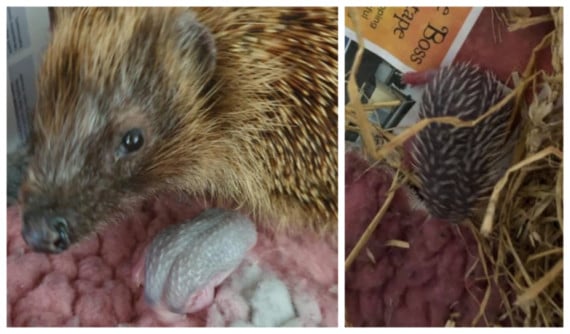
For the first time ever we were lucky enough to have a female hedgehog give birth to two hoglets a few days after arriving.
She is the most attentive mother, keeping both babies snuggled underneath her - warm and well fed.
As you can see from the first picture a new-born hoglet’s spines are covered by a protective membrane to prevent them from harming their mother during birth. Within 24 hours the membrane shrinks away leaving about 150 soft spikes underneath.
These will be replaced with stronger spines after six to eight weeks in a process called quilling (the spines are, technically, quills because they are filled with keratin).
When a hedgehog is about 12 months old a second quilling takes place, and they develop their fortified adult spines.
This is a peak time of year for hedgehogs to have their young, and you may have a nest in your garden. Please be extra vigilant when you’re strimming long grass and check it thoroughly before you start cutting.
Comments
This article has no comments yet. Be the first to leave a comment.