
Although microchipping is a legal requirement for dogs, and has been for several years, it is not currently a requirement for cats unless they are travelling abroad.
It’s difficult to put a precise figure on the number of cats who are chipped, but in the UK the PDSA estimates that it’s over 70%.
We’re not confident that the figure is as high as that in the Isle of Man, based on the cats who come to us for rehoming, those involved in road traffic accidents, or those brought to us as potential strays.
It’s possibly as low as 40% in the island.


.png?width=209&height=140&crop=209:145,smart&quality=75)

Which is why we really want to push for all owned cats in the Isle of Man to be chipped.
Why?
Because microchipping is the best way lost and stray cats can be reunited quickly with their owners, preventing days, if not weeks, of misery and anxiety for both a cat and its owner whilst the hunt for a missing, much-loved pet takes place.
We regularly hear heartwarming stories of the huge joy and relief when a missing cat is returned home thanks to the details of their microchip.
Let’s not forget how much roaming and exploring is part of a cat’s DNA, with adventurous young males in particular often wandering miles away from home in their search for prey or female cats.
And it’s not uncommon for a curious cat to jump into a delivery van whilst the driver is distracted, only to be driven for many miles until the van doors are opened again and the terrified cat can make a bid for freedomâ?¦only to realise that it’s completely lost.
We’re not sure why some owners chose not to chip their cats, but here are some possible reasons:
’Putting a microchip in my cat will be painful’ [this is not the case - the chip is the size of a grain of rice and is popped under the cat’s skin with a sharp needle.
It doesn’t go into muscle or into a blood vessel, and so it’s not like the injections we sometimes have as humans that can cause discomfort].
’I can’t afford to microchip my cat’ [the ManxSPCA’s charge is just £15 per cat].
’I keep meaning to get round to it’ [we say ’book a chip today and don’t delay’!].
Another huge benefit of having a microchipped cat is that you can then use a microchip cat flap, which you programme with your cat’s unique chip number.
It’s a great way to prevent unwanted cats coming into your house and, unlike magnetic cat flaps, it means your cat doesn’t have to wear a collar [which can often be pulled off].
Our call to chip all owned Isle of Man cats comes at the same time as the UK government’s eight-week public consultation on whether cat microchipping should be made compulsory.
The consultation was launched at the end of December, following a ’call for evidence’ in 2019 that showed 99%of people support compulsory chipping.
All of the ManxSPCA’s rescued cats are re-homed with microchips in place, and all that we ask is for new owners to keep their contact details up-to-date with the microchip company.
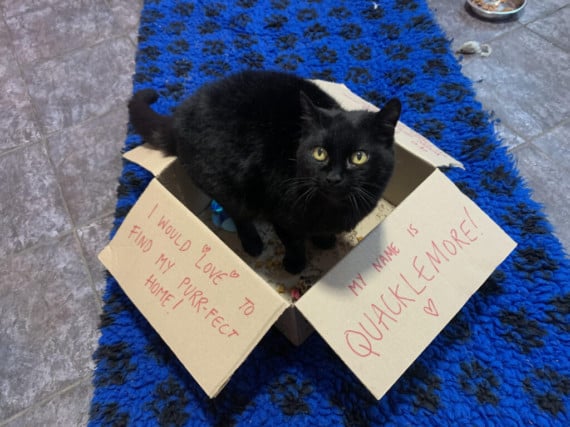
Beautiful black cat Quacklemore came to us as a stray, unchipped, and therefore we don’t know anything about her past.
We estimate that she’s about five or six years old, and we’ve been able to observe lots of her personality traits such as not liking other cats, and only wanting a stroke when she’s in the mood for one.
She can be very loving, though, and she will enjoy being with an owner who has lots of time for her, and who understands that a lasting bond won’t develop overnight.
A quiet, calm and stable environment would be ’purrfect’ for Quacklemore - somewhere she can feel at home.
Comments
This article has no comments yet. Be the first to leave a comment.