
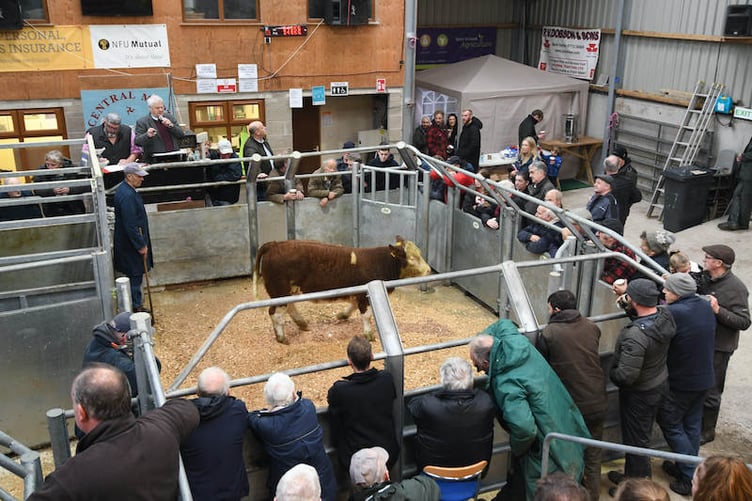
There’s something for everybody today,’ says auctioneer Peter Quayle as he mounts the rostrum for one of the last sales of the year at Central Marts, at Knockaloe.
As with all the sales, this one is a good barometer of how farming is doing on the island.
It’s a promising day as there are gale force winds and rain outside, which usually means a good turnout - in fine weather farmers are busy out in the fields. Certainly by 1.20pm, ten minutes before the sale is due to start, the place is filling up fast.
For farmers, most of whom spend a lot of their working day alone, a trip to sales for a few hours is as much a social occasion as anything else and a chance to catch up.
.png?width=209&height=140&crop=209:145,smart&quality=75)
’People come for a cup of tea and a chat, especially on wet days,’ says Sheila Quayle, the Mart secretary.
She is busy in the office, stamping the passports of the cattle who have been brought in to go under the hammer. There are 90 animals today, mostly suckler calves, Simmentals and Limousins, with some in-calf cows as well. She is being assisted by Murray Crowe who points out another very important role played by the Mart.
He says: ’Manx agriculture needs a live ring for the valuation of stock. Even the guys trading privately want to know the prices we are getting here.’
The amount of business done at the Mart, and the concerns that farmers are discussing among themselves, reflect the state of Manx agriculture generally. The big talking point at this sale is the rise in the price of fertiliser: from around £2.80 a ton last September it is currently running at around £6.90 a ton. Clearly the amount of grass farmers think they will have next summer influences the amount of stock they are looking to buy.
Chairman of the Mart, Roger Chadwick, says: ’There are not as many farmers [on the island] and the age of them is getting higher so in that sense the Mart is doing less.’
The Mart was previously held behind the Farmer’s Arms pub in St John’s. When that closed, in 2011, the Mart was left homeless for a while.
Roger says: ’We were nomads for a couple of years. We had nowhere to go but we kept it going for the live ring so farmers had a price benchmark, even if they were selling privately. Then farmers bought bonds to pay for it and we built this place.
’It’s a communal thing: people come here and have a chat. There’s always someone here who’s had the same problem before that they’re having now and they can talk to them about it.’
Stephen Corlett and his wife Denise, who farm at Glen Roy along with their son, Sam, have brought 16 suckler calves to be sold. Their stock is well thought of and achieved top price in the equivalent sale last year.
’We seem to get regulars who like ours and come back for more. But there isn’t masses of people buying and it only takes a few to be ill...,’ says Stephen.
Denise adds: ’It’s a year’s work to end up here and [the outcome] is all on one day.’
When the sale starts, their calves are the first to go under the hammer. The first two enter the ring and Peter Quayle starts the bidding at £500. It quickly rises and they go for £700 apiece which is a good start and turns out to be the top price per kilo in this sale.
Peter reports afterwards that the prices overall for suckler calves were very similar to last year’s: ’People haven’t got the confidence to buy more stock coming into winter with higher feeds costs,’ he says.
He adds that prices might have been expected to go up as prices at the Meat Plant have risen: ’It hasn’t come through to the sucklers as much as we had hoped.’
But Stephen and Denise are happy with the prices their stock has achieved: ’We’re pleased not to be taking any home with us,’ says Stephen with a wry smile.
Comments
This article has no comments yet. Be the first to leave a comment.