

.jpeg?trim=0,0,3,0&width=752&height=501&crop=752:501)
Plans to use Cross Vein mine for the disposal of silt dredged from Peel marina has been approved by the Council of Ministers on appeal.
An application to treat dredged sediment for reuse in a remediation scheme at the old mine site (25/90698/B) had been refused by the planning committee in January.
The vote was split three-three and the plan thrown out on the casting vote of chairman Rob Callister MHK who questioned why a scheme of such national importance had not been ‘called in’ by the CoMin.
Applicant, the Department of Environment, Food and Agriculture, appealed and the application went to a planning inquiry.
Planning inspector recommended that the planning committee’s decision by overturned and now CoMin has determined that the appeal be allowed and the application approved.
DEFA’s plans will see the transportation of sediment from the Peel silt lagoon to the mine, treatment of it on-site, and the material used as a capping layer across 'the deads' to reduce surface run-off and the amount of heavy metal contaminants going into the River Neb catchment.
A barren ‘moonscape’ site will return to heathland, the committee was told back in January.
But concerns were raised about why alternatives had not been considered, why the material had to be treated on site and about the impact of the 60-a-day movements of HGV carrying silt from the dewatering lagoon to the mine and back.
Recommending that the planning committee decision by overturned, the planning inspector said: ‘There can be no doubt that in its current state, ‘the deads’ represents a significant public and ecological hazard.
‘There is a pressing environmental need of national importance to permanently remediate the uncapped spoil.’

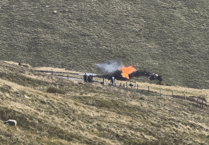


Periodic dredging is carried out at Peel marina because of the build-up of sediment. It was last dredged in 2020 and 2021.
Chemical analysis has recorded concentrations of lead and zinc that exceed levels which would allow it to be deposed of at sea.
Cross Vein mine, known as ‘Snuff the Wind’, closed in 1881 and in recent decades was used by off-road motorbikes until this was banned in 2020.
The planning inspector concluded that the significant environmental and public benefits of DEFA’s plans outweighed any temporary, minor harm to residents from the noise of lorries transport the treated silt to the site.
The inspector also acknowledged a ‘residual moderate negative impact’ to one species of bryophyte (mosses and liverworts) which favours the heavily contaminated mine spoil found at Cross Vein.
The planning committee in January approved two allied applications submitted by the Department of Infrastructure.
A retrospective application submitted back in 2022 to turn the temporary marina silt storage site at Rockmount on the Poortown Road into a permanent facility (22/00287/B) was approved by five votes to one.
And a second retrospective application (24/00301/B) to extend to December 2027 the lifetime of the lagoon at Ballaterson Farm, Peel, used for dewatering and storing the silt, together with the associated discharge pipeline along the River Neb, was also approved by five votes to one.