
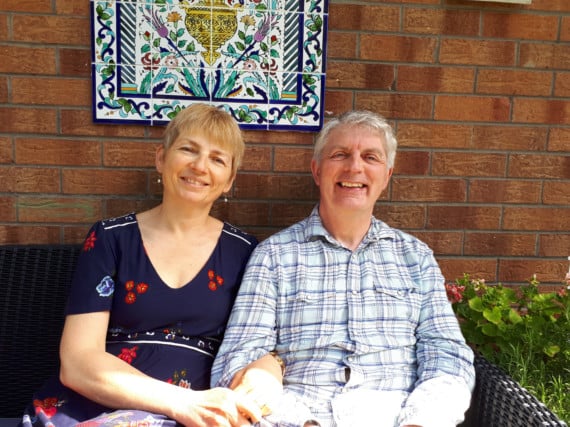
Hugo Merritt, from Port Erin, was, at the age of 51, diagnosed with Alzheimer’s five years ago. To coincide with Dementia Awareness Week 2019, his wife Nicky tells reporter Jess Ward what it’s like to be his new full-time carer.
I wasn’t surprised, I knew it was coming -I could see it happening, Nicky says.
She explained she could spot the signs that her husband Hugo had Alzheimer’s - a type of dementia that causes problems with memory, behaviour and thinking - well ahead of getting a diagnosis.
It started with Hugo, a former Spanish and French teacher at St Ninian’s High School, forgetting and struggling with things that were once a normal day to day practice for him.
.jpeg?width=209&height=140&crop=209:145,smart&quality=75)
-(1).jpeg?width=209&height=140&crop=209:145,smart&quality=75)

.jpeg?width=209&height=140&crop=209:145,smart&quality=75)
Making a cup of tea, spelling or keeping up with other’s conversations became increasingly difficult for him over time.
’To get a confirmation was still a shock,’ she said. ’It was awful and I don’t think Hugo took it in, he was in denial.’
Their two daughters were young teenagers and Nicky was only 47 years old when news came about his illness.
’It took about four years to accept that he had Alzheimer’s. I thought "it cannot be true" even though it was,’ Nicky continued.
’Alzheimer’s is a gradual progression. I had people asking "is he much the same?". No, he’s getting worse. It’s a deteriorating condition. Just a few months ago there was quite a rapid deterioration.’
Nicky explained that because of this she could no longer keep up with her job as an advocate while tending to her husband.
’Until a couple of years ago I was doing two jobs at the same time. The firm was wonderful and set me up with a computer here,’ she said. ’This winter was a tough one and I couldn’t delegate time to each job, so now I’m his full-time carer.’
Sitting at the family’s kitchen table across from Nicky with Hugo sitting quietly listening next to me, she explained that it’s been ’really, really hard’.
’He doesn’t remember us getting married, when we met or when the girls were born. We met in 1987 and he has been my life and soul mate. At one point he walked in and didn’t know who I was.
’When you’re the carer trying to make him do things it makes you a bad guy.
’I don’t get kisses or hugs. If possible, he’ll give me a peck on the cheek or the lips. It’s a huge change in our relationship and it’s really tough and really lonely.
’He was multi-lingual and he was incredibly fit and still is. I’m just watching him disappear.’
Hugo can fully wash himself in the shower, but has to be reminded casually to wash his hair. Nicky also assists him when changing by handing him pieces of clothing.
’He sometimes offers me a cup of tea and we both laugh because we know he can’t do that,’ she said.
She added that because they are essentially stuck in a house with each other 24/7 it can be difficult for both of them.
Once a week Hugo goes to Thie Meanagh EMI Unit care home in Farmhill, Douglas, which he affectionately calls ’The Club’.
The pair have received support from Manx charity Crossroads Care, Manx Decaf - which helps families affected by dementia - and Southern Befrienders as well as Alzheimer’s Society Isle of Man.
Nicky cannot stress too much the importance of these charities and having people to speak to.
’The first few years [after Hugo’s diagnosis] were lonely because we didn’t know anyone in our situation. It was only until we went to Alzheimer’s care that it changed,’ she said.
’It was the first time I was able to say things and people understood what I meant. It was a huge moment.’
Stigma surrounding the illness exists and this has been tough on the couple as some people may feel too afraid or uncomfortable to help them out. Nicky wants people to get away from the idea that people with dementia are elderly and live in care homes.
Hugo chipped in, saying: ’We’re not monsters. The illness is just a thing that’s there. Alzheimer’s is a really horrible thing.’
Throughout the interview Hugo would add to the conversation, but it would be a comment that linked to a previous point which he would repeat. Nicky describes it as ’scribbling talk’.
’You got him on a good day,’ Nicky tells me. I noticed his demeanour started off quiet, but over time it changed to being fun and boisterous as he would dance or act out what he was saying.
Nicky continued: ’When we’re on our own and we really want to go out and do something that can be very difficult. I’ve accepted it now. Our family have really good friends . If I ask them they will help and they treat us normally. Hugo also has his colleagues who help.’
She encourages people to look out for their neighbours - especially those living on their own - and to be proactive in their help. Examples are taking someone like Hugo, who is physically fit and able, out for a kick-about in the park or doing the food shopping.
’A couple of hours here and there makes a huge difference,’ she said.
Nicky is eager to help those who are facing a similar situation like themselves. If you would like to contact her in regards to this, email: [email protected]
Comments
This article has no comments yet. Be the first to leave a comment.