
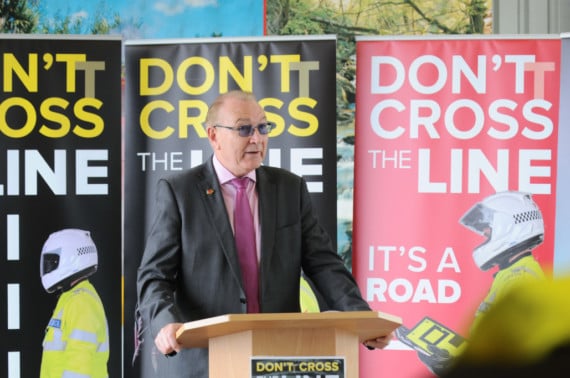
A new strategy designed to improve safety on the island’s roads has ruled out the introduce a blanket national speed limit.
The Road Safety Strategy 2019-2029, due to be presented to Tynwald by Home Affairs Minister Bill Malarkey MHK, aims to reduce the number of people annually killed or seriously injured in crashes on the roads by 40%.
The strategy, due to be presented next week, outlines other aims including protecting vulnerable road users such as cyclists and horse riders, to develop a culture for respect for all road users, to address the high rate of deaths during the TT and MGP and encourage the understanding that road safety is everyone’s responsibility.
To support this, the DHA will use data to improve the strategy and aim to reduce what it calls the ’fatal-four’ inappropriate behaviours, speeding, drink and drug driving, dangerous driving and mobile phone use.

.jpeg?width=209&height=140&crop=209:145,smart&quality=75)
.jpeg?width=209&height=140&crop=209:145,smart&quality=75)
In his foreword to the strategy Mr Malarkey said people tell him ’one of the most emotive issues that crops up is that of road safety’.
He added: ’People often hold strong views about how our roads are used, how safe they are (especially for cyclists and pedestrians) and how we could do more to reduce the harm caused by serious collisions.
’I am therefore pleased to be able to bring forward the first ever comprehensive Road Safety Strategy for the Isle of Man.’
To improve safety, the strategy will consist of four areas, safe roads, safe vehicles, safe speeds and safe people.
These areas will focus on designing safer roads, maintenance of vehicles, further education and enforcement of speed limits and possible changes to the driving test to ensure drivers are more competent on the road.
However, the strategy states: ’The Council of Ministers does not plan to introduce mandatory annual vehicle checks at this time.’
The strategy also explores the issue of the island’s de-restricted roads, which are unique in the British Isles and Crown Dependencies and pose ’additional challenges’ to the making the roads safer that other jurisdictions don’t have to cover.
The strategy adds: ’The nature of our roads, however, is part of the culture of the Isle of Man.
’Speed limits will not be considered on a blanket basis, rather on a case by case basis, informed by evidence.’
One key area the DHA feels it has to work on to improve the road safety is during motorcycle festivals.
The strategy states that 44,367 visitors came for TT in 2018, which resulted in ’expenditure of an estimated £37.1 million’.
However, the negative impact of the events is the ’significant increases in injury collisions, particularly those involving fatal or serious injury and the ensuing financial impact’.
This is evident by the peaks in traffic crashes in May and June as well as August and September.
The DHA admits this is a ’conundrum’ as it wants to improve the safety of the events without reducing the appeal of the events.
Mr Malarkey added: ’Some aspects of the strategy will require new and challenging policy decisions, some of which may have far-reaching implications.
’However, I am encouraged by the support that members of Tynwald have offered during the writing of the strategy and I look forward to this continuing as the strategy is implemented.
’It is only by working together that we can make our roads safer for everyone.’
Comments
This article has no comments yet. Be the first to leave a comment.