

Work to repair damaged and sinking block paving on Douglas Promenade is due to begin today (Monday, October 19).
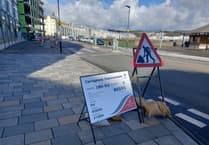
New pictures and video show the condition of the paving at pedestrian crossings on Loch Promenade, where repairs will take place over the next two weeks.
The Department of Infrastructure has confirmed that work will focus on crossings near the junctions with Victoria Street and Regent Street.
The repairs follow concerns about sections of the distinctive block paving sinking and individual bricks becoming damaged.
During the first week, the crossing nearest Victoria Street will be repaired, with the road remaining open under temporary three-way traffic lights.
The temporary controlled pedestrian crossing near Regent Street will be suspended to avoid conflicting with the traffic lights.
Pedestrians will instead be directed to the zebra crossing at Howard Street, which will reopen once the Victoria Street repairs are complete.
During the second week, the zebra crossing opposite Villiers Square, which is currently closed because of nearby building work, will be repaired, followed by the crossing at Regent Street.



The temporary controlled crossing at Regent Street will reopen once those repairs are complete.
The Department said the damaged block paving will be removed and replaced with asphalt as an interim safety measure.
Investigations found that deterioration was concentrated at specific crossings, while the underlying concrete foundation slabs remained in good condition.
The longer-term intention is to replace all the crossings with natural stone granite paving.
However, the department said this would need to be carried out in phases because of the scale of the work and available budgets and resources.
The repairs follow similar work last month on a raised tabletop at the busy Lord Street, Duke Street and Market Hill junction.
The wider Douglas Promenade redevelopment was completed in 2021 following several years of delays and disruption.
The main scheme cost £25 million, with a further £2.2 million added through the capital inflation scheme, bringing the total to around £27.7 million.