
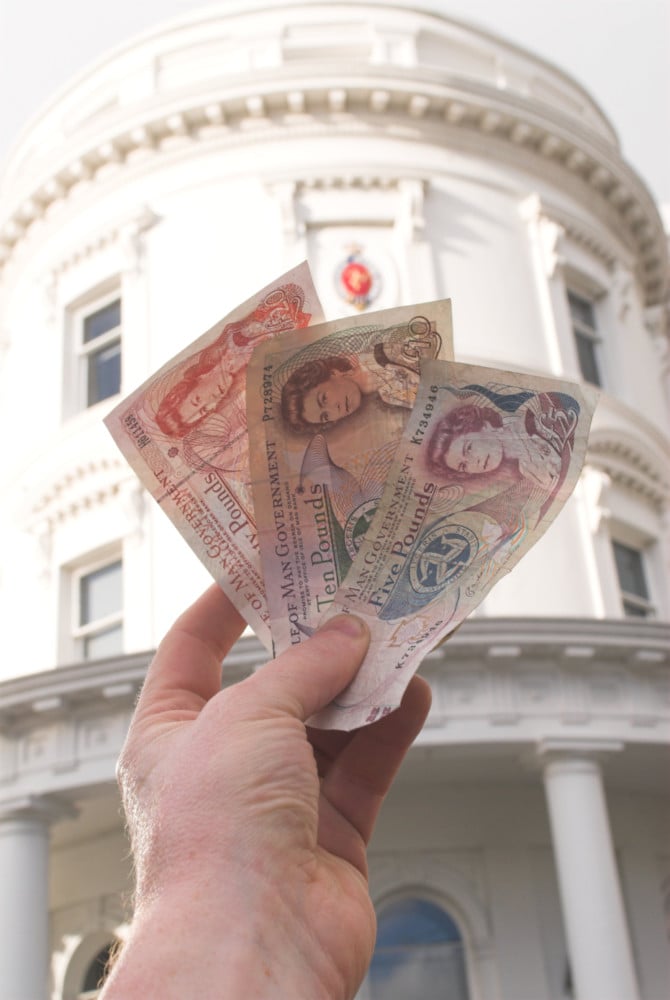
Tynwald has finally got round to launching an independent review of its members’ remuneration, three years after Lord Lisvane recommended this should happen as a matter of urgency.
The parliamentary establishment may well be reluctant to re-open an issue that is one of the angriest hornets’ nests in the undergrowth of Manx politics.
Whatever the outcome of the review, due to report by the end of the year, it will face the wave of public cynicism that is the usual reaction to the topic of politicians’ pay.
Yet there are good reasons for revisiting a subject that has a real bearing on the nature and quality of our democracy.
.jpg?width=209&height=140&crop=209:145,smart&quality=75)

The current system reinforces a network of unhealthy patronage worthy of a one-party state, and discourages the expression of independent and alternative voices.
The problem is that virtually all of the members of Tynwald are on the government payroll, obscuring the distinction between parliament and executive that is supposed to be of fundamental importance.
Of the 33 elected members, only four do not have some form of government job, with a department or other public body, that is dependent upon appointment or nomination by the Chief Minister or Council of Ministers.
The four outsiders are the President of Tynwald and the Speaker of the House of Keys, who are both automatically ineligible for executive positions, and the MHKs Chris Robertshaw and Kate Beecroft.
So 88 per cent of our national parliament is sitting comfortably inside the government tent, with a lonely 12 per cent standing outside.
The arrangement is far from balanced, and it strikes external observers as rather peculiar.
In addition to their executive posts most members also serve on various parliamentary committees, scrutinising the very government to which they belong. This confusion of of perspectives is untenable, but it is part of the culture.
Opportunities for further financial reward (an extra £13,000 a year for a departmental membership, for example), and for career advancement, are largely within the gift of the Council of Ministers.
The system may not make members puppets of the regime but it is bound to influence behaviour and it certainly affects public perceptions of political independence.
Inducements to work in government are not matched by incentives to pursue a career in parliamentary scrutiny, as there is no extra payment for being a chair or member of a Tynwald standing committee.
The independent review will be looking at whether committee chairs should attract the same salary as a minister, as recommended by Lord Lisvane, who also concluded that committee members should be paid the same as members of departments.
Such parity would be a significant breakthrough because it would encourage the separation of the Tynwald membership into two camps, government and scrutiny.
Members would look greedy if they continued to serve in both roles and received two lots of additional payment.
Fear of the headline ’Pay rise for politician X’ might help them choose to stay on one side of the tent.
In reducing the number of departmental members, the change would also be an opportunity to apply more broadly the lesson from the Michael review of health and social care, that politicians should not be hands-on managers of public services.
The worry is, of course, that splitting the membership into two groups would lead to the development of oppositional ’yah-boo’ politics at odds with the Manx tradition of constructive consensus.
It is indeed true that parliamentary vehicles can be hijacked and misused by those with their eyes on higher executive office. But there is less danger of this happening if the scrutiny function is led by MLCs, who are effectively barred from becoming ministers and so have more limited scope for ambition than their colleagues in the House of Keys.
The independent review of pay and allowances has been given a number of principles to guide its deliberations. These stipulate that the remuneration should be sufficient to allow anyone to serve, with the prudent caveat that there should be no increase in overall cost to the taxpayer.
Diversity among our politicians, so that they reflect a broad cross-section of the community, is today recognised as a good thing. Yet one of the barriers to wider participation is the relatively modern notion that Tynwald membership has to be a full-time job.
Members are expected to justify their salaries by extreme and visible busyness, by rushing around in a bewildering variety of departmental and committee hats.
One MHK even produces a Pooterish blog sharing every detail of his daily round to show how extraordinarily busy he is.
The problem with this frantic 24/7 approach to political service is that it can substitute complicated activity for coherent action. After years of hard work - endless meetings, e-mails, phone calls, presentations - members often struggle to sum up what they have achieved, individually and collectively.
The emphasis on quantity over quality also precludes the potentially valuable inputs of those who, for various reasons, can only contribute on a part-time basis.
The answer is to stop pretending that the rudimentary role of Member of the Legislative Council requires a full-time commitment, and to slash the basic salary accordingly. MLCs currently receive the same basic as MHKs - £43,479 per year - an equivalence which fails to recognise the constituency duties of the Keys and causes much resentment.
We should allow some MLCs to be openly and unashamedly part-time.
The others should lead the scrutiny of government and be paid extra for this important work.
The money saved by cutting basic salaries in the second chamber would help to fund new incentives for serving on parliamentary committees.
Comments
This article has no comments yet. Be the first to leave a comment.